Wood PLA or TPE? Decorative Appearance or a Flexible Functional Part?
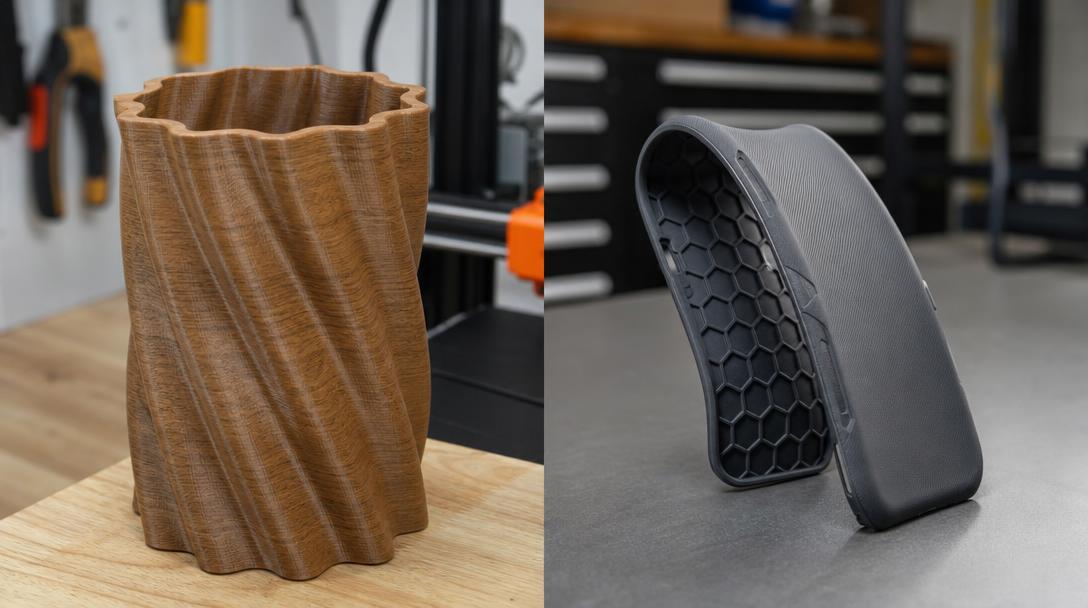
Wood PLA or TPE? The choice depends less on how attractive your part looks and more on how it needs to behave in use. Wood PLA is intended for prints that call for a wood-like surface and decorative presentation; TPE is considered for parts where flexibility is part of the function. Both are FDM filaments, but they are not interchangeable.
Wood PLA: appearance and shape come first
Wood PLA is a type of PLA-based filament prepared with additives that give it a wood-like feel. Keep in mind that the finished part is not real wood; its appearance and surface character are intended for decorative purposes. It is well suited to applications that do not bear loads, such as scale models, desktop objects, presentation models, and visual prototypes. Depending on the model and settings, the printed surface can be altered with finishing steps such as sanding or painting.
This material is not the right default choice for parts expected to bend repeatedly, absorb impacts by flexing, or operate under a tight fit. Given the general behavior of the PLA family, decisions about use at high temperatures or outdoors for extended periods should be based on the part’s actual operating conditions. A wood-like appearance does not guarantee mechanical strength.
TPE: for applications that require controlled flexibility
TPE belongs to the family of thermoplastic elastomers used to make flexible parts. It may be suitable for applications such as protective feet, flexible bumpers, and spacers that reduce the risk of vibration or scratching. However, being “flexible” does not mean it will safely absorb every kind of impact or suit every geometry. The part’s thickness, orientation, connection method, and how often it will deform all affect the result.
TPE should not be used in place of a rigid load-bearing bracket or a precision housing whose dimensions must remain unchanged. Flexible filaments may also require more careful material feeding and geometry choices during printing than rigid filaments. Very fine details, long and narrow channels, or high-speed targets can make production more challenging; it is better to assess each file and part individually.
Make your decision based on four criteria
- Function: Wood PLA is a more suitable starting point for visual models and decorative surfaces; TPE is more appropriate for protective or spacer parts expected to bend.
- Rigidity: Consider Wood PLA for a decorative model expected to retain its shape, and TPE where flexible behavior is needed. For load-bearing parts, the geometry and actual load should be assessed separately.
- Outdoor use and heat: For neither material should you assume suitability for prolonged sun exposure, heat, or weather conditions based on the filament name alone. Verify the application conditions and the material’s technical information.
- Ease of printing: In general, rigid PLA-based filaments are easier to control than flexible TPE. With TPE, part geometry and printer-material compatibility can be more decisive.
- Cost considerations: Consider not only filament use, but also print time, support requirements, the risk of failed prints, and post-processing. Surface finishing for a visual model, or testing and fit costs for a functional flexible part, can change the total.
Choose based on the part
If you are making a wood-look decoration, display object, or architectural model, start with Wood PLA and check whether the surface meets your expectations using a sample. If you need a flexible bumper, protective foot, or bendable connector, consider TPE; design the connections and dimensional tolerances with flexibility in mind. You can explore the general properties of these two materials on our our printing materials page, and read our guide to Wood PLA and metal-filled decorative filaments.
If your file is ready, share the part’s intended use with a consultant as part of our 3D printing service; the material and geometry can be assessed together. When checking affordable 3D printing prices, keep in mind that the price per gram alone does not tell you the total cost. Uploading your file to get an instant quote can also help with initial planning.



 Türkçe
 العربية
 Русский
 فارسی
فارسی Deutsch