Wood PLA or PETG? Decorative Appearance or a More Durable Functional Part?
Wood PLA or PETG becomes an important question when choosing between a decorative model and a part that will face demanding everyday use. Wood PLA appeals to those looking for a wood-like texture and appearance, while PETG may be a better choice for more functional parts exposed to impact and moisture. Both materials can be used in FDM printing, but they do not meet the same expectations.
What are Wood PLA and PETG used for?
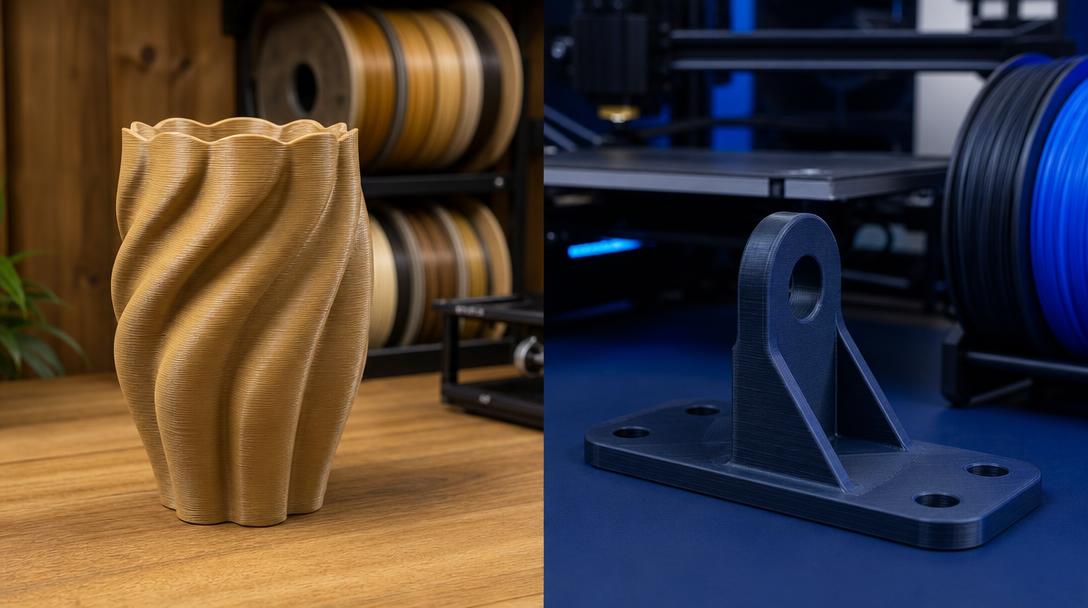
Wood PLA is a group of decorative filaments made by adding wood particles and similar fillers to a PLA base. It can create a naturally textured appearance on the printed surface, and suitable post-processing can enhance its wood-like feel. It is a sensible starting point for decorative coverings other than vases, models, figurines, presentation pieces, and visual prototypes. However, it does not behave like real wood; for a part that will be used outdoors or under continuous mechanical load, you should not decide based on appearance alone.
PETG is a thermoplastic that can be tougher than PLA and offer greater impact tolerance, making it a common choice for everyday functional parts. It can be considered for boxes, brackets, protective components, connectors, and some lightly load-bearing parts. Since not every brand of PETG behaves the same way, you need to check the manufacturer’s profile, printing temperature, and build-plate conditions.
Comparing outdoor use, heat, and impact resistance
Wood PLA is generally not a safe default for outdoor use. Sunlight, moisture, and temperature changes can negatively affect the decorative surface and the part’s dimensions. PETG is not an unlimited outdoor material either; however, it may be a more sensible candidate than Wood PLA for everyday applications exposed to moisture and impact. If there will be prolonged UV exposure or high temperatures, another material such as ASA should also be considered.
In terms of impact resistance, PETG tends to be a more suitable option than most decorative Wood PLA parts. The fact that Wood PLA feels rigid does not automatically mean it is more durable; layer orientation, wall count, and infill have a significant effect on the result. PETG may also have an advantage with heat, but for areas near a motor, locations exposed to sunlight inside a vehicle, or high-temperature mechanisms, validation testing is required based on the actual operating temperature.
- Appearance: Wood PLA for a wood texture and paintable surface; PETG for a clean, technical appearance.
- Impact: If everyday knocks and flexing are likely, PETG is the safer starting point.
- Outdoor environment: Both can be considered for short-term or sheltered use; Wood PLA should be approached cautiously under continuous sunlight and weather exposure.
- Rigidity: Both materials can produce rigid parts; geometry, walls, and print orientation determine the actual result.
Printability and cost considerations
Thanks to its PLA base, Wood PLA generally offers an easier starting point than PETG. However, the wood particles may require attention to nozzle diameter, flow settings, and surface cleanliness. The risk of clogging or irregular flow in fine details varies depending on the filament composition. With PETG, you may encounter issues such as stringing, excessive adhesion to the build-plate surface, and temperature adjustment; dry filament and the correct profile can have a significant effect on the result.
When making a cost decision, consider not only the spool price but also the risk of failed prints and the required post-processing. Wood PLA may require additional sanding, painting, or varnishing to achieve a decorative result. Although PETG has a simpler surface appearance, it may be possible to put a functional part into use with less processing. You can narrow down suitable options for your project by reviewing our printing materials according to the intended use.
Which material should you choose for each part?
If you are printing a model, maquette, or presentation object that will sit on a shelf, Wood PLA makes more sense. For a cable bracket, box, protective cover, or assembly part exposed to light impact, starting with PETG may be the better choice. Before making a production decision, write down the part’s priorities for temperature, load, moisture, and appearance. You can order a 3D printing service for your needs and evaluate the price per gram model. If your file is ready, you can view an initial production estimate through the instant pricing process.
In summary, Wood PLA stands out for appearance and texture, while PETG is better suited to more balanced functional use. When you take the part’s actual operating conditions into account, your choice becomes more reliable.



 Türkçe
 العربية
 Русский
 فارسی
فارسی Deutsch