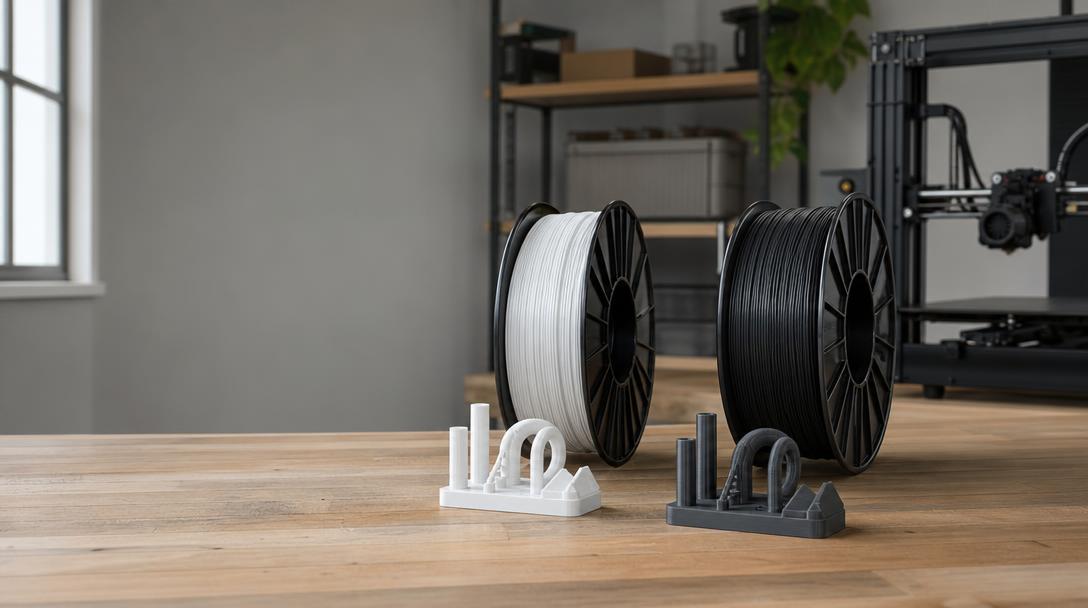
PLA+ or TPC? An Everyday Functional Part or a Flexible, Wear-Prone Part?
If you are looking for both usable strength and the right level of flexibility in an FDM part, PLA+ and TPC address different needs. PLA+ is a more rigid and relatively easy-to-print option, while TPC stands out for parts that require controlled flexibility and repeated bending. Therefore, the choice should be based not only on whether the material is strong, but also on how the part will function.
What is PLA+ used for, and what is TPC used for?
PLA+ is considered one of the variants developed from the standard PLA family for everyday functional parts. Although its properties may vary depending on the brand and formulation, it generally offers a hard material profile that maintains its dimensions well and is relatively easy to print on desktop FDM printers. It can be a sensible starting point for boxes, fixtures, enclosures, prototypes, connecting parts, and decorative yet functional products.
TPC belongs to the thermoplastic copolyester elastomer group and is a flexible filament. It should not be expected to behave exactly like soft rubber; its hardness depends on the product formulation. Nevertheless, it may be a more suitable choice than PLA+ for cable pass-throughs, vibration-damping parts, flexible bumpers, gripping surfaces, and components subjected to repeated movement.
Stiffness, flexibility, and impact behavior
If stiffness is your priority, PLA+ is the more practical option. This rigidity is an advantage for a mounting fixture or electronics enclosure that must retain its shape under load. TPC’s flexibility, on the other hand, can help the part absorb impacts through controlled deformation. However, with flexible materials, part geometry, wall thickness, and print orientation have a major effect on the result; simply changing the filament does not automatically make every design durable.
TPC’s energy-damping potential can be useful in parts exposed to impact. On the other hand, if the connection must remain fixed in position, resist compression around a screw, or hold a cover securely in place, PLA+ may behave more predictably. For designs with sharp edges, very thin sections, or high stress between layers, the model may need to be redesigned for either material.
Making a decision for outdoor use and heat
Do not automatically assume that PLA+ and TPC are safe for continuous sunlight, high temperatures, or harsh outdoor conditions. PLA+ may lose stiffness as the temperature rises; this risk should be considered especially carefully in warming environments such as the interior of a vehicle. Although TPC may retain its flexibility, not every TPC product has the same resistance to UV, temperature, and weather conditions. For a part that will be used outdoors, it is safer to check the product datasheet, expected temperature, and mechanical load together.
Printability and cost considerations
PLA+ generally offers an easier starting point: with the right profile, bed adhesion, bridging, and dimensional control may be easier to manage. With TPC, the flexible filament’s feed path, extruder design, need for low printing speeds, and retraction settings become important. On some printers, feeding long or highly flexible TPC filaments can be difficult. This can increase production time and the number of test prints, affecting the material’s overall cost considerations.
Do not make your decision based solely on the price of the spool. Part weight, printing time, the likelihood of a failed print, and any subsequent assembly requirements should also be taken into account. Reviewing the price per gram approach can help you make a more accurate comparison when evaluating the same geometry with different materials.
Which material should you choose for each part?
- Choose PLA+: If you are printing a rigid box, a dimensionally stable fixture, a prototype, a desktop organizer, or a connecting part that requires little flexibility.
- Choose TPC: If you are designing a flexible protector, vibration bumper, cable pass-through, gripping surface, or a part subjected to repeated bending.
- Research another material: If continuous outdoor exposure, high heat, heavy loads, or very high wear are involved, do not limit yourself to PLA+ and TPC alone.
If your project geometry is ready, you can narrow down the suitable option by reviewing our printing materials. To clarify your production decision, you can get support through the 3d printing service page and upload your file to see the instant price.
In summary, PLA+ is the safer starting point for everyday parts that require hardness, printability, and dimensional stability. TPC makes sense for designs where flexibility is the part’s primary function and impacts or repeated movement need to be managed. If the part does not truly need to flex, start with PLA+; if it cannot function without flexing, start with TPC.


 Türkçe
 العربية
 Русский
 فارسی
فارسی Deutsch