ABS+ or Copper PLA? Functional Part or Metallic Decorative Model?
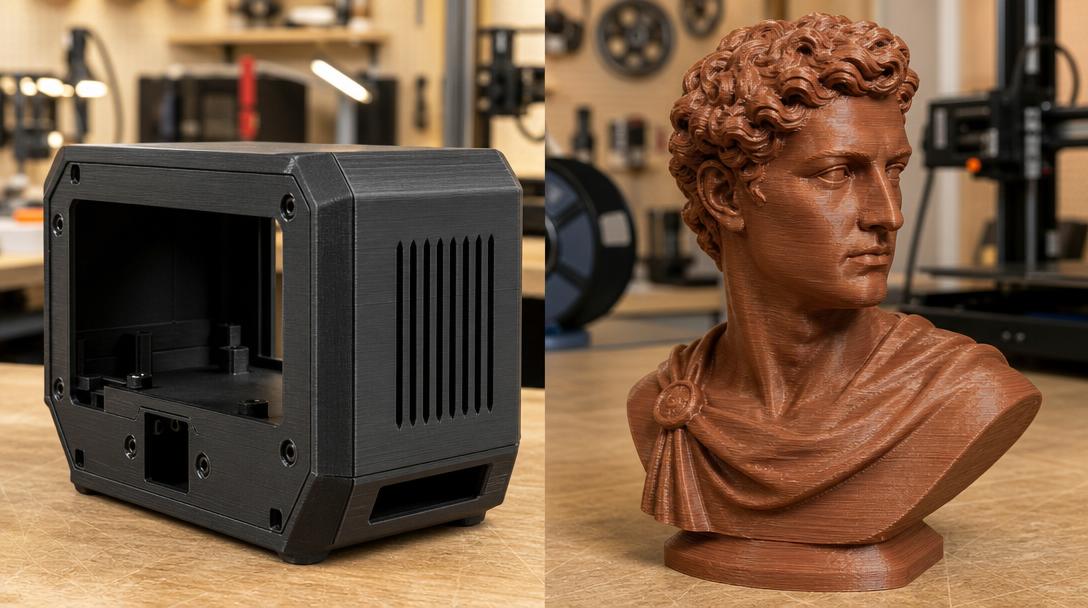
ABS+ and Copper PLA serve different needs: ABS+ is primarily suited to parts focused on impact resistance and functionality, while Copper PLA makes sense for decorative models where a copper appearance and a sense of weight are desired. Rather than comparing them for the same task, it is better to decide according to the intended use scenario.
What are ABS+ and Copper PLA used for?
ABS+ is one of the variants in the ABS family designed to behave more consistently in FDM printing. Depending on the product formulation, printability, layer adhesion, or impact resistance may be improved; however, these properties can vary from one brand to another. It is a functional starting point for boxes, fixtures, enclosures, workshop equipment, and parts exposed to loads in everyday use.
Copper PLA is a decorative filament with a PLA base and metallic copper filler. The print is not made of real copper; it gives a plastic-based part a copper-like color, surface texture, and, depending on the filler, a more substantial sense of weight. It stands out in applications such as busts, scale models, accessories, sign letters, and display models, where appearance is important.
Differences in heat resistance, impact resistance, and rigidity
If the part will be used in a sunny environment, inside a vehicle, or in a hot space, Copper PLA is generally not a safe engineering choice. Because of its PLA-based structure, the risk of deformation under heat may increase depending on the part’s geometry and the ambient temperature. ABS+ does not offer unlimited heat resistance either; however, with a suitable printer and printing conditions, it may be a more sensible candidate for everyday functional parts exposed to heat.
The same distinction applies to impact resistance. ABS+ can offer an advantage in enclosures or connecting parts that need flexibility and toughness. Copper PLA gives a more rigid, decorative feel; however, its metallic filler does not automatically make it more durable or as strong as real metal. For thin protrusions, clips exposed to impacts, and connections that carry continuous loads, choosing Copper PLA for the sake of decorative appearance may not be the right decision.
Ease of printing and surface expectations
For ABS+, an enclosed chamber, good heat management, and proper bed preparation improve results on most printers. Since warping at the corners and cracking between layers may occur in large parts, the printing environment is important. Thanks to its PLA base, Copper PLA can be printed more easily on most desktop FDM printers; however, its filler can wear down the nozzle. If recommended by the manufacturer, a hardened nozzle should be used, and the nozzle diameter and flow settings should be checked.
The purpose of Copper PLA is more apparent when it comes to surface finishing. Sanding, brushing, or suitable patina treatments can enhance its copper-like appearance. These processes do not turn the part into real copper; the result depends on the filament’s filler ratio, layer height, and the quality of the finishing work. ABS+ can be painted and provides a more neutral surface for functional housings.
Cost considerations and which material suits which part?
When choosing filament, consider not only the spool price but also the risk of failed prints, finishing time, and the part’s service life. Copper PLA can add value to an appearance-focused model; material consumption can be managed with the right wall thickness and sparse infill instead of unnecessarily dense infill. ABS+, although it requires more demanding print preparation, may perform the job of a repeatedly used fixture better. Under the current price per gram approach, material and production conditions should be evaluated together.
- Choose ABS+: If you are printing an impact-exposed box, fixture, connection enclosure, or functional part that will encounter heat.
- Choose Copper PLA: If you are producing a copper-look scale model, decorative object, display piece, or model where a sense of weight is desired.
- If you are undecided: First have a small sample or a prototype of the critical area printed to verify your expectations for dimensions, surface quality, and strength.
Once your part’s geometry and intended use are clear, you can review our printing materials page to find the appropriate production method. By uploading your file, you can see an instant price through the online 3d printing process and, when needed, take your ABS+ or Copper PLA choice into production with professional 3d printing services.


 Türkçe
 العربية
 Русский
 فارسی
فارسی Deutsch