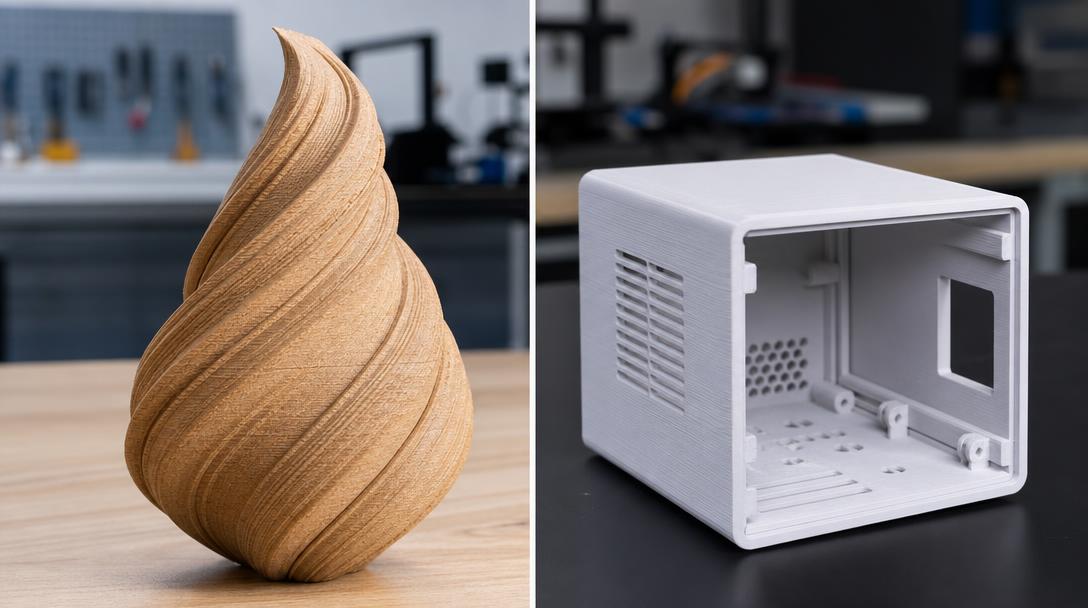

Wood PLA or HIPS? Are You Printing Decorative Models or Lightweight Prototypes?
In some 3D printing projects, the goal is not part strength but capturing the right character for the appearance and the intended use scenario. This is exactly where Wood PLA and HIPS stand out in different ways. While Wood PLA attracts attention in decorative prints that need a warm, wood-like appearance, HIPS becomes more meaningful for lighter, more workable parts, especially in prototype-focused applications. In other words, these two materials are not exact equivalents of each other, but they often come up for comparison when it is time to choose.
If you want to have a sample, display model, or low-volume concept part produced, it is much safer to choose the material according to the purpose of the part with a professional 3D printing service. On the budget side, geometry and material behavior matter more than memorized numbers; for that reason, it is healthier to understand the logic of the price per gram. If your file is ready, you can quickly get a preliminary idea through online 3D printing.
What is it good for, and what is it not good for?
Wood PLA’s biggest advantage is that it gives the print a natural and warm surface character. It can deliver impressive results in presentation models, decorative objects, desktop accessories, mock-ups, and products focused on ambience. On the other hand, it is generally not the right first choice for parts that carry mechanical loads, take impacts, or will stay outdoors for long periods.
HIPS, by contrast, stands out more for lightweight prototypes, enclosures, visual validation parts, and some support applications. Surface finishing and post-processing are relatively practical. However, HIPS is not a one-size-fits-all material either for jobs that require outdoor durability or high heat resistance. In short, Wood PLA is stronger on visual character, while HIPS is stronger on the practical side of prototyping.
If you would like to compare them with other options as well, the general our printing materials page is the right starting point.
Appearance and surface feel
If it is important that the part should not look like plastic at first glance, Wood PLA is by far the more eye-catching option. Its wood-like texture feel makes a real difference, especially in decorative and presentation-focused prints. HIPS, on the other hand, offers a more neutral character; this plain structure can be an advantage in design validation, volume checks, and mock-up work before painting.
The critical distinction here is this: Do you want the part to look attractive, or do you want to see the form quickly and, if necessary, sand it and refine it? For the first question, Wood PLA makes more sense; for the second, HIPS becomes the more logical choice.
Heat, impact, and outdoor use
For both materials, long-term outdoor durability is not their strongest point. If sunlight, a hot car interior, or long-term UV exposure is involved, it may be more appropriate to turn to different materials. Even though Wood PLA gives a wood-like feel, it is an FDM-based composite material; outdoors, it does not behave like real wood. HIPS may work in some scenarios against light impacts, but it may not be the first recommendation in harsh environmental conditions.
So outdoor use, high temperatures, and demanding functional applications are not the main playing field of this pair. These two materials should be considered more for indoor use, visual prototypes, and lightly loaded parts.
Printability and processing logic
In printing practice, part geometry changes many things; still, as a general trend, Wood PLA can deliver satisfying results in aesthetic-focused projects, while HIPS can offer a workability advantage in prototype workflows. For sanding, surface correction, or preparation before painting, HIPS feels more practical for most users. Wood PLA, by contrast, can provide its appearance advantage the moment it comes off the printer; this can reduce post-processing time.
In terms of cost logic as well, not only kilograms but also the error rate and post-processing time matter. In a decorative product, starting with Wood PLA can sometimes make more sense than trying to create a wood effect afterward. In fast visual prototyping, simple materials like HIPS can reduce the total workload.
Which one makes more sense for which part?
- Wood PLA: decorative object, architectural model detail, desktop accessory, presentation part that needs a natural appearance
- HIPS: lightweight prototype, enclosure, concept model, visual validation part before painting
- Weak area for both: outdoor parts exposed to high heat, functional components carrying heavy mechanical loads
Final decision
If the part’s appearance comes first for sales or presentation purposes, Wood PLA is the more logical choice. If you want a fast, lightweight prototype that will be worked on afterward, HIPS is the better choice. So in this comparison, the real question is not which one is stronger, but whether the part will live in a display setting or be tested in the workshop.


 Türkçe
 العربية
 Русский
 فارسی
فارسی Deutsch