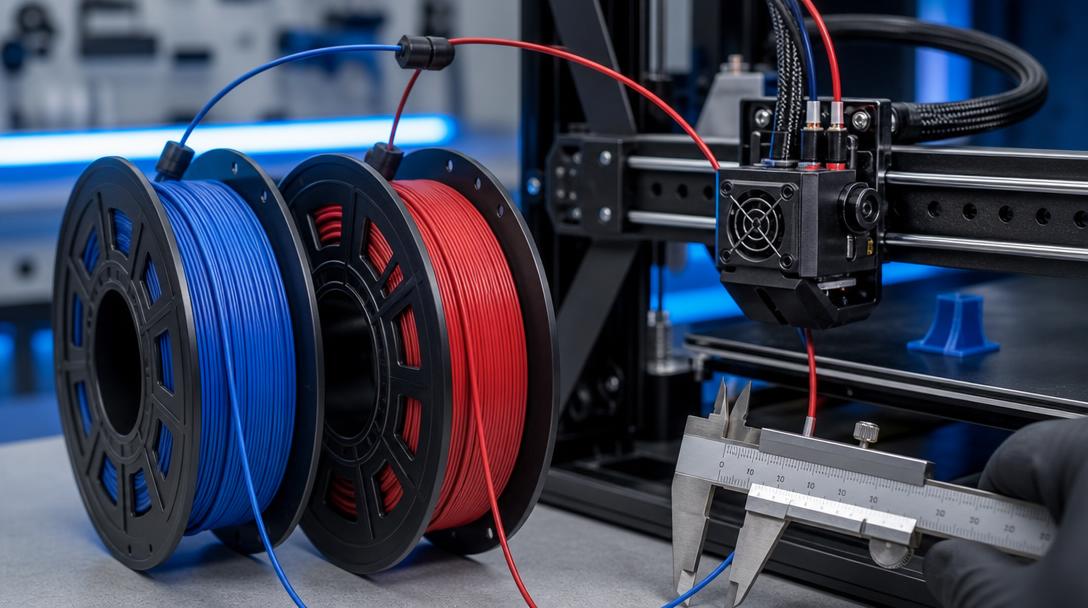

Filament Diameter Tolerance: 1.75 mm or 2.85 mm, Why Does It Matter?
Filament diameter tolerance is a critical metric that directly affects FDM print quality, regardless of whether the question is 1.75 mm or 2.85 mm. The short answer is this: 1.75 mm is the standard in most desktop FDM printers, while 2.85 mm is still a sensible option in some older or specific industrial systems. In practice, however, the only factor that determines print quality is not the nominal diameter, but how consistently the spool is manufactured from beginning to end—in other words, filament tolerance.
On a filament spool, you may sometimes see a label such as “1.75 ±0.02 mm” or “2.85 ±0.05 mm.” This value shows how much the actual diameter may deviate from the target measurement. As diameter fluctuation increases, the actual amount of plastic entering the hotend changes even if the extruder pushes the same length of filament. As a result, wall thickness varies, layers become inconsistent, and surface quality deteriorates, especially in parts that require dimensional precision. That is why reliable tolerance matters just as much as choosing the correct diameter.
What is the main difference between 1.75 mm and 2.85 mm?
1.75 mm filament has become the de facto standard of today’s desktop FDM ecosystem. It is more widely available, offers broader printer and hotend compatibility, and provides more options in multi-color systems. 2.85 mm filament, on the other hand, continues to be used especially in certain Ultimaker-type systems, some large-body extrusion setups, and older-generation installations.
- 1.75 mm: More common, more material and color options, high compatibility with modern desktop printers.
- 2.85 mm: It may provide a more stable feeding feel in certain systems, but the pool of options is more limited.
- The real critical point: You must use whichever diameter your printer was designed for; diameter cannot be compensated for with software.
If you plan to have your print file manufactured externally, you can review how the process works on the 3d printing service page to choose the right material and production approach.
Why does tolerance directly affect print quality?
Filament tolerance ensures that the same amount of material flows through every centimeter coming off the spool. For example, if a filament sold as 1.75 mm measures 1.70 mm in some sections and 1.80 mm in others, the extrusion amount constantly changes. This can lead to the following problems:
- Under-extrusion and weak layer adhesion in thin sections
- Over-extrusion in thick sections, causing rough surfaces and dimensional inaccuracy
- Unexpected tolerance errors in precision fits
- In long prints, the print profile may suddenly appear to have “gone bad”
In technical parts especially, this issue also affects cost. That is because a poorly toleranced spool means more test prints, more setup time, and sometimes re-production. So it is important to look not only at filament price, but also at print efficiency. If you want to compare the cost logic in part production, you can clearly see on the pricing page why the price per gram approach matters.
When is 1.75 mm more logical, and when is 2.85 mm more logical?
If you are buying a new printer or setting up a general-purpose FDM workflow, 1.75 mm is the more sensible choice in most cases. That is because access to spare parts, hotends, nozzles, and filament is easier. If your existing system is already built around 2.85 mm, you do not need to change the entire mechanical system just for the diameter difference; what matters here is stable feeding and using the correct profile.
When making your decision, ask these three questions:
- Which filament diameter was my printer designed for by the manufacturer?
- Can I regularly source the material I use in this diameter with consistent quality?
- Is my real production problem the diameter choice, or low-tolerance filament?
Most users realize in the third question what the real issue is: not the nominal diameter, but inconsistent manufacturing quality.
How should diameter and tolerance information be interpreted in part design?
If you are printing a press-fit part, cover, or slot where dimensional precision matters, filament tolerance indirectly affects the final dimensions. For this reason, when evaluating print parameters, you should look not only at slicer settings but also at the stability of the material. At this point, the guide Nozzle (Extruder Tip) Sizes and Their Effect on Printing is also useful, because it is difficult to achieve healthy results without considering nozzle diameter and material flow together.
In short, there is no “single correct” answer between 1.75 mm and 2.85 mm; the right choice depends on your printer’s design. However, whichever diameter you use, tight-tolerance and consistent filament is what makes the real difference in print quality. When you want to clarify the right material and production route for your part, starting with the right choice instead of a small test always saves time.




 Türkçe
 العربية
 Русский
 فارسی
فارسی Deutsch