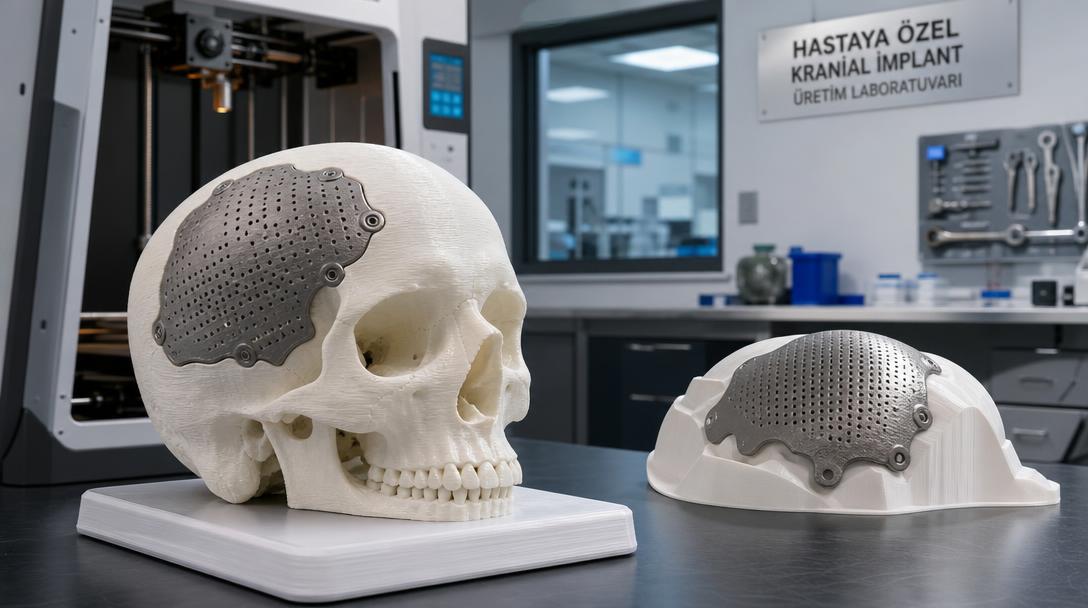

Why Walter Reed’s FDA-Cleared Patient-Specific Cranial Implant Matters: A New Threshold for In-Hospital Production in Medical 3D Printing
One of the most striking recent developments on the medical 3D printing side has been Walter Reed National Military Medical Center receiving FDA pre-clearance for its patient-specific Titanium Cranial Plate. According to the source, the news was published by TCT Magazine on July 30, 2026. The critical point here is not simply the announcement of a new implant; it is that the in-hospital production approach is beginning to rest on a more concrete regulatory foundation.
For the Ucuz3D reader, the value of this news is that it clearly shows 3D printing is no longer limited to prototype or visual model production. Especially in fields that require patient-specific geometry, managing the digital design, scanning, and production chain in a single flow is becoming increasingly strategic. That is why teams looking for a 3d printing service today also need to think not only about the part itself, but about the entire workflow.
What is the truly important point in this development?
The key point highlighted in the report is that Walter Reed received FDA clearance for a patient-specific implant developed at the point of care, meaning within the institution where treatment is delivered. In other words, production is not left solely to an outside supplier; clinical need, design validation, and the production chain are brought together in a much closer structure. This approach can make a major difference, especially in applications where anatomy varies significantly from one person to another.
The lesson to take from this is clear: one of the greatest strengths of 3D printing is not only that it can produce complex shapes affordably, but also that it can digitally manage a solution tailored to a person or a specific problem. At Ucuz3D, it is no coincidence that customers want to see fast pricing in the online 3d printing workflow; a file-, geometry-, and production-parameter-driven way of working is now becoming standard across many industries.
Why does this matter beyond the medical sector?
Although this news comes directly from the medical field, its impact is broader. Producing a patient-specific implant means working with scan data, managing tolerances, preserving a quality trail, and designing a repeatable production process. The same discipline also applies to spare parts, fixtures, assembly jigs, protective covers, or ergonomic custom part production.
Especially when low-volume but critical parts are involved, the question is being asked more and more often: should a traditional mold process be set up for a single part, or should production move directly from digital data? At this point, the per-gram pricing logic on the affordable 3d printing prices page also makes the decision process easier, because for low-volume jobs with custom geometry, the overall production logic often works differently from conventional methods.
Practical takeaways for the Ucuz3D reader
- The value of custom geometry is increasing: Just like human anatomy, a broken cover, an old button, or an ill-fitting mounting part is essentially a custom geometry problem.
- A digital archive is becoming critical: Once a part has been modeled, reproducing it when needed becomes much easier.
- Validation and material selection should be considered together: Not every 3D printed part is suitable for end use, but in the right scenario it offers very strong advantages for prototypes, test fixtures, and functional parts.
- The process matters as much as the single part: When scanning, model preparation, tolerances, and production settings are managed together, the result becomes far more predictable.
What is the angle from the FDM world?
The implant solution in the report is not directly the same thing as a desktop FDM order; that distinction should not be confused. However, there is a similar direction in terms of workflow logic: production from a digital model according to need, making low-volume parts more economical, and enabling fast iteration. Today, the FDM production workflow used for functional prototypes, jigs, or custom parts carries the same digital reflex.
If you are also trying to determine which material would be suitable for your own project, the our printing materials page is a good place to start. Because the main lesson we see in this medical news is not simply 3D printing on its own; it is the selection of the right material and the right production plan for the right application.
Conclusion
The Walter Reed example shows that medical 3D printing is becoming not only innovative, but also a production model moving closer to regulation. From Ucuz3D’s perspective, the main message of this news is this: in custom or low-volume parts, processes that flow from digital data to production are now being approached more seriously, more traceably, and more operationally. That makes the value of 3D printing more visible for both prototypes and functional parts.


 Türkçe
 العربية
 Русский
 فارسی
فارسی Deutsch