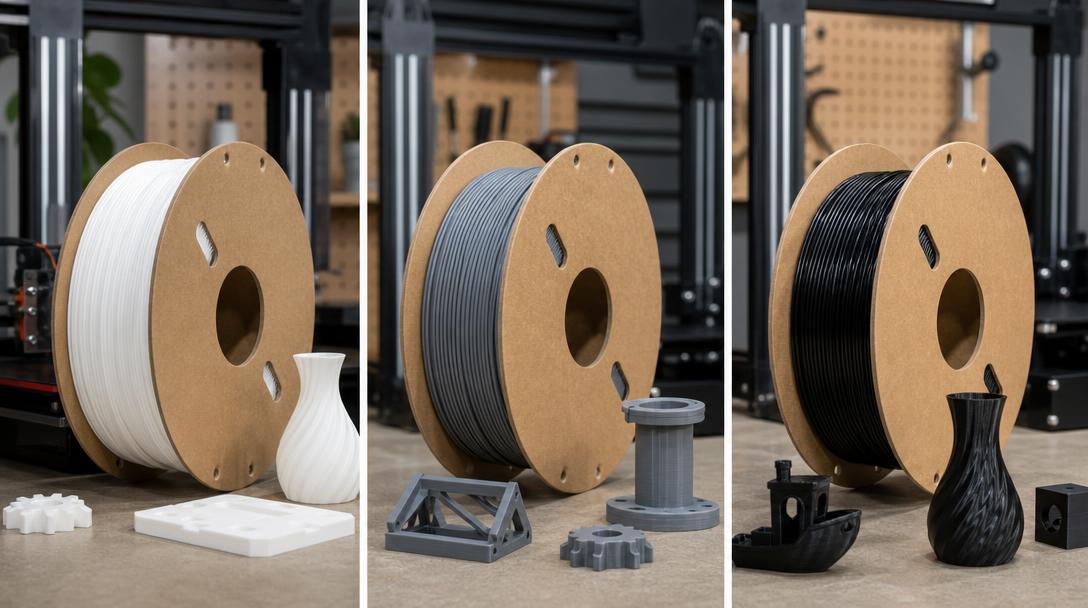

Why Is eSUN’s New PLA Series Important? The PLA, PLA+ and Basic PLA Split Clarifies FDM Material Choice
In its July 30, 2026 announcement, eSUN highlighted a three-tier PLA series for the US market: PLA Filament, PLA+ and Basic PLA. In the Markets Insider announcement published as the source, this distinction appears to aim at creating a clearer selection language for everyday prints, tougher functional parts, and more accessible routine production. At first glance, it may seem like a small product expansion; however, it is noteworthy because it shows that, on the desktop FDM side, the PLA family is no longer being treated as a single material.
For Ucuz3D readers, the key point is this: the “PLA” label alone no longer provides enough information. When printing the same geometry, if the goal is only a visual prototype, a PLA may be sufficient; but if you have a part that will see light impact, needs to feel a bit tougher, or requires more reliable layer adhesion, variants such as PLA+ become a more sensible choice. On the other hand, for fast and economical repeat prints, the Basic PLA approach offers many users a simpler decision path.
This distinction also creates a practical outcome for customers receiving 3D printing service: when placing an order, instead of simply saying “make it PLA,” it becomes more valuable to describe how the part will be used. Especially if price-performance balance is important, it is healthier to evaluate how material selection affects the overall decision through the logic of price per gram.
Why should this news be seen as a signal for the industry?
PLA is still the most common entry point in the desktop FDM world. For that reason, when a major material brand separates its PLA portfolio into clearer layers based on use case, it shows that the market is maturing. In the past, users often learned the difference between PLA and PLA+ from forums or through trial and error. Now, manufacturers have started positioning the material directly around the intended print purpose.
This can shorten decision time, especially in prototyping and small-batch production. It becomes easier to quickly understand which PLA derivative makes more sense for jobs such as visual models, educational parts, desktop fixtures, boxes, lids, or lightly functional components. Of course, this does not mean that every PLA+ product will deliver the same performance; real results vary depending on the printer, nozzle, print temperature, cooling, and profile quality. Still, such a clear separation within the product family is a development that reduces confusion on the purchasing side.
What is its practical meaning from Ucuz3D’s perspective?
In Turkey, one of the most common mistakes on the ordering side is choosing material only based on popularity. Yet while standard PLA is sufficient for some parts, in others an alternative that behaves a bit tougher can significantly increase post-print satisfaction. That is why, in the online 3D printing process, it is important not only to upload the model file but also to describe how the part will be used.
For example, standard PLA is often a sensible choice for a model that will sit on a desk, a visual verification prototype, or a presentation piece. For a clip, fixture, or a part that will be exposed to light stress in daily use, the PLA+ class may be a safer option. For educational or testing jobs where many repeat prints will be made, more economical classes may stand out. If you want to view material selection in a broader framework, the our printing materials page is a good reference.
The underlying message of this news: PLA is no longer a single category
The main takeaway is that PLA is no longer a single-piece entry-level material. Material manufacturers are now making distinctions within the same family according to usage priorities: ease of printing, slightly higher toughness, accessibility, speed, or surface quality. If this trend continues, in the near future users will more often ask not only “PLA or PETG?” but also “which type of PLA?”
In conclusion, eSUN’s move may not be a revolutionary technological leap; however, it is a meaningful step that simplifies material decisions in the FDM market and encourages more informed ordering. On the Ucuz3D side, the takeaway is also clear: choosing the right PLA derivative for the right part can sometimes make a bigger difference than the printer itself.


 Türkçe
 العربية
 Русский
 فارسی
فارسی Deutsch