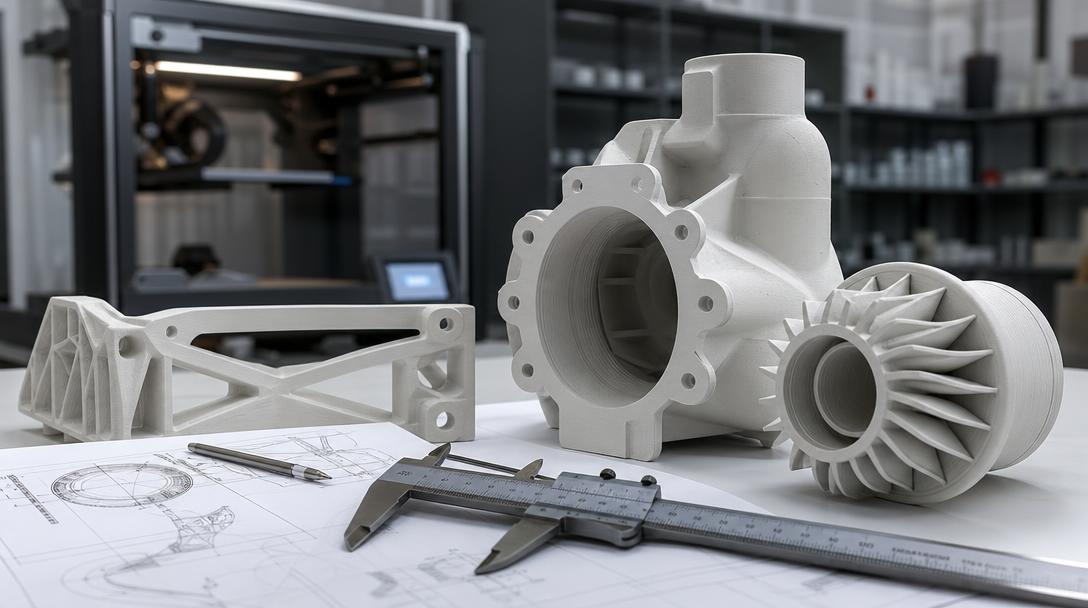

Why Is ASTM’s New Design Guide for 3D Printed Ceramics Important?
When new materials in 3D printing are discussed, the focus is often on machine speed, print quality, or part cost. But on the industrial side, what usually makes the real difference is design rules and verifiable processes. That is why ASTM’s step toward preparing a new design guide for 3D printed ceramic parts may look niche at first glance, but it is actually a noteworthy development for the maturation of additive manufacturing.
According to a news report published by TCT Magazine on August 6, 2026, the work being carried out under ASTM International’s Additive Manufacturing Committee structure came to the agenda under the title “New Guide for Additive Manufacturing – Design – Parts using ceramic materials.” The aim of the work is to create a clearer framework for risks such as shrinkage and brittleness that must be taken into account during the design stage of ceramic-based 3D printed parts.
Why is this not just ceramic news?
For Ucuz3D readers, this topic matters because the issue is not only about ceramics. The news shows that as material diversity in 3D printing increases, the question “which geometry really works in which process?” becomes more central. The same logic applies in the FDM world: as the material changes, impact resistance, thermal behavior, layer adhesion, and tolerance expectations also change. That is why drawing the model alone is not enough for a good result; the effect of the material on the design must be considered from the very beginning.
This perspective helps teams developing custom parts ask better questions when purchasing a 3D printing service. For example, before asking “can this part be printed?”, it is much more critical—especially in functional and repeatable production—to ask “is this geometry safe with this material?”
Why is ASTM’s move considered an industrial signal?
Standards organizations usually do not sit down at the table until a field becomes active enough. ASTM’s effort to create a framework here suggests that ceramic-based 3D printing has moved beyond being just a laboratory experiment and has reached a level that requires design validation, production repeatability, and a common supply-chain language. As stated in the report, the goal is to create a simpler yet comprehensive set of rules for designers and developers.
This is also indirectly important for small and medium-sized manufacturers. Because clearer standards reduce uncertainty in quotation, sampling, revision, and end-use part processes. It becomes easier to explain why a part is considered risky. By the same logic, affordable 3D printing prices or a general price-per-gram approach are not enough on their own to make a decision; in most cases, the real cost is determined by choosing the right material and the right design.
What should FDM users take away from this news?
- Material-independent design thinking is getting weaker. Not every material tolerates the same wall thickness, the same corner geometry, or the same assembly approach.
- Part function should be defined early. Needs such as heat, impact, rigidity, and chemical contact should guide the design before printing even starts.
- Verifiability creates commercial value. A one-off mockup and a functional part to be reproduced repeatedly do not follow the same decision logic.
- Standards build trust, not sales. Especially in regulated or critical applications, the clearer the process language becomes, the greater the acceptance of 3D printing.
That is why, before moving to an online order, it is highly valuable in the online 3D printing workflow not only to upload the file but also to specify the part’s real usage scenario. A good quotation process reads not only the print time, but also the compatibility between material and design.
What is the practical meaning of this from Ucuz3D’s perspective?
Ucuz3D does not directly offer ceramic printing services; however, this news is still meaningful because it shows the direction of the game in industrial 3D printing: more materials, more applications, and more design discipline. On the FDM side as well, standard PLA and engineering-focused options should not be evaluated with the same expectations. To understand this distinction, the approach on the engineering materials page can be a useful starting point.
In short, ASTM’s move shows that the discussion has shifted from “does 3D printing work?” to “under which design rules does it work reliably?” This points to a more informed era of part development, both in prototyping and in low-volume functional production.



 Türkçe
 العربية
 Русский
 فارسی
فارسی Deutsch