
Why Hyundai and Kia’s New 3D Printing Center Matters: Prototypes, Fixtures, and Service Parts Under One Roof
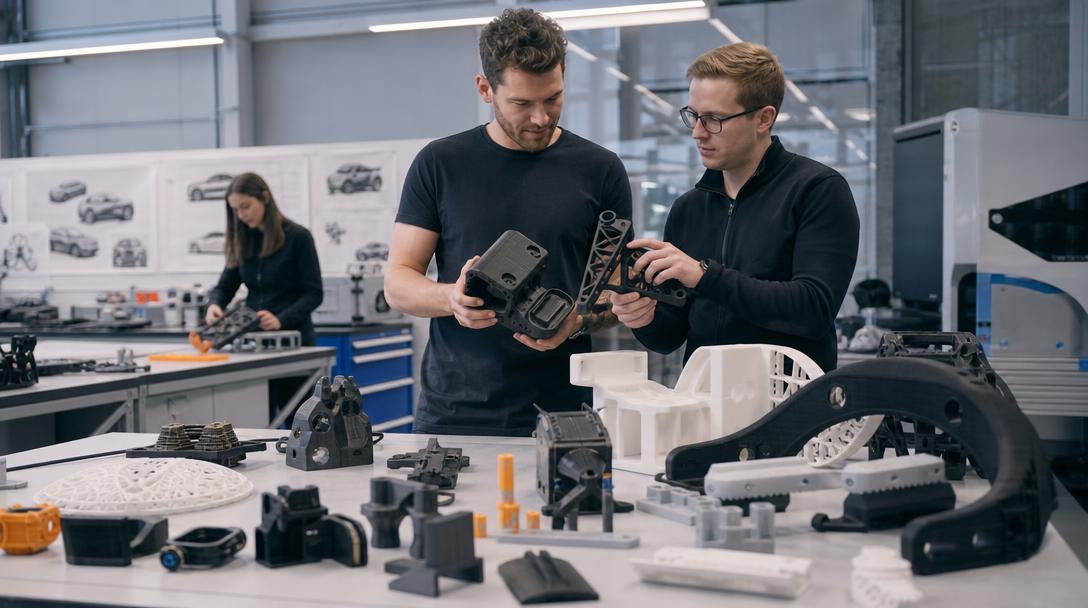
According to VoxelMatters’ August 8, 2026 report, Hyundai Motor and Kia have opened a new facility called the Additive Manufacturing Solution Center at the Namyang R&D center in South Korea. At first glance, the news may look like a major corporate investment; however, from a Ucuz3D reader’s perspective, the real point is that 3D printing is now finding a more systematic place in automotive not only for testing ideas, but also across the flow of prototypes, production tooling, and service parts.
This new center brings different needs together in a single workflow: vehicle development prototypes, jigs and fixtures used on the production line, service parts for discontinued vehicles, and reverse engineering-based refurbishment work. In other words, 3D printing here is not positioned merely as a tool for quickly producing models; it is being positioned as a real production infrastructure that supports operations.
Why is this noteworthy from Ucuz3D’s perspective?
In Turkey, many businesses still see 3D printing only as a presentation mockup or a one-off hobby part. Yet this move by Hyundai and Kia shows that decision-makers now clearly see benefits in three areas: shortening development time, keeping fixture and tooling costs under control, and creating an alternative production route for hard-to-find spare parts.
In particular, auxiliary parts used on the production line, assembly tools, inspection fixtures, cable routing elements, and low-volume interior trim components are among the areas where 3D printing delivers value the fastest. For similar needs, using a 3d printing service can provide serious time savings for teams that want to test in the field without opening a traditional manufacturing mold.
What does the single-center approach change?
The strongest aspect of this facility is that it creates an institutional workflow instead of scattered experiments. The path of a part from a digital model to a physical product is handled together with measurement and quality control steps. This means 3D printing is moving beyond the “nice idea” stage and becoming a manufacturing tool with real process discipline.
This approach is especially important in sectors with many different parts, such as automotive. Because not every part has a mass-production volume. Some parts are needed only for validation, some to make the assembly line easier to operate, and some for the service needs of older vehicles. At this point, 3D printing stands out thanks to low volumes, fast revisions, and geometric flexibility.
Why do service parts and reverse engineering matter?
One of the striking points in the report is the reproduction of parts for discontinued vehicles and urgent service needs. This issue concerns not only major manufacturers, but also businesses in Turkey with aging machine fleets, workshops restoring classic vehicles, and maintenance teams looking for solutions to unavailable plastic parts.
Of course, not every part is suitable for 3D printing; temperature, load, impact, and tolerance requirements must always be evaluated. However, when the right material is used for the right part, 3D printing can become a strong alternative, especially for low-volume functional components. Since material selection is decisive in this type of work, it is often a better starting point to look at engineering materials.
Not price, but decision logic comes to the forefront
The main message of this kind of news is not just technology investment; it is a change in the decision-making model. The question is now often no longer “How else can we manufacture this part?” but rather “Which method lets us validate or put this part into operation fastest and most logically?” That is why, at the start of a project, it is healthier to first look at the per-gram pricing logic on the affordable 3D printing prices page, and then review the real picture based on the actual file.
Likewise, it should be clarified early whether the part is a prototype, an assembly tool, a cover, a clip, or a low-volume service component. Because most of the decision is made through the material, wall thickness, and printing strategy. If the file is ready, getting an early quote through the online 3D printing workflow can reduce unnecessary revisions.
Conclusion: In automotive, 3D printing is no longer a tool sitting on the sidelines
Hyundai and Kia’s new center shows that 3D printing in automotive is moving beyond one-off showcase applications and turning into a more permanent operational layer. Bringing prototypes, fixtures, service parts, and reverse engineering work together under the same center once again reminds us that the real value of this technology appears in low-volume but critical jobs.
In short: This news may be more important than a new printer announcement for the desktop user. Because the real shift is that it is now much clearer where 3D printing truly affects business outcomes when it is used in the right place.


 Türkçe
 العربية
 Русский
 فارسی
فارسی Deutsch