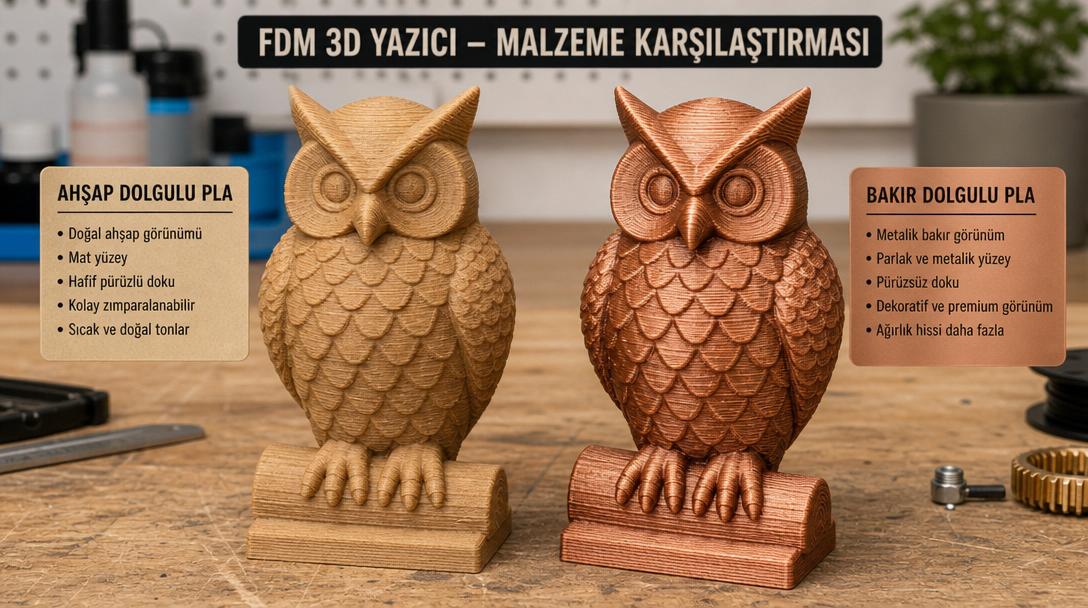

Wood PLA or Copper PLA? Which Makes More Sense for Decorative 3D Printed Parts?
Not every filament makes sense for every decorative part. A product that calls for a wood texture and an object that should feel heavier, cooler, and closer to metal do not ask for the same material. That is why, although Wood PLA and metal-filled filaments such as Copper PLA often end up in the same basket, their logic of use is different. If you want to clarify which look and which performance suit you best before ordering, making the right material choice from the start in the 3D printing service process can seriously affect the overall result.
In short: Wood PLA offers a warmer, more natural look that is closer to furniture and accessory aesthetics. Copper PLA and similar metal-filled filaments, on the other hand, can deliver a denser feel, a richer surface character, and a decorative result that may be perceived as more “premium.” But there is an important limit here: these materials are not real wood or real metal parts; in FDM printing, they are preferred for decorative effect and surface character.
What is it good for, and what is it not good for?
Wood PLA makes sense for desktop décor, model accessories, nameplates, box lids, gift objects, and presentation pieces where a natural look is desired. It is a good option for users looking for a warm wood-like tone. However, it is not the right candidate for parts that carry high mechanical loads, are exposed to friction, or will remain outdoors continuously.
Copper PLA and other metal-filled filaments stand out in figurines, award objects, desktop accessories, decorative panel parts, and prototypes where a “metal appearance” is desired. On the other hand, if real metal strength, real metal heat performance, or structural load-bearing performance is expected, this can create the wrong expectation. Especially if the part is meant to be used as if it were truly metal, it is better to reconsider the application rather than use this class of filament.
Which is safer for outdoor use and heat?
Since both materials are basically based on the PLA family, they are limited when it comes to temperature. It would not be realistic to expect a long service life from parts exposed to sunlight, used inside a vehicle, or working near hot surfaces. For this reason, neither material should be the first choice for a balcony fixture, a part near an engine, an accessory left in a car during summer, or fastening elements that will stay outdoors all year round.
If a job like this requires a more general material choice rather than a decorative one, the options on Ucuz3D’s our printing materials page provide a more accurate framework. Also, when evaluating order cost, instead of memorizing exact figures, it is healthier to look at the price per gram logic to see how part volume, infill, and material type affect the total result.
The difference in impact resistance, rigidity, and surface feel
Wood PLA is generally chosen for visual effect; it can offer sufficient rigidity in lightweight decorative parts, but it should not be expected to behave like a “functional engineering material” under impact. Copper PLA, by contrast, may feel denser and heavier because of its filler structure. This is an advantage for objects displayed on a shelf; however, feeling heavier does not always mean it is more durable.
For applications that require flexibility, neither material is suitable. For clips, seals, impact-absorbing bumpers, or parts that bend continuously, it is necessary to turn to different materials. Here, the decision criterion is the question: “Should it be rigid and decorative, or flexible and functional?”
Ease of printing and production logic
In many cases, Wood PLA can offer a production experience close to standard PLA; however, because of its filler structure, nozzle diameter and layer settings can become critical. While the surface may look attractive in fine details, it may require more careful settings in very small channels or on sharp thin tips. Copper PLA and metal-filled filaments, on the other hand, may require a more cautious approach in terms of flow, layer consistency, and especially nozzle wear, because they contain heavier fillers.
For this reason, if the goal is the aesthetics of a single part, sometimes not the “coolest filament” but the option with the most predictable overall surface performance gives better results. If you want to see material and production suitability for your file in advance, the instant quote screen is a practical starting point; dimensions, geometry, and the expected surface effect should especially be evaluated together.
Which one makes more sense for which part?
- Wood PLA: rustic décor, desktop accessory, box, gift object, presentation piece that calls for a natural look
- Copper PLA / metal-filled: figurine, award object, desktop décor, design that seeks an antique feel, metal-look prototype
- Weak area for both: outdoor use, hot environments, load-bearing mechanical parts, applications expected to deliver real metal performance
In conclusion, the choice starts with the visual goal. If your part will be “a warm object with a wood-like feel,” Wood PLA makes more sense. If you want a decorative result that is “heavier, denser, and more metallic in character,” Copper PLA or metal-filled options stand out. But if aesthetics are the priority on either side, you are in the right place; if strength, heat resistance, or outdoor use comes first, it is better to look at other filaments.


 Türkçe
 العربية
 Русский
 فارسی
فارسی Deutsch