
PETG or TPU? Will You Print a Part That Takes Impact or One That Flexes?
In FDM printing, choosing the right material often makes a bigger difference than the printer itself. PETG and TPU are two common sides of that decision. Although both may look durable on paper, they behave quite differently: PETG is generally seen as a more rigid, shape-retaining, engineering-type general-purpose material, while TPU stands out in parts that can flex and work by absorbing impact. That is why the real question is usually not “which one is better?” but which one is more suitable for which part?
The core difference: PETG keeps its shape, TPU works by changing shape
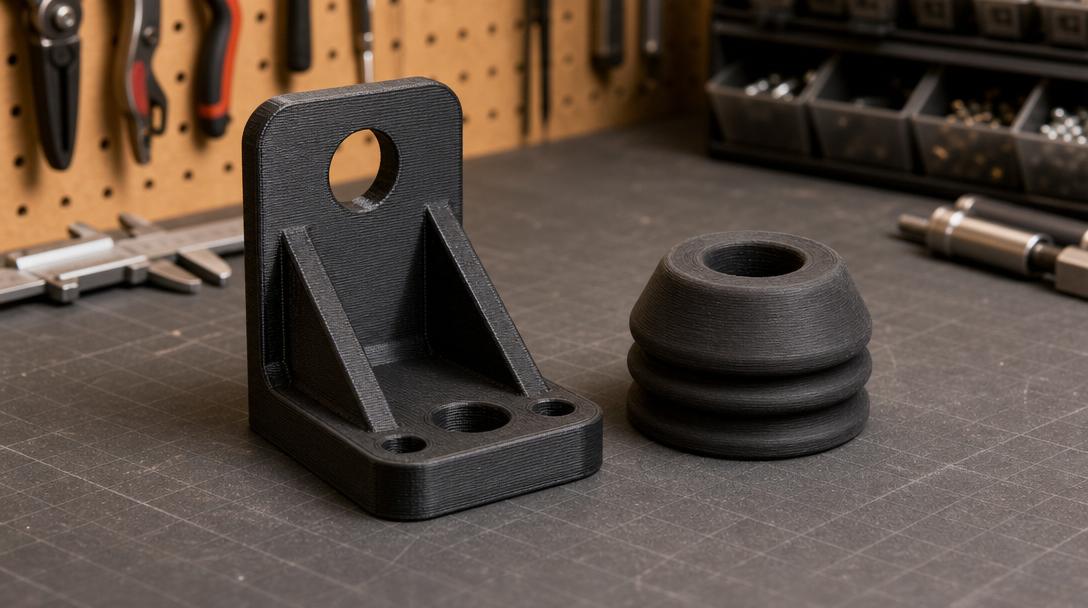
Compared with PLA, PETG is tougher, less brittle, and a more reassuring option for most everyday functional parts. It is often preferred for fixtures, enclosures, brackets, covers, and lightly loaded functional components. TPU, on the other hand, behaves like rubber; it can be compressed, bent, and can dampen impact energy. That makes it a more logical choice for flexible components such as bumpers, feet, gasket-like parts, or protectors that should not damage a surface.
The critical point here is this: if a part’s job is to keep its dimensions and carry a load, PETG is usually the better fit. If the part’s job is to flex, grip, reduce slipping, or absorb impact, TPU takes the lead. It is useful to keep this distinction in mind when looking at our baskı malzemelerimiz page at Ucuz3D as well.
What is it good for, and what is it not good for?
Right scenarios for PETG
- Electronics boxes, sensor enclosures, hanging brackets, simple mechanical supports
- Parts that may take some impact but do not need to flex continuously
- Functional uses that will face slightly warmer conditions than PLA
PETG is not expected to be highly flexible. It is not always ideal for parts such as clips that repeatedly open and close, work by compression, or require soft contact. Also, even if the surface quality is good, some geometries may show a tendency to string.
Right scenarios for TPU
- Protective parts such as phone-case-like covers, vibration-damping feet, non-slip bases, bumpers, and flexible connections
- Parts that need to absorb impact or are expected to operate quietly
- Applications that need to grip a surface rather than rely on a tight fit
TPU, however, may not be suitable for rigid brackets, long cantilevers, slots where dimensional stability is critical, or parts expected to hold a firm screw connection. In other words, TPU is durable, but that durability comes not from staying rigid, but from distributing the load by flexing.
Which one comes out ahead for outdoor use, heat, and impact?
Both materials can be used outdoors; however, success depends on the function of the part. PETG is considered a reasonable general option for many outdoor parts because it is generally comfortable with moisture and behaves more reliably than PLA. TPU can also be used outdoors, especially where impact, rubbing, or surface protection is needed. On the other hand, trying to solve a rigid load-bearing part that must keep its form in the sun with TPU is not the right approach.
When it comes to heat, PETG gives a more shape-retaining feel than TPU in everyday use. TPU does not become completely useless under heat, but since it is already flexible, it should be considered more limited for parts where clearly maintaining shape is important. For impact, however, the picture can reverse: in situations involving drops, collisions, and vibration damping, TPU is often more forgiving.
Printability and cost logic
PETG is a very common and accessible choice when dialed in correctly. TPU, on the production side, requires more care; because of its flexible nature, printer compatibility, speed, and feed stability can be more sensitive. For that reason, it is important to think not only about material cost but also about production risk and the likelihood of part success. When ordering a 3d baskı hizmeti, what matters is choosing the right material so the part gets close to the target on the first attempt.
In cost evaluation, looking only at “which filament is cheaper?” can also be misleading. Printing a part that needs to be rigid in TPU, or trying to solve a part that needs to be flexible with PETG, may create the need for rework. So when evaluating the logic of gram başı fiyat, material suitability should also be taken into account. If your file is ready, getting an anında fiyat and seeing the most suitable guidance based on the part type can also speed up the process.
Final decision: which one for which part?
If the part is a fixture, enclosure, support, or an everyday functional component that needs to keep its shape, PETG is usually the more balanced choice. If you want the part to absorb impact, run quietly, grip a surface, or flex by design, TPU is the better option. In short: PETG sits on the “solid and orderly” side, while TPU is on the “flexible and forgiving” side. The right choice becomes easier when you focus not on the technical name of the material, but on the real job the part needs to do.



 Türkçe
 العربية
 Русский
 فارسی
فارسی Deutsch