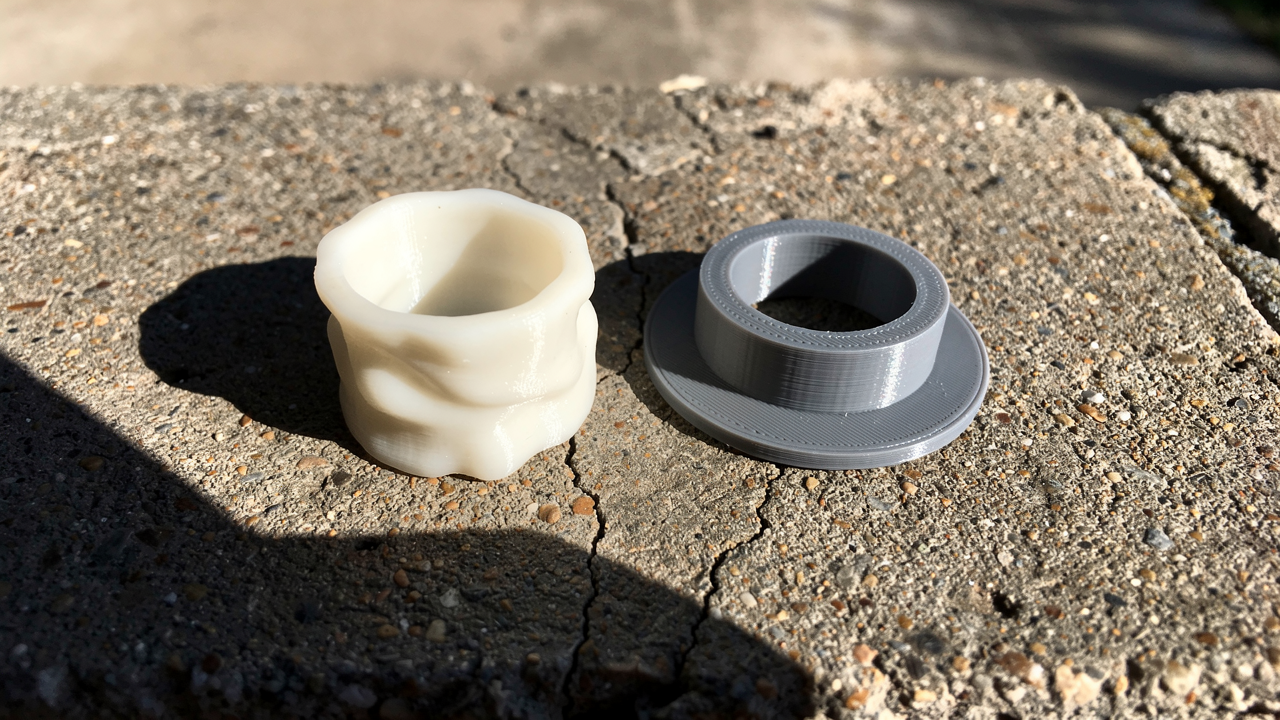

PLA or ASA? Which Is Better for Sun, Heat, and Outdoor Parts?
At first glance, PLA and ASA may seem to do the same job: both are commonly used materials in FDM-type 3D printing. However, where the part will be used, whether it will be exposed to sunlight, how much heat it will face, and how smoothly you want the printing process to go all make a major difference in the choice. If you are trying to decide on a material for a prototype, fixtures, or end-use parts, choosing the right material from the start through a professional 3d printing service makes more sense than having the part printed again later.
In short: PLA is generally easier to print, more economical, and better suited to indoor use. ASA, on the other hand, is often the better choice for applications exposed to outdoor conditions, sunlight, and higher temperatures. To make a clear decision, you need to look at the actual use scenario.
What is PLA good for, and what is ASA good for?
PLA is often preferred for visual prototypes, scale models, desktop organizers, light-duty covers, and parts intended for indoor use. Surface quality is usually satisfactory, and the printing process is relatively straightforward. For this reason, it offers an advantage in rapid trial production and in projects where you want to keep costs under control.
ASA is a more sensible choice for automotive-adjacent accessories, outdoor enclosures, sun-exposed mounting components, sensor boxes, and parts that may be exposed to UV effects. In particular, if the part will remain for a long time in places such as a windowsill, balcony, garden, or inside a vehicle where temperatures fluctuate, ASA is often a safer choice than PLA.
When is it not suitable?
The main weak point of PLA is heat and long-term outdoor exposure. In parts left inside a car in summer, kept under direct sun, or operating near a hot machine, it may struggle to maintain its shape. For that reason, choosing PLA for outdoor use just because it “looks very durable” does not always lead to good results.
ASA is not automatically the right option for every job either. It is not as easy to print as PLA; the risk of shrinkage and warping may be higher. For small desktop decorative items, simple prototypes that will only be used indoors, or quick price-focused trials, ASA can create unnecessary cost and process difficulty. Before ordering, looking at the logic of price per gram can help you choose the material you actually need.
Outdoor use, sunlight, and temperature differences
This is the most critical axis of the comparison. The area where ASA stands out is UV resistance and outdoor stability. When you think of a sun-exposed label stand, outer housing, camera mount, or garden equipment part, ASA makes more sense. In terms of color and mechanical behavior, it tends to deliver more consistent results over time.
PLA can perform perfectly well in cool, shaded indoor environments; however, as temperature rises, its disadvantage becomes more apparent. The risk increases especially inside vehicles, near radiators, or on surfaces exposed to summer heat. If you want to see other options focused on outdoor use, our printing materials page is a useful starting point.
Impact, rigidity, and feel in use
PLA generally gives a rigid and solid feel. This can be an advantage in prototypes where dimensional control matters and in presentation pieces with aesthetic value. However, being rigid does not always mean it is more durable; under sudden impact or heat, it may behave in a brittle way.
ASA, by contrast, offers a more balanced engineering feel in many applications. Thanks to its impact resistance and tolerance to environmental conditions, it can inspire more confidence in functional parts. This difference is especially important in clips, enclosures, or connection parts used outdoors. Even so, for very high mechanical loads, part geometry and wall thickness are at least as decisive as the material itself.
Printability and cost logic
If your priority is ease of production, PLA comes first. It offers a lower-risk printing process, a cleaner surface, and faster iteration. That is why it is frequently used in first-stage validation prototypes. During online ordering, you can use the online 3d printing tool to see how a model is positioned across different materials.
ASA is generally the kind of material that is “valuable where it is truly needed.” In other words, it should be chosen not simply because it looks more technical, but because there is a real expectation of sunlight, temperature exposure, and outdoor performance. Otherwise, you may be over-engineering the solution. In short, PLA makes more sense for indoor prototypes, while ASA is the more logical option in most scenarios for outdoor end-use parts.
Which one should be chosen for which part?
- PLA: scale model, visual prototype, indoor desktop fixture, light-duty cover, and presentation model
- ASA: outdoor enclosure, vehicle interior/exterior accessory, sun-exposed mounting fixture, functional part with UV risk
If the part will not be exposed to sunlight, will not reach high temperatures, and fast/economical production is important, PLA is generally sufficient. If the part will stay outdoors or is expected to hold its shape in summer heat, ASA is the better investment. The best choice is made according to the environment the part will actually live in; the material name alone is not enough to make the decision.


 Türkçe
 العربية
 Русский
 فارسی
فارسی Deutsch