
Carbon Fiber or Glass Fiber? Which Makes More Sense for Rigid, Dimensionally Stable Parts?
In the FDM world, the two most common options when reinforced filaments are mentioned are carbon fiber and glass fiber filled materials. Both occupy a more technical position than standard materials; however, they do not do the same job. When making a decision, a general view such as “stronger” is not enough on its own. Whether the part will take impact, whether it will operate in a hot environment, how rigid it needs to be, and how important ease of printing is should all be evaluated together.
If you are considering professional production instead of printing a part on your own machine, it is safer to choose a material suitable for the application through the 3d printing service. To see the material options in general, the engineering materials 3d printing page is also a good starting point.
When does carbon fiber stand out?
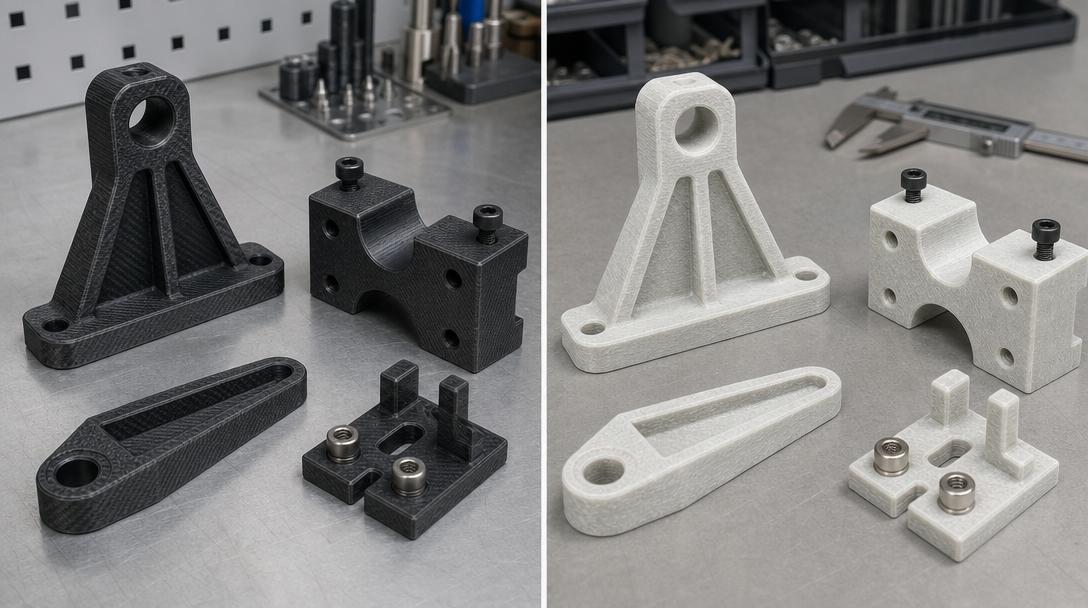
Carbon fiber reinforced filaments are generally preferred for higher rigidity and a more solid engineering feel. They can be advantageous when you want to reduce part flex, keep long-arm geometry more stable, or achieve stiffer behavior without increasing weight too much. They are a sensible choice for camera mounts, drone connection elements, carrier brackets, device housings, and jig-like parts that require dimensional precision.
However, carbon fiber is not always the right option. If the part is exposed to frequent hard impacts, the fiber reinforcement may result in behavior that is more rigid but, in some scenarios, less forgiving. In other words, instead of bending and recovering, the part may move toward a sharper fracture behavior. In addition, manufacturing-side effects such as surface quality and nozzle wear should also be taken into account.
When is glass fiber the better choice?
Glass fiber reinforced filaments are also used for rigidity and dimensional stability; however, in most applications they offer a more balanced engineering solution rather than the “lightweight and premium” perception associated with carbon fiber. They stand out especially in jobs where maintaining shape under temperature, reducing bending in long parts, and strengthening structural feel are important. They can deliver good results in enclosure parts, assembly fixtures, industrial covers, and mechanical housings.
On the other hand, glass fiber is not a miracle solution either. It is not the right choice for clips that need flexibility, parts that bend continuously, or products that require soft contact. For this kind of work, an unreinforced or more flexible material family is usually the more logical option.
Carbon fiber or glass fiber? 6 key factors when deciding
1) What is it good for, and what is it not good for?
Both materials are suitable for strengthening structural feel, reducing flex, and achieving a more professional result in some parts. By contrast, they do not stand out in parts where high decorative gloss, softness, or frequent bending is expected. In other words, these are not the first choice for parts such as phone cases, flexible gaskets, or toy-like components that need to absorb impact continuously.
2) Rigidity and flex control
If you want the part to flex as little as possible, carbon fiber is usually the first option many users consider. Glass fiber is also strong in this area; however, if your goal is to get as close as possible to the stiffest feel, carbon fiber generally looks more attractive. On the other hand, if you are looking for slightly more balanced load-bearing behavior and shape retention, glass fiber can be a sensible choice.
3) Impact and long-term durability behavior
For parts exposed to impact, looking only at rigidity can be misleading. In some applications, a very stiff structure is an advantage, while in others, slight flex extends service life. For this reason, in impact-related use, the base polymer of the material becomes critical. So simply saying “carbon” or “glass” is not enough on its own; the main polymer carrying the reinforcement must definitely be taken into account.
4) Heat and outdoor conditions
Reinforcement fibers alone do not guarantee outdoor performance. In most cases, the real determining factor is the carrier polymer. For example, if outdoor exposure, UV, or high temperature is involved, you need to look not only at the fiber type but also at the performance of the base material under those conditions. Therefore, it is not correct to automatically say “carbon fiber is for outdoor use” or “glass fiber will definitely withstand heat.”
5) Ease of printing
Neither family may be as easy to work with as standard PLA or PETG. Because of their abrasive nature, suitable equipment and the right process may be required. If you do not want to deal with these details in your own production, uploading your file through the online 3d printing infrastructure and clarifying the right material scenario can save time.
6) Cost logic and which one for which part?
With reinforced materials, the decision is not made solely based on spool price. Reducing the risk of reprinting the part, allowing a thinner design with sufficient stiffness, or behaving more stably during assembly can all affect total cost. For that reason, when looking at the logic of price per gram, you should also take into account the functional gain provided by the material.
- Carbon fiber: stands out in load-bearing parts that require a sense of lightness, high rigidity, and a technical appearance.
- Glass fiber: makes sense in housings and fixtures that require dimensional stability, shape retention under temperature, and a balanced engineering approach.
- If neither is suitable: for flexible parts, decorative products, or low-cost rapid prototyping jobs, unreinforced materials may be the better choice.
Conclusion
In summary, the choice between carbon fiber and glass fiber should not be reduced to a one-sentence answer to “which is stronger.” Carbon fiber is often selected for a more aggressive rigidity target, while glass fiber stands out in projects seeking more balanced dimensional stability and structural consistency. The right decision is made according to what the part actually does and under what conditions it will operate. If the goal is to produce a functional FDM part, clarifying the use scenario before the fiber type is the healthiest approach.


 Türkçe
 العربية
 Русский
 فارسی
فارسی Deutsch