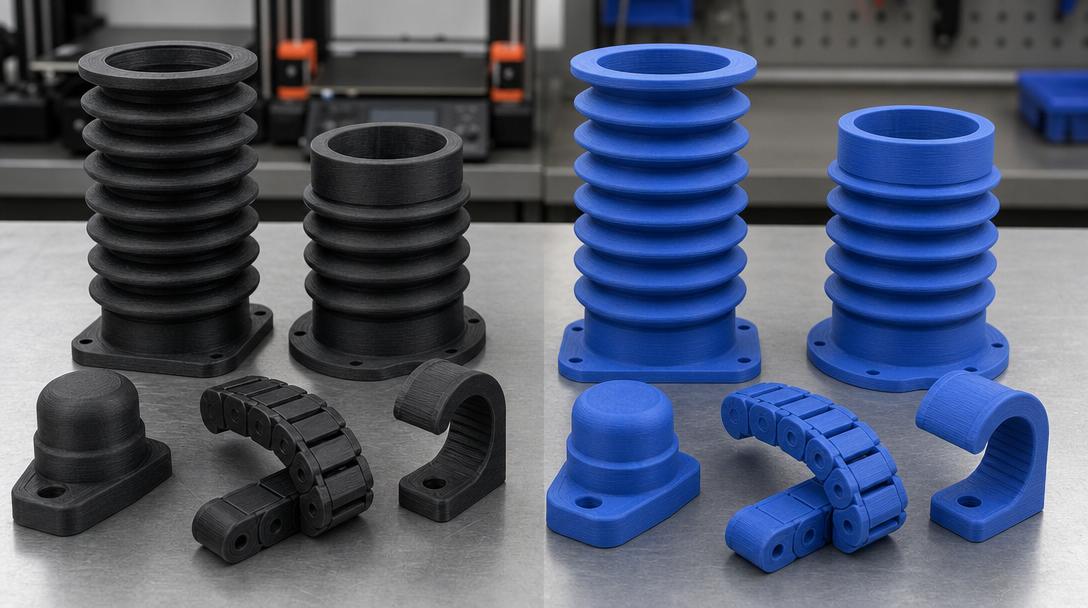

TPU or TPC? Which Is the Better Choice for Flexible Parts That Work Under Load?
When people think of flexible filament, TPU is usually the first material that comes to mind. However, not every flexible part serves the same need. In some parts, softness and impact damping are the priority, while in others, friction, repeated bending, and slightly higher heat resistance may matter more. That is where TPC also enters the conversation. If you are planning to order a 3d printing service for your part, it is more accurate to decide based not only on “which one is more flexible?” but on the actual use scenario.
In short, TPU is generally the more common, more familiar, and safer choice for most flexible applications. TPC is not necessary for every project, but for certain parts exposed to wear, repeated motion, and tougher working conditions, it can become the more sensible option. If you would like to see all of Ucuz3D’s available material options together, the our printing materials page is a good place to start.
What is TPU used for, and what is TPC used for?
TPU offers a flexible but controlled character. It is often preferred for phone holders, bumpers, cable protectors, vibration-exposed spacers, grip surfaces, and light impact-absorbing parts. Since it is also accessible for most users, it usually becomes the first candidate when testing flexible parts.
TPC, on the other hand, can be thought of in some cases as a “slightly more technical” flexible material. It can offer advantages especially in parts exposed to constant friction, repeated bending and straightening, or mechanical use where a longer service life is expected. Belt-like elements, bellows, protective covers, and certain machine-adjacent parts can fall into this group.
In which cases is each one not a good choice?
TPU is versatile, but it is not a solution for everything. It can quickly reach its limits in parts that need to hold their shape strongly under load, require high rigidity, or are expected to retain their form better in hot environments. For this reason, TPU may not be the right choice for a rigid fixture, a thin but rigid clip, or a dimensionally sensitive engineering part.
TPC also does not automatically provide a superior result for every project. First of all, it is a more niche material, and the difference it offers may not be noticeable in every part. If the application is only a soft protective case, a simple foot pad, or a comfortable hand grip surface, moving up to TPC may be unnecessary. In these types of scenarios, it is important to consider not only the material name but also the production logic and the price per gram approach together.
Differences in outdoor use, heat, and impact
For outdoor use, the performance of both materials depends on sunlight, load, color, part geometry, and duration of use. In general, TPU can be used for many everyday outdoor applications; however, when long-term mechanical stress and wear come into play, TPC may become the more sensible choice in some applications. Still, the single fact that a part “will be used outdoors” is not enough on its own to make the decision.
On the heat side, TPC may be considered more advantageous in some scenarios, but this difference should not be exaggerated. If the part will work near a motor, inside a hot enclosed housing, or around equipment heated by the sun, the real conditions of use must be considered separately. In terms of impact and flexing, TPU performs very well; especially when softness and vibration damping are desired, it is a strong candidate.
Rigidity, flexibility, and ease of printing
TPU usually offers a more predictable flexible-part experience. That makes it practical for both prototypes and end-use parts. TPC can be very valuable in the right application, but process discipline may be more important on the printing side. With flexible filaments, part design, wall thickness, and print orientation directly affect the result; for this reason, choosing only the material is not enough, and the model must also be prepared properly for printing.
If you want to upload your file and compare options on a part-by-part basis, you can make a more accurate evaluation based on dimensions, geometry, and intended use through the online 3d printing system.
For which parts is TPU more logical, and for which parts is TPC more logical?
- TPU: protective case, bumper, grip surface, cable organizer, flexible foot, vibration damper, everyday-use part exposed to light impact
- TPC: bellows, flexible part exposed to friction, component subjected to repeated bending, technical flexible part expected to have a longer service life
A quick decision from a cost logic perspective
If your goal is a fast, sensible, and safe flexible solution for most scenarios, TPU is usually the first material to consider. If the part needs to be not only flexible but also capable of handling tougher mechanical cycles and wear conditions, TPC may be the better investment. The best choice is not the material that looks “more technical,” but the one that responds best to what the part will actually experience.
For that reason, flexibility should not be the only criterion when making the decision; wear, heat, outdoor conditions, service life, and print geometry should all be evaluated together. For most users, TPU is sufficient; but in certain technical parts, TPC can clearly be the more logical option.


 Türkçe
 العربية
 Русский
 فارسی
فارسی Deutsch