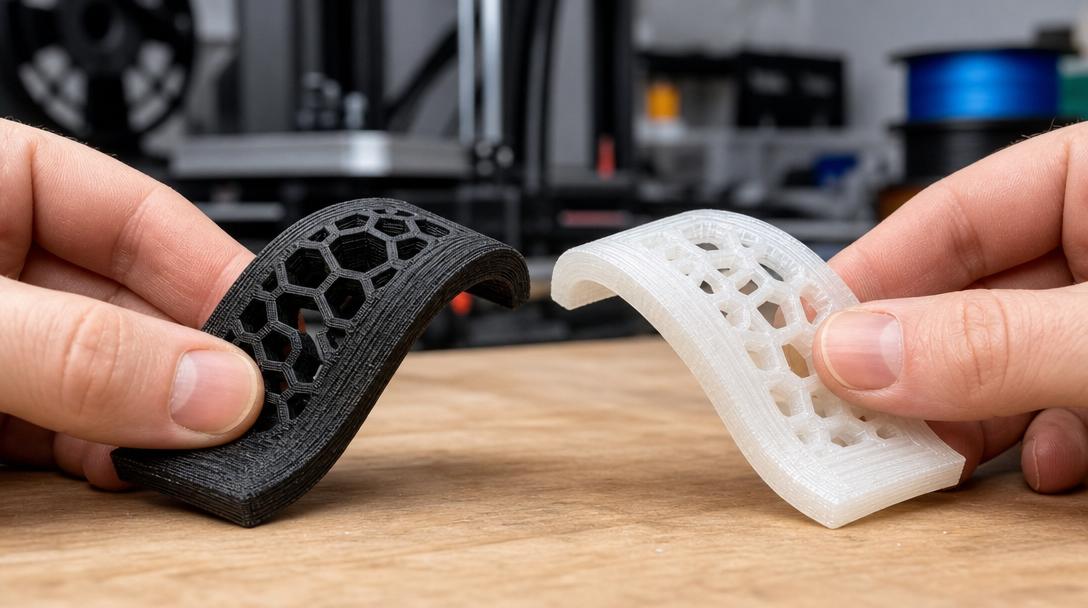

TPU or TPE? Which Makes More Sense for Flexible 3D-Printed Parts?
Choosing a flexible filament is not as simple as choosing rigid materials. On paper, TPU and TPE look very similar; both produce parts that can bend, absorb impact, and feel softer than classic rigid plastics. However, in real use, the difference becomes clear when it comes to how much the part needs to flex, how much friction it will face, and how smoothly the printing process needs to go. If you want to define the right material before moving into production, it is important to describe the part’s function from the very beginning during the 3d printing service process.
What are TPU and TPE basically used for?
TPU is usually preferred for more controlled and more predictable flexible parts in most FDM applications. Protective parts similar to phone cases, vibration-damping feet, bumpers, non-slip surfaces, cable holders, and parts exposed to light impact are natural examples for TPU. TPE, on the other hand, can stand out in applications that require a softer feel, greater flexibility, and behavior closer to rubber. Soft gasket-like parts, frequently opened and closed tabs, or products that need to feel more rubber-like in the hand can make TPE a sensible option.
The critical point here is this: TPE is not always better just because it can be softer; since TPU behaves in a slightly more controlled way, it becomes the safer choice in day-to-day production.
When is it not suitable?
Neither material is the right choice for load-bearing parts that require high rigidity. For rigid brackets that must keep their shape under screw tightening, jigs that require millimetric dimensional accuracy, or structural parts that need to maintain their form in hot environments, TPU or TPE often introduces unnecessary flexibility. In addition, in combinations of very thin walls and extremely soft geometry, TPE may create more printing difficulty than part functionality.
The difference in flexibility, impact, and user feel
TPE can generally offer a more “rubbery” character. This is an advantage for parts where user touch matters. For example, TPE can feel more natural for a button cover that is squeezed by hand or for a protective coating that requires a soft contact surface. TPU, on the other hand, usually feels a bit firmer; in other words, it flexes, but recovers in a more controlled way. For this reason, TPU is often preferred for impact-exposed corner protectors, feet, and damping parts.
In short, if a softer feel is the priority, choose TPE; if more balanced flexibility and more predictable mechanical behavior are the priority, TPU is generally the more sensible option.
Which makes more sense for heat and outdoor use?
With flexible materials, the decision is not based on flexibility alone. Sun exposure, temperature fluctuations, and surface fatigue also matter outdoors. In general, TPU offers a more controlled approach than TPE for outdoor use in many practical applications. Even so, the manufacturer’s formula can create serious differences in both materials; therefore, blanket statements such as “all TPEs are weak” or “every TPU is suitable for outdoor use” are not accurate. If you are planning long-term outdoor use, it is helpful to first look at the options on the our printing materials page to see the material family.
For parts that operate close to high heat, the risk of a flexible material losing its shape should be considered from the start. For this reason, TPU and TPE are usually not the first choice for technical parts around engines, inside hot enclosures, or under continuous heat load.
Ease of printing: why do most users lean more toward TPU?
In FDM printing, the real test for flexible filament begins on the printer itself. Especially very soft types of TPE may be more prone to bending in the filament path and causing feeding difficulties during extrusion. TPU, on the other hand, generally advances more stably, so it creates fewer surprises both in professional service work and in hobby use. Of course, printer architecture, extruder design, and speed settings all affect the outcome; however, when compared within the same segment, TPU’s printability advantage is frequently seen.
If you are thinking about cost not only in terms of spool price but also in terms of the probability of getting a successful print on the first try, the logic of the decision changes. At that point, rather than giving direct figures, it is healthier to evaluate the price per gram approach together with the production conditions.
Which one should you choose for which part?
- TPU: phone case, vibration foot, bumper, non-slip pad, protective corner, parts that need to be flexible but still keep their shape
- TPE: softer contact surfaces, a more rubber-like feel, tabs with low hardness expectations, and comfort-focused flexible parts
If your priority is production reliability, part repeatability, and balanced flexibility, TPU is the safer starting point. If your priority is maximum softness and getting closer to a rubber-like feel in the hand, TPE should be considered. If your file is ready, you can get an instant quote and quickly compare which option makes more sense based on the geometry.
Conclusion
When choosing between TPU and TPE, the only question should not be “which one is more flexible?” The real question is how soft the part needs to be, how smoothly the printing process is expected to go, and what the usage environment requires. In most FDM projects, TPU is the more practical and balanced choice; TPE becomes meaningful for special parts that require a softer feel and more rubber-like behavior. The best choice is made by considering both part function and the realities of printing at the same time.



 Türkçe
 العربية
 Русский
 فارسی
فارسی Deutsch