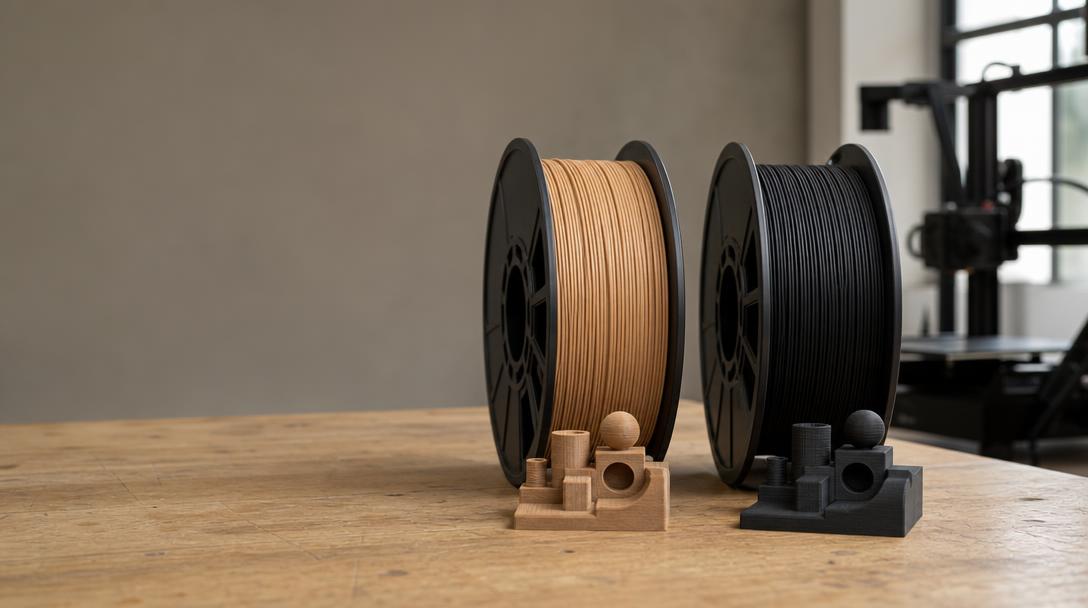
Wood PLA or ABS+? Decorative Look or Functional Part?
Wood PLA and ABS+ are not two materials that meet the same FDM printing need. While Wood PLA stands out for models that need a wood-like feel and decorative appearance, ABS+ is considered for functional parts that need greater durability and better heat tolerance. For that reason, the choice should be based not only on the filament price, but also on where the part will be used and how much stress it will face during use.
What is it good for, and what is it not good for?
Wood PLA is a decorative FDM filament made by adding wood-like additives to a PLA base. It is attractive for surfaces close to a natural texture, scale models, figurines, sign details, and presentation pieces. After printing, the appearance can be improved further with sanding and suitable painting. However, it does not behave like real wood; it should not be the first choice for load-bearing joints, mechanisms exposed to constant friction, or structural parts left outdoors for long periods.
ABS+ is a variant designed to be easier to manage during printing than standard ABS, and it is used for functional parts that require impact resistance and heat tolerance. It can make sense for boxes, enclosures, fixtures, connectors, and workshop equipment parts. That said, ABS+ is not infinitely durable either. The part geometry, layer orientation, wall count, and manufacturer profile all seriously affect the result.
Outdoor use and heat comparison
Wood PLA is the option that requires a cautious approach for outdoor use. Sun, moisture, and temperature changes can cause the surface and dimensional stability to deteriorate over time. When deciding to use it in places such as a veranda, inside a vehicle, or on a sunlit windowsill, the part’s real heat exposure should be taken into account.
ABS+ is a more suitable candidate than Wood PLA when it comes to temperature; however, if UV resistance is needed outdoors, materials such as ASA should also be evaluated separately. It is not correct to approve a heat-exposed part by looking only at the filament name. Continuous operating temperature, the load on the part, and the design safety margin should be examined together.
Impact, rigidity, and flexibility
Wood PLA usually gives a rigid feel and helps a decorative model keep its form. But rigidity does not mean impact resistance. Thin protrusions, clips, and repeatedly bent arms can break. In a scale model where wood texture is important, this limitation may be acceptable; however, for a working hinge or a frequently used latch, it can create risk.
ABS+ makes sense for those aiming for a tougher part with better impact resistance. A certain amount of flexibility can provide an advantage under sudden loads; however, print orientation and interlayer bonding are still decisive. It should not be assumed that a very thin-walled ABS+ part will always perform better than a properly designed thick-walled Wood PLA part under all conditions.
Printability and cost logic
Wood PLA may be more accessible at the beginning thanks to its print behavior being close to the PLA family. Even so, its filled structure can increase nozzle wear and the need for flow adjustment; manufacturer recommendations should be checked. ABS+, on the other hand, may require an enclosed chamber, good bed adhesion, and greater control of ambient temperature. Printer conditions are important to reduce the risk of warping and layer separation in large parts.
When making a cost decision, you should consider not only the kilogram price or the price per gram, but also the risk of failed prints, post-processing time, and the service life of the part. For a decorative object, the appearance advantage of Wood PLA can reduce total labor. If a functional fixture needs to be replaced again and again, ABS+ may be more troublesome at the start but can offer a more reasonable total cost.
Which one should you choose for which part?
- Wood PLA: Scale models, decorative figures, display pieces, sign details, and low-load products where a wood look is desired.
- ABS+: Boxes, enclosures, workshop fixtures, impact-exposed covers, and functional parts that may be exposed to heat.
In short, if appearance and an easy start are your priorities, choose Wood PLA; if you expect impact resistance, function, and higher temperature performance, ABS+ points in the right direction. You can compare other options for your project on the our printing materials page. To have your part produced by experts, you can visit the 3d printing service page, and you can evaluate the affordable 3d printing prices approach together with part weight and quantity. If your file is ready, you can use the online calculator to get an instant quote.


 Türkçe
 العربية
 Русский
 فارسی
فارسی Deutsch