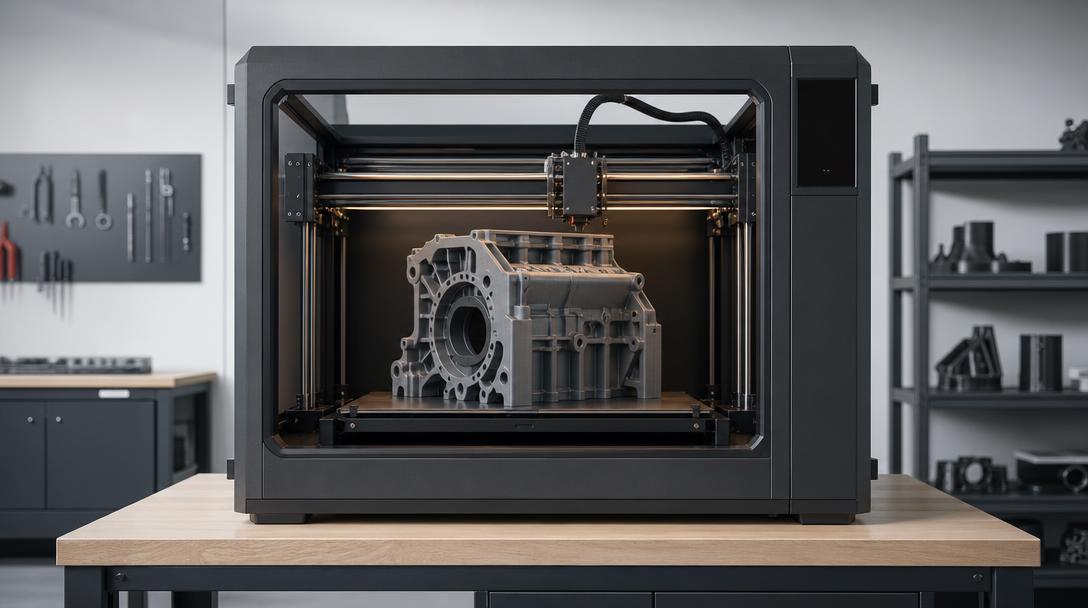

QIDI Plus5 Unveiled: 320×320×300 mm Volume and Heated Chamber for Large-Format FDM Printing
On August 5, 2026, QIDI globally introduced Plus5, the new model in its Plus series. According to the manufacturer’s announcement, the printer aims to combine large-format FDM printing with bigger parts and engineering-grade filaments. The news is especially noteworthy for those producing enclosures, fixtures, prototypes, and functional workshop parts that do not fit on a standard desktop printer.
The source of this development is the launch announcement published by QIDI Technology via GlobeNewswire and the Yahoo Finance article covering the announcement. The source date is August 5, 2026. It should be noted from the start that the announcement is a manufacturer press release, so its performance claims are not the same as independent test results.
What stands out technically about the Plus5?
According to the information provided by QIDI, the Plus5 has a build volume of 320×320×300 mm. This size offers about 18 percent more model space compared with the Plus4, while the company says it has kept the same overall body size. For users, this could mean producing some parts in a single run that previously had to be split, or using the print bed more efficiently.
The printer includes a reinforced metal frame, linear rails on the X axis, and a 9 mm wide belt system intended to improve stability during high-speed movement. The manufacturer also mentions an automatic leveling approach that uses physical nozzle contact. On paper, these features look beneficial for first-layer consistency and motion repeatability; however, real-world results will still depend on the print profile, bed surface, part geometry, and machine setup.
How does the heated chamber affect engineering filaments?
One of the most important differences in the Plus5 is its active chamber heating. QIDI reports that the chamber temperature can be managed up to 65 °C and that the hotend can reach 370 °C. This capability can help maintain a more controlled printing environment for ABS, ASA, Nylon (PA), Polycarbonate (PC), and some reinforced filaments. Still, high-temperature capability alone does not guarantee a successful part: dried filament, a suitable bed surface, correct print orientation, sufficient layer adhesion, and safe ventilation also matter.
Especially with materials such as ABS and PC, the risk of cooling-related shrinkage and cracking may still remain depending on the design. For that reason, it is healthier to evaluate the Plus5 not simply as a machine that can “print hotter,” but as an enclosed FDM production tool that requires proper settings and process discipline. To review material options together, you can visit the engineering materials 3D printing page.
What it means for workshops and businesses
A larger volume does not mean every project will involve printing a bigger part. Large parts can take longer, consume more filament, and create greater loss if a print fails. On the other hand, single-piece production can reduce assembly marks and the need for screws or adhesives. When making a decision, it is necessary to consider the part size, service temperature, impact expectations, and production quantity together.
If it makes more sense to have your model produced externally, you can get support on materials and production methods through 3d printing service. To make your production decision based on cost, also review the logic of price per gram; looking only at the printer’s build volume does not show the total cost. For those who want to upload a model and get a quick initial evaluation, the instant quote tool can also be used.
Conclusion: Who is it meaningful for?
QIDI Plus5 is a launch that may catch the attention of users printing large and functional FDM parts and those wanting to move into ABS or other filaments that require higher temperatures. On the other hand, for people producing only small PLA decorative items, a heated chamber and a larger body may mean unnecessary cost and space requirements. The most accurate evaluation can be made after comparing the manufacturer’s technical data with independent reviews and real part testing.



 Türkçe
 العربية
 Русский
 فارسی
فارسی Deutsch