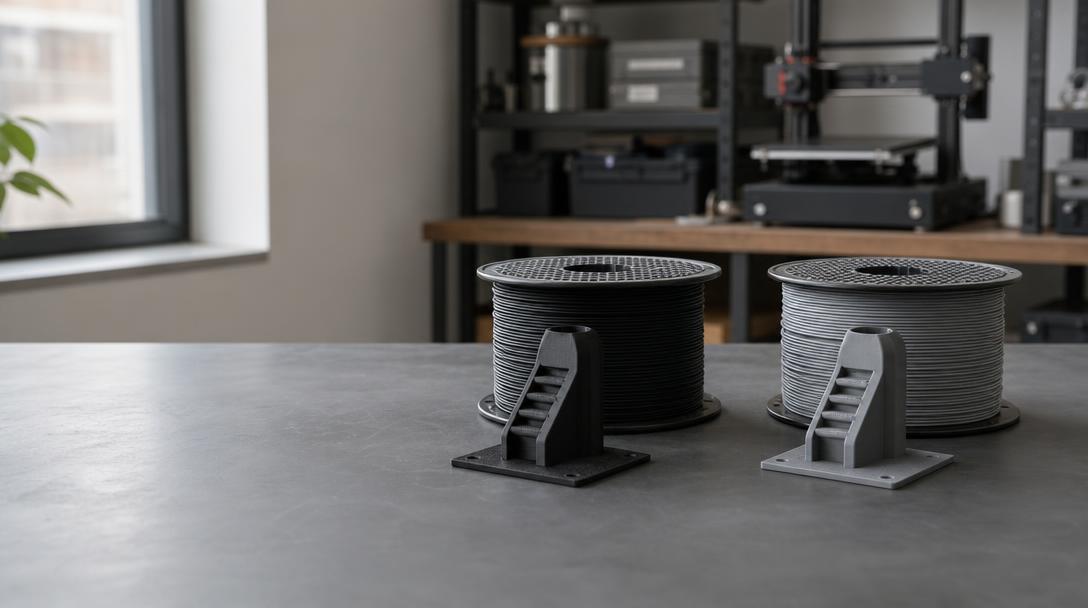

ABS+ or TPC? A Rigid Functional Part or a Flexible Wear Part?
Choosing the right filament for an FDM part is not only about making the print look good. How the part behaves under load, how it responds to impact, and how much it can flex during use should also be defined from the very beginning. In this respect, ABS+ and TPC are two quite different options: ABS+ suits those who want a stiffer, more structural part, while TPC is better for those looking for controlled flexibility and wear resistance.
When deciding, first define the part’s function. If you are printing a housing, connector fixture, or a rigid mounting part, ABS+ may be a more natural starting point. For a cable grommet, vibration damper, flexible cover, or a part exposed to constant friction, the elastomer character of TPC makes more sense. To see a suitable production approach, you can review our printing materials.
What are ABS+ and TPC used for?
ABS+ can be thought of as a version of the ABS family adapted for functional uses. It aims to offer a balanced option between rigidity, impact resistance, and functional prototype production. It can be considered for boxes, covers, fixtures, connectors, and protective parts used around machinery. However, since product formulation can vary by brand, actual performance should always be evaluated together with the technical datasheet of the filament you choose and the print settings.
TPC, on the other hand, is a thermoplastic copolyester-based material group with flexible behavior. Rather than holding its shape like a hard plastic, it allows more bending, compression, or repeated movement. For this reason, it can stand out for gasket-like parts, impact-absorbing intermediate components, flexible clips, and wear-contact parts. TPC should not be considered the same as real rubber; the level of flexibility, shore hardness, and print geometry significantly affect the final result.
The difference in rigidity, impact, and flexibility
If rigidity is your top priority, ABS+ is generally the more sensible choice. A bracket or support body that needs to keep its shape during assembly may move more than desired if made with TPC. ABS+ can also offer a solution that is not brittle against impact; however, layer orientation, wall count, and print temperature determine the outcome.
The advantage of TPC is that it can handle impact and vibration in a more controlled way. Its flexible structure can absorb part of a sudden load through deformation. This makes TPC interesting for parts exposed to friction and repeated bending. On the other hand, too much flexibility becomes a disadvantage in parts that must maintain precise dimensions, must not move at all, or must directly carry screw-tightening force.
Which one under outdoor conditions and heat?
Before using ABS+ and TPC outdoors, do not look only at the material names. Sunlight, temperature changes, moisture, chemicals, and whether the part remains under constant load should all be considered together. ABS+ may be a more suitable candidate for outdoor use than PLA; however, for long-term UV exposure, the manufacturer’s data should be checked. TPC may retain its flexibility, but its UV and chemical resistance still depend on its grade, additives, and usage conditions.
For a rigid fixture exposed to heat, ABS+ may be the more suitable starting point. Although TPC offers an advantage with its flexibility at low and moderate temperatures, the risk of softening and deformation may increase as temperature rises. For parts such as those around motors, hot air ducts, or covers exposed to continuous heat, do not make a selection without measuring the actual operating temperature.
Printability and cost logic
ABS+ may not be as easy to print on desktop FDM printers as PLA. Enclosed chambers and careful bed preparation may be necessary to deal with airflow in the print environment, corner lifting on large parts, and stress between layers. With TPC, it may be necessary to prevent the flexible filament from wandering in the feed path, keep retraction settings under control, and reduce print speed. In other words, the difficulty of the two materials is different: ABS+ requires environmental stability, while TPC requires disciplined mechanical feeding and tuning.
When comparing costs, consider not only the spool price but also the risk of failed prints, support requirements, post-processing time, and the service life of the part. For your project, reviewing affordable 3D printing prices and the price per gram logic can help you compare the two options based on the same part weight.
Which one should you choose for which part?
- Choose ABS+: If you are printing a rigid housing, mounting fixture, support bracket, durable prototype, or a functional part that needs to hold its dimensions.
- Choose TPC: If you are designing a flexible cover, vibration-absorbing foot, friction-contact spacer, bending clip, or a component that needs to soften impact.
- Reconsider your choice: If the part will operate at high temperature, continuously outdoors, or in a critical safety role, do not make a final decision without the material datasheet and prototype testing.
At the final stage, optimize the print orientation, wall thickness, and connection geometry together with the material. If you are unsure, you can make the production plan more concrete by getting an instant quote for your file using the online 3d printing tool. In short: for a rigid and dimensionally stable functional part, ABS+ is the better starting point; for controlled flexibility and repeated contact, TPC is the better choice.



 Türkçe
 العربية
 Русский
 فارسی
فارسی Deutsch