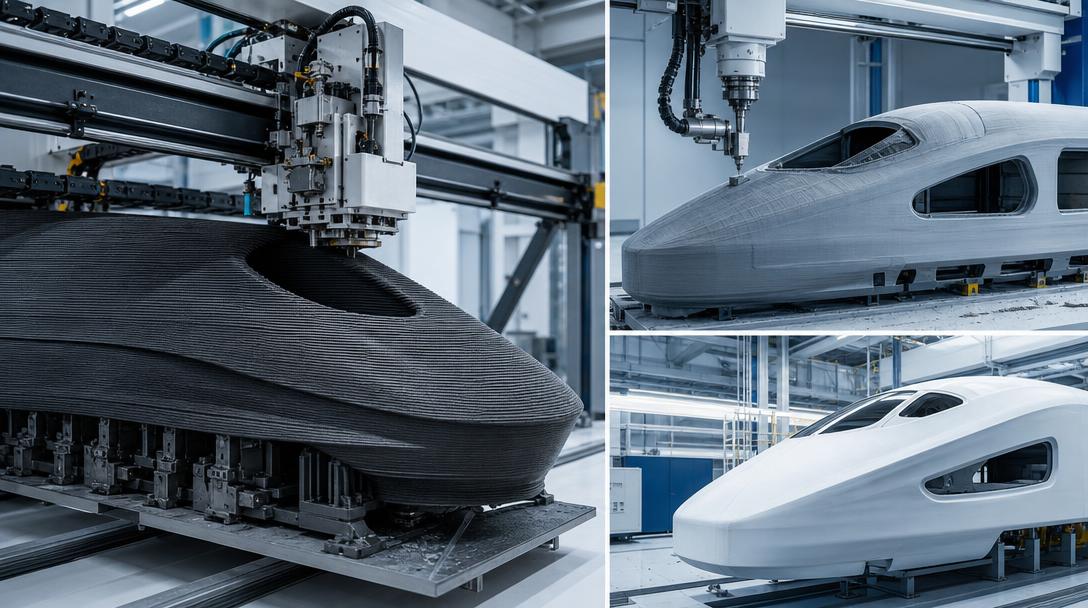

What Does HVE’s 3D Printing Move for the Siemens ICE 3neo Tell Us? Mold-Free and Recyclable Train Parts
Producing large exterior body parts used in high-speed trains is not only about printer volume. Mold cost, production time, manual labor, surface quality, and how the part will be handled at the end of its service life are also part of the decision. The 3D-FiberTrain project, completed by HÖRMANN Vehicle Engineering (HVE) and its research partners, stands out because it addresses all of these topics within the same production chain.
Source and date: This development was announced in 3D Printing Industry’s August 24, 2026 report. The project was validated by producing two demonstrator parts for Siemens Mobility’s ICE 3neo high-speed train family: the nose section and the front skirt.
The core idea of the project: a digital production chain instead of molds
In traditional composite manufacturing, large exterior cladding parts often require processes such as custom tooling, hand lay-up, or vacuum infusion. In low-volume production, these methods can become burdensome because of the time and cost required to prepare molds. The 3D-FiberTrain approach, by contrast, places large-format, pellet-fed extrusion printing at the start of the process. This tests the idea of producing complex geometry without preparing a custom mold.
However, the goal is not simply to build the part layer by layer. Continuous fiber reinforcement is added to regions of the produced structure where loads are concentrated. Then, automated milling is used to move closer to dimensional and surface requirements. These three stages bring together, in a single workflow, the goal of rapidly forming the geometry of a large part and improving mechanical performance in critical areas.
Why are the Siemens ICE 3neo demonstrators important?
To understand the real value of a technology demonstration, it is necessary to look at which part was printed. Instead of working on a small laboratory-scale sample, the HVE team focused on the nose section and front skirt of a high-speed train. These parts are large, aerodynamically important, and exposed to outdoor operating conditions. As a result, the project provides an opportunity to evaluate issues such as build volume, surface finishing, fiber placement, and assembly fit together.
This does not mean the new method can immediately be used for every train part. In railway applications, fire behavior, strength, repeatability, dimensional accuracy, and the relevant approval processes must all be assessed separately. The demonstrator production described in the report is not itself commercial serial-production approval; it is a step showing the feasibility of a mold-free and hybrid production chain.
Benefits in terms of recyclability and low-volume production
One of the notable aspects of the project is that the chain is built around thermoplastic materials. HVE and its partners state that this could make the parts more favorable for recycling compared with traditional thermoset composites. Of course, the actual outcome will depend on the polymer used, the type of fiber, the part design, and the recycling method. Even so, thinking about the material family from the beginning is an important design decision for the life cycle of large composite parts.
Mold-free production can be especially valuable for spare parts, prototypes, and low-volume custom components. Being able to move from a digital file to production without preparing a new tool can make it easier to test design changes. In a similar way, a measured part could potentially be evaluated for small-batch or custom production through a 3d printing service. To clarify the selection of the right material and production method, you can review our printing materials.
Key takeaway for Ucuz3D readers
The HVE example shows that large FDM and pellet extrusion systems are not considered only for sculpture or visual prototype production. For a large part to be functional, print orientation, placing the fiber along the load path, finishing allowance, and connection zones must all be planned at the first stage of design. The same principle also applies to desktop-scale parts: material, layer orientation, and finishing should be decided together.
For your project, seeing the logic of price per gram and the production scope can help with an approximate cost evaluation. If your file is ready, you can use the online calculation tool to get an instant quote. HVE’s train demonstrators teach us this lesson: with large and complex parts, the real efficiency comes not only from print speed, but from combining molds, reinforcement, and finishing into a single well-planned production workflow.



 Türkçe
 العربية
 Русский
 فارسی
فارسی Deutsch