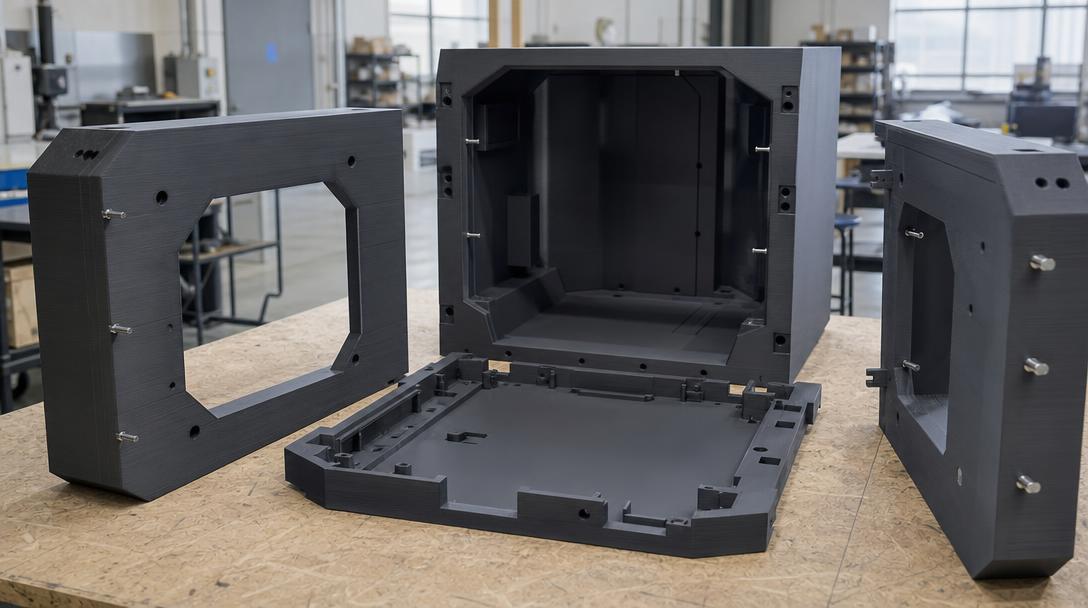

Is Large-Format 3D Printing Possible? Is One-Piece Printing or Producing It in Sections More Sensible?
Large-format 3d printing is possible; however, in FDM production, the most suitable method is not always one-piece printing. Part size, print orientation, strength requirements, and delivery risk are evaluated together; in most projects, dividing the model in a controlled way and then assembling it delivers safer and more economical results.
Especially when it comes to large covers, enclosures, decorative panels, device housings, prototype shells, and custom-sized fixtures, the real question should not be “can it be printed?” but “how can it be produced with the least risk?” A model with suitable geometry can be produced in one piece; however, as print time increases, the likelihood of errors, bed separation, warping, and material waste also rises. That is why, in large-format jobs, the right strategy is not to push the print volume to its limits, but to set up the production plan intelligently.
When does one-piece printing make sense?
If the model fits comfortably within the print area, is not long and slender, requires a moderate print time, and surface continuity is critical, one-piece printing may be advantageous. For example, a cover that needs to appear as a single surface, a simply shaped panel, or an aesthetic shell that is difficult to join later without leaving marks may be considered for one-piece production. In such cases, when planning a 3d printing service, layer orientation, bed contact, and part weight are considered together.
Even so, in FDM printing, deciding to produce large parts in one piece is not something that should be based only on whether the part fits within the printer’s build volume. Questions such as how much space the part occupies on the bed, how many hours the print will take, whether stress will form at the corners, and whether the entire job will be wasted in the event of an error are more decisive.
Why does producing in sections often give better results?
Dividing a large model into two or more parts significantly increases production reliability. Each sub-part is printed in a shorter time, and if an error occurs, only the faulty section is reproduced rather than the entire product. Also, because some geometries can be positioned in a better print orientation, both surface quality and strength improve together. In addition, shipping, assembly, and on-site replacement become easier.
For example, a large electronics box, a long channel, a machine guard, or a bulky prototype housing often makes more sense when produced in sections. If dowels, snap-fit features, bolt seats, or bonding surfaces are designed in suitable places, the joint line can be both strong and clean. Since clearance calculations are critical in the areas to be joined, the approach in the guide What Is Tolerance? How Should Interlocking Parts Be Designed? is very useful for this type of work.
Which criteria are considered when deciding on a large-format FDM part?
- Print volume: Does the part physically fit in a single run?
- Print time: One very long print, or several shorter and safer prints?
- Strength direction: Along which axis will the load be applied, and does the layer orientation support it?
- Post-processing: Is the joint line acceptable, and will sanding or bonding be done?
- Logistics: Is the part easier to manage during shipping, assembly, or at the place of use?
Because of these factors, there is no general rule in large-format 3d printing projects that “one piece is best.” In fact, for functional jobs, controlled splitting is often the more professional solution.
How are cost and delivery time affected?
For large parts, cost does not depend only on the outer dimensions; it varies according to weight, material type, wall thickness, infill ratio, number of parts, and post-processing requirements. Sometimes, one-piece printing may theoretically require less assembly, but because of the long print time and high reprint risk, it can increase the total cost. In contrast, an intelligently designed layout split into two or three parts can progress both more safely and more quickly. In such a job, it is possible to clarify the dimensions, file, and production approach through the online 3d printing workflow and see the price more accurately.
In short, in large-format FDM part production, the right answer is not to push the printer’s build volume to its limits, but to plan the part in the safest way according to its intended use. Even if one-piece production is possible, choosing sectional production when it makes more sense will often deliver a cleaner result.



 Türkçe
 العربية
 Русский
 فارسی
فارسی Deutsch