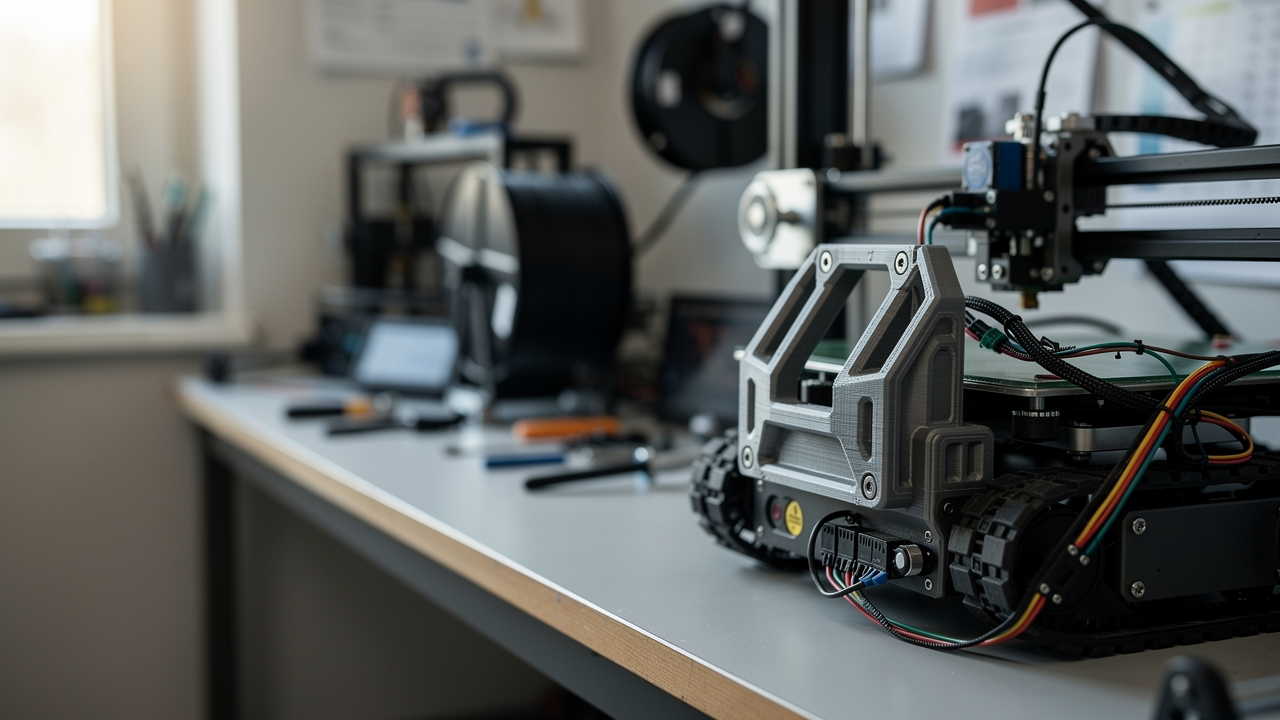

Why Xenia’s Filament Support for the ASTRA Rover Matters: Material Selection for Robotic FDM Parts Is Reaching the Field
University projects are often seen as little more than a nice showcase; however, some of them make real engineering decisions directly visible. According to the news published by VoxelMatters on 7 August 2026, Xenia Materials is providing filament support from its 3DF Materials series to Politecnico di Torino’s ASTRA team for the spherical lunar rover project called Scout. The news matters more than a simple sponsorship announcement on its own, because it offers a concrete example of the question which part is printed with which material, and why in FDM production.
The ASTRA team is developing robotic systems for lunar base scenarios. Scout is a rover concept with robotic arms and pendulum-driven motion, designed to move across rough terrain. The especially striking point in the article is that the team is turning to recyclable thermoplastics for components such as body segments and the outer shell, particularly ASA and nylon-based solutions. This choice shows that, in desktop or industrial FDM printing, material selection now needs to be considered not only in terms of prototyping convenience, but also together with rigidity, impact resistance, environmental stresses similar to outdoor conditions, and weight balance.
Why is this news valuable for Ucuz3D readers?
Because while many customers still think of 3D printing only as a way to see a shape quickly, the industry in the field is moving beyond that. In areas such as robotics, vehicle-mounted enclosures, outer shells, fasteners, fixtures, and lightweight structural parts, FDM is now being used with more deliberate material choices. When getting a 3d printing service for a similar part, the only critical question is not just the dimensions; it is also whether the part will face impacts, whether it will remain under the sun, whether it needs flexibility or rigidity, and what service life is expected.
The Scout example provides a good reference point here. While ASA stands out as an option that can keep color and mechanical performance more stable in conditions closer to outdoor use, nylon is one of the engineering materials frequently mentioned in applications involving wear, impact, and mechanical loads. Of course, the requirements of a student rover and those of a commercial end product are not exactly the same. Still, the article is important because it shows how real projects answer the question of whether PLA is enough or whether it is necessary to move up to an engineering material.
What is the main message for robotics and functional parts?
The main message here is that material selection for FDM parts has become just as critical as geometry. If there are risks such as scratching on the outer shell, cracking under impact, deformation under heat, or loosening at connection points during long-term use, a low initial cost alone may not be the right decision. That is why the project chooses its material according to the application from the very beginning. On the Ucuz3D side as well, especially in jobs that move from prototype to functional part, engineering materials are often the main factor that defines this distinction.
This is also very important on the commercial side. The goal is not just to have a part printed cheaply, but to produce it appropriately for its purpose with the right material on the first try. For this reason, when planning a project budget, it is necessary to look not only at the total order but also at the production logic of the material. Depending on the application, within affordable 3D printing prices, not only the per-gram pricing logic but also the selected filament’s potential to reduce the need for reprints can affect the total cost.
What lessons can be drawn for which parts?
- Outer shells and covers: If there is a risk of sun exposure, heat, and impact, materials similar to ASA may be a more sensible choice.
- Load-bearing connectors or parts in moving environments: Nylon-type materials may provide a more suitable basis in terms of wear resistance and durability.
- Early visual prototypes: More economical and faster materials may be sufficient; however, the same approach is not always right for a part that will go into the field.
- Robotics and in-vehicle fixtures: Not only the shape of the part, but also its service conditions should determine the printing decision.
In short, the Xenia–ASTRA news shows that 3D printing is moving beyond the model-making mindset toward mission-appropriate part production. If you also want to clarify material options for a functional enclosure, an outdoor fixture, a lightweight mechanical component, or a robotic part, making the right material match early in the online 3d printing workflow often creates the biggest difference. For this type of work, the our printing materials page is also a good starting point for seeing the general options together.


 Türkçe
 العربية
 Русский
 فارسی
فارسی Deutsch