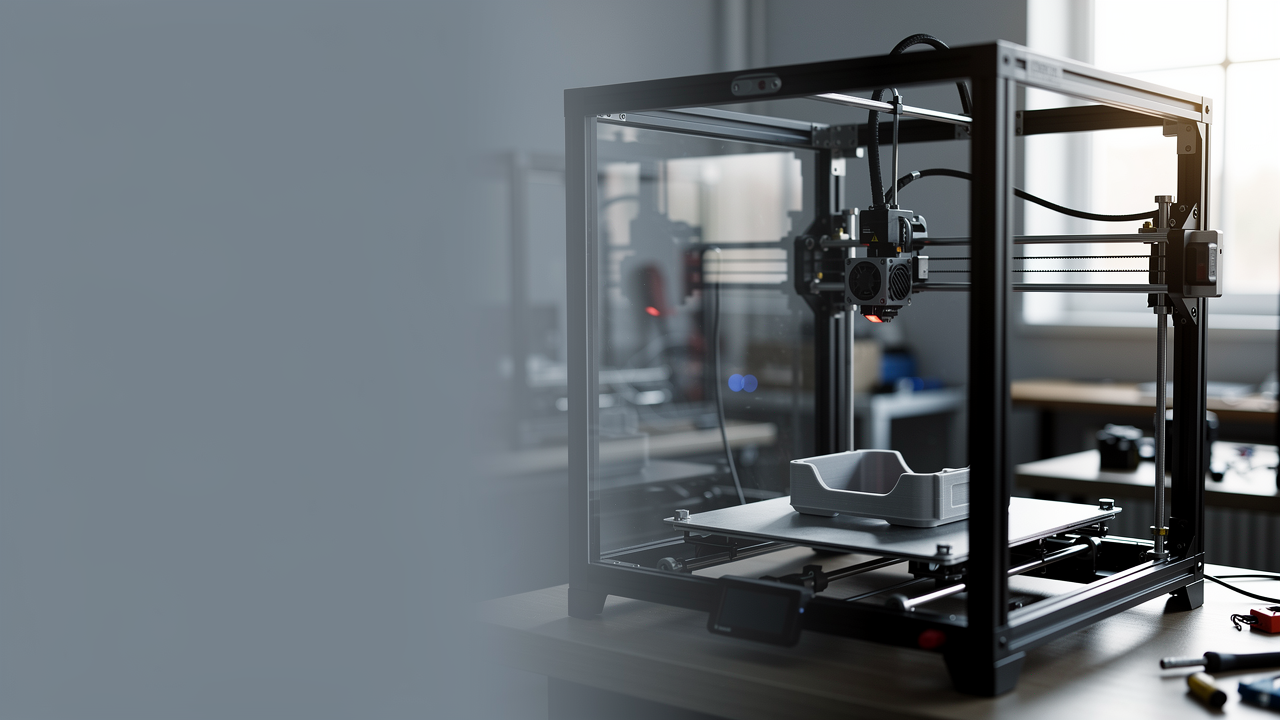

Why IMDEA and Lawrence Berkeley’s 3D Printer Variability Research Matters: A New Approach to Print Farm Quality
In 3D printing, almost everyone in the field knows that two printers of the same brand and model do not always deliver the same result. However, this usually remains an observation based on experience; measuring it systematically and turning it into a production strategy is more difficult. According to a VoxelMatters report dated July 22, 2026, researchers from IMDEA Materials Institute and Lawrence Berkeley National Laboratory developed an algorithm focused precisely on this problem. The study measures how 3D printers that are theoretically identical behave differently in practice, and then recommends either shared optimization or device-specific optimization accordingly.
For Ucuz3D readers, the value of this news is quite clear: in 3D printing, quality differences cannot be explained only by the model, temperature, or filament brand. The printer’s own behavior can also affect the result. The researchers first create a performance profile for each machine, then statistically compare the deviation between printers. If the machines are close enough to each other, shared optimization makes sense; if not, a separate settings approach is preferred for each device. Especially for production cells running multiple printers, this is a practical idea that could reduce unnecessary reprints and dimensional deviations.
The validation section shared in the report is also important. The team worked on three theoretically identical 3D printers and found measurable differences between the machines. As a result, device-specific optimization reportedly achieved faster convergence and lower error in part weight compared with an approach that assumes all machines are the same. This should not be read as a “miracle solution”; the research does not offer a single recipe for every print farm. But it sends a clear message: as a print farm grows, it can become risky to load the same profile onto every printer and expect the same output.
Why is this approach commercially important? Because customer expectations are usually simple: a part produced today should behave the same as a part produced next week. Consistency is at least as critical as speed, especially in serial prototyping, small-batch production, jigs, fixtures, or recurring spare-part jobs. For that reason, when purchasing a 3d printing service, it is worth considering not only the printer model, but also process standardization, calibration discipline, and quality-control habits. In the field, reliable output usually comes more from process discipline than from the machine fleet itself.
The issue of machine variability also connects with material management. The same printer can still behave differently with filament at different moisture levels, with different diameter tolerances, or with a different drying history. That is why not only the printer profile but also consistency on the material side matters. In technical jobs, controlled management of the material pool, such as the options on the our printing materials page, is a quiet but critical part of process repeatability.
On the cost side, the report also indirectly points to something important. Poor-quality reprints, wasted operator time, and dimensional deviations noticed later are often hidden costs that are not obvious at first glance. That is why it makes sense to think not only about the price per print, but about total process efficiency. Before placing an order, when evaluating the logic behind affordable 3d printing prices, it is more accurate to consider how consistent production affects total cost. Similarly, to quickly see whether a file is manufacturable and reduce the number of repeats, the instant quote flow can simplify the initial decision stage.
In my opinion, the real importance of this report is that it moves the quality discussion in 3D printing beyond the level of “good printer, bad printer” and into data-driven process management. Especially in multi-printer workshops, teams doing serial prototyping, and service providers handling regular repeat jobs, measuring device character seems likely to become more visible. In short, the IMDEA and Lawrence Berkeley study reminds us once again that quality consistency in 3D printing is not only a matter of experience, but a measurable production problem.


 Türkçe
 العربية
 Русский
 فارسی
فارسی Deutsch