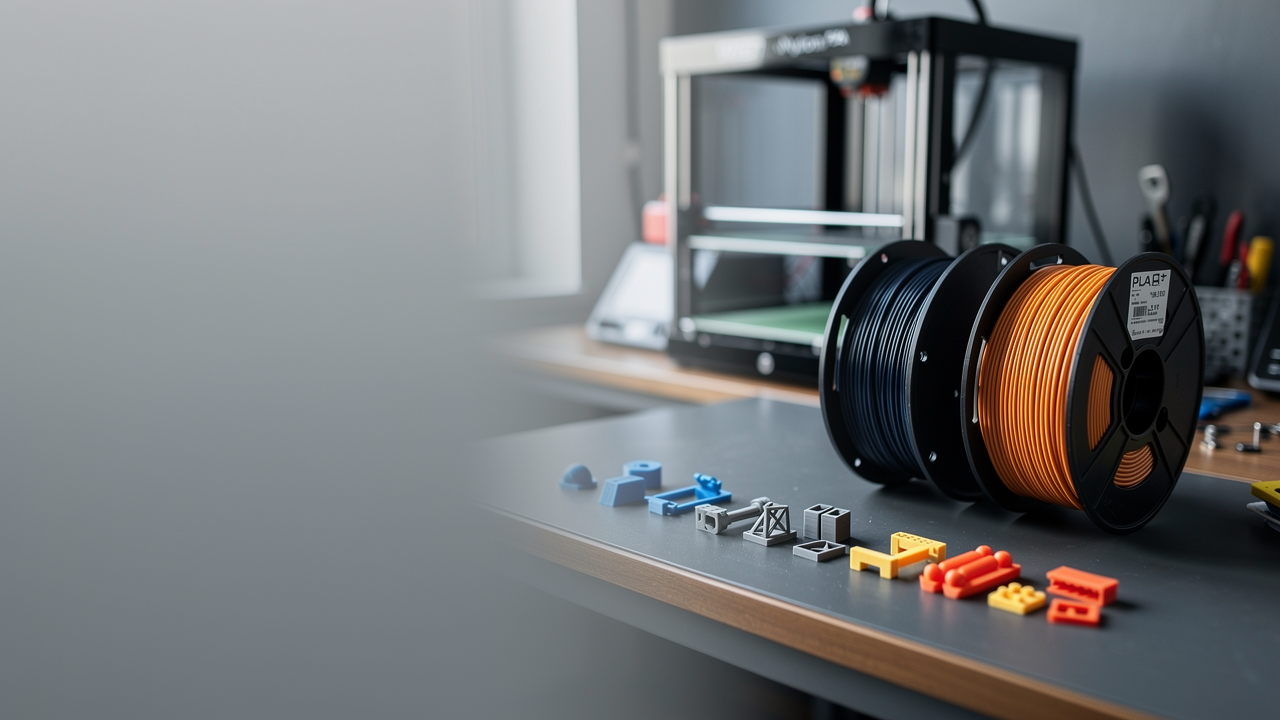

PLA+ or Nylon (PA)? Which Is the Better Choice from Everyday Functional Parts to Wear-Prone Mechanical Components?
PLA+ and nylon (PA) are two FDM materials that are often placed in the same basket but actually meet different expectations. One stands out for jobs that require more practical, clean, and fast results; the other offers advantages when it comes to friction, impact, and long-term mechanical use. If you want to not just print a part but actually use it, material selection directly affects the quality of the result. Especially when getting a 3d printing service, clearly describing the part’s purpose will make you much more satisfied with the final print.
Let’s start with a short summary: PLA+ makes sense for most desktop accessories, prototypes, enclosures, and visual-functional hybrid parts. Nylon, on the other hand, is a stronger candidate for gears, bushings, clips, parts that work under friction, and components that may fatigue under load. However, nylon’s advantage does not mean it is automatically better for every job.
What is PLA+ good for, and what is nylon good for?
PLA+ is generally a slightly tougher, slightly more crack-resistant, and more user-friendly option than standard PLA. It is often preferred for boxes, assembly fixtures, desktop equipment, prototype housings, and mid-level functional parts where dimensional control matters. Its print surface is also usually more predictable.
Nylon (PA), on the other hand, stands out more for mechanical use. It makes more sense in parts that wear, rub, need slight flexibility, or are expected to absorb impact by deforming rather than breaking. That is why it can stand out in moving joints, cable guides, mechanical holders, and some spare-part scenarios. In Ucuz3D’s engineering materials approach as well, nylon is evaluated more often for parts that carry real usage loads.
Which has the advantage in heat, outdoor use, and impact?
PLA+ may be sufficient for everyday use, but hot environments are not its strong area. It may struggle to keep its shape in parts left under the sun, forgotten inside a vehicle, or operating close to heat. For outdoor use, only limited and low-risk applications should be considered.
Nylon, by contrast, is generally a more reassuring option against heat and impact. It can also respond in a tougher way rather than behaving in a brittle manner. This makes it stand out especially in parts exposed to mechanical stress. Still, it would not be correct to call it “always the best choice” for outdoor use on its own, because moisture behavior and part geometry can seriously affect the result.
Rigidity or flexibility?
This is the critical distinction here: PLA+ gives a more rigid feel and holds its shape better. That is an advantage in body parts that need to stay fixed. Nylon, on the other hand, can behave in a more flexible and tougher way. For this reason, a bracket that must stay very stiff and a latch that needs to flex slightly without breaking do not call for the same material.
- Rigid body, clean appearance, fast prototype: PLA+
- Wear, impact, friction, fatigue resistance: Nylon
- Visual-functional parts requiring tight tolerances: usually PLA+
- Working mechanical part: usually Nylon
Printability and cost logic
PLA+ is generally lower-risk on the printing side. It challenges the user less in terms of moisture, warping, and sensitivity to settings. This increases the chance of getting a good result on the first attempt. Nylon, however, requires a more careful process; moisture control, environmental conditions, and part orientation become more critical. In other words, not only the material but also production discipline becomes more important.
This difference also changes the cost logic. Choosing the strongest material for every part is not economical. Sometimes PLA+, which is easier to print and provides sufficient durability, becomes the more correct choice in the overall production logic. In addition to the price per gram logic, the number of trials, the risk of failed prints, and processing time also affect the overall picture. To see which material makes more sense for your file, leaving a technical note in the online 3d printing workflow makes a big difference.
Which material for which part?
If you are printing a product enclosure, desktop accessory, prototype housing, presentation model, or a fixed part exposed to moderate loads, starting with PLA+ is usually a logical choice. If the part will be repeatedly attached and removed, subject to friction, exposed to impact, or expected to operate mechanically over a long period, nylon is the stronger candidate.
The summary decision can be made like this: if you are saying, “The part should stay stiff, come out clean, and let’s move forward quickly and smoothly,” then PLA+ makes sense; if you are saying, “The part should work, wear over time, but not give up immediately,” then nylon should be considered the more appropriate direction. In the final choice, geometry, thickness, and the usage scenario are always more decisive than the material name itself.


 Türkçe
 العربية
 Русский
 فارسی
فارسی Deutsch