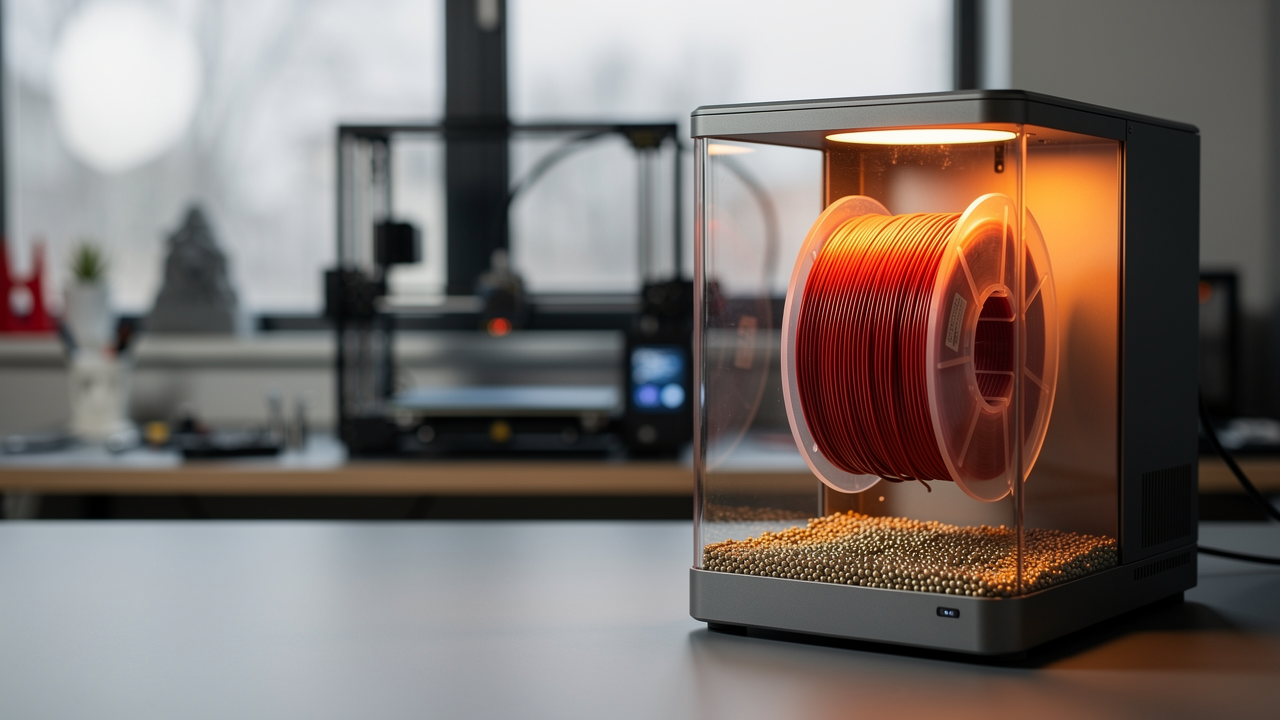

Why Is the ELEGOO H1 HT Filament Dryer Getting Attention? What Does 85°C Drying Change in FDM Printing?
Filament drying has long been a topic FDM users know about, but often postpone until print quality starts to fail. According to VoxelMatters’ July 25, 2026 report, with the H1 HT Filament Dryer announced on July 24, ELEGOO is trying to move this area into a more serious equipment category. The news is not just about the launch of an accessory box; the real issue here is that moisture management is no longer limited to PLA and PETG, but is becoming part of the daily workflow for more demanding materials such as nylon, PC, and similar options.
In FDM printing, filament that has absorbed moisture shows familiar symptoms to most users: rough surface texture, increased stringing, weak layer adhesion, small vapor marks, and dimensional inconsistency. These effects become even more visible especially with PETG, TPU, nylon, and some fiber-reinforced filaments. That is why the important part of this new dryer news is not only material storage, but also that it targets a wider range of filaments with a solution that reaches 85°C.
Why is this news important?
For Ucuz3D readers, the issue is very practical: many print-quality problems are actually not printer failures, but material condition problems. According to VoxelMatters, the standout feature of the H1 HT is that it can dry up to 85°C. This points to a more ambitious level than the temperature range usually offered by ordinary desktop solutions. Such a high temperature may not always be necessary for relatively forgiving materials like PLA; however, for PETG, PA, and PC, the need for more controlled drying is much more meaningful.
So the value of this news lies less in a brand launch and more in signaling the maturation of the filament-preparation stage in FDM production. Today, a part succeeds not only with the right temperature and the right infill, but also with material at the right moisture level. This difference becomes even greater especially in repeat production or customer work. When you outsource your part, one of the advantages of getting 3d printing service is that not only the printer but also material preparation is kept under control.
What does it promise on the technical side?
According to the information in the report, the device is designed so that the spool rotates inside to provide more even drying. Dual automatic ventilation expels moist air during operation and then closes the system again after the process is finished. In addition, having a separate feed outlet designed for TPU and fiber-reinforced filaments is important; because with these types of materials, not only drying but also a smooth, low-friction feed path during printing is critical.
- Drying up to 85°C: offers a more meaningful upper limit for more technical filaments.
- 11 preset modes and manual adjustment: does not force the user into a single profile type.
- Rotating spool structure: aims for more homogeneous heat distribution.
- TPU and fiber filament-focused outlet: offers an approach to reducing feed friction during long prints.
- Safety features: includes extra protection against situations such as overheating, the lid being left open, and fan failure.
Even here, it is necessary to stay cautious: not every device capable of high temperatures offers the same recipe for every filament. The wrong temperature and unnecessarily long drying time can lead to unwanted results in some materials. So this news does not mean dry every spool at 85°C; the correct message is that controlled drying suited to the material is now becoming more accessible.
What is the practical meaning of this on the Ucuz3D side?
Especially in functional prototypes, low-volume production, and engineering-focused parts, print success does not depend only on the model file. Keeping the material ready for printing is just as important as choosing the right material. For this reason, it makes sense to look at the our printing materials page to understand which filament is more suitable for which use scenario. If your goal is not only a visual model but a part that will see real use, moisture management is also an unseen part of the cost calculation; in general terms, this should be considered on the affordable 3d printing prices side.
The main message of this news is this: the FDM ecosystem is maturing not only through faster printers, but also through more controlled auxiliary equipment. Whether you are trying printing at home or sending it out for professional production, material condition directly affects the results. If you want to see how your file will translate on the production side, you can get the first overview through the online 3d printing flow, and you can evaluate much more clearly why moisture is still a critical variable, especially in PETG, TPU, nylon, or more technical parts.


 Türkçe
 العربية
 Русский
 فارسی
فارسی Deutsch