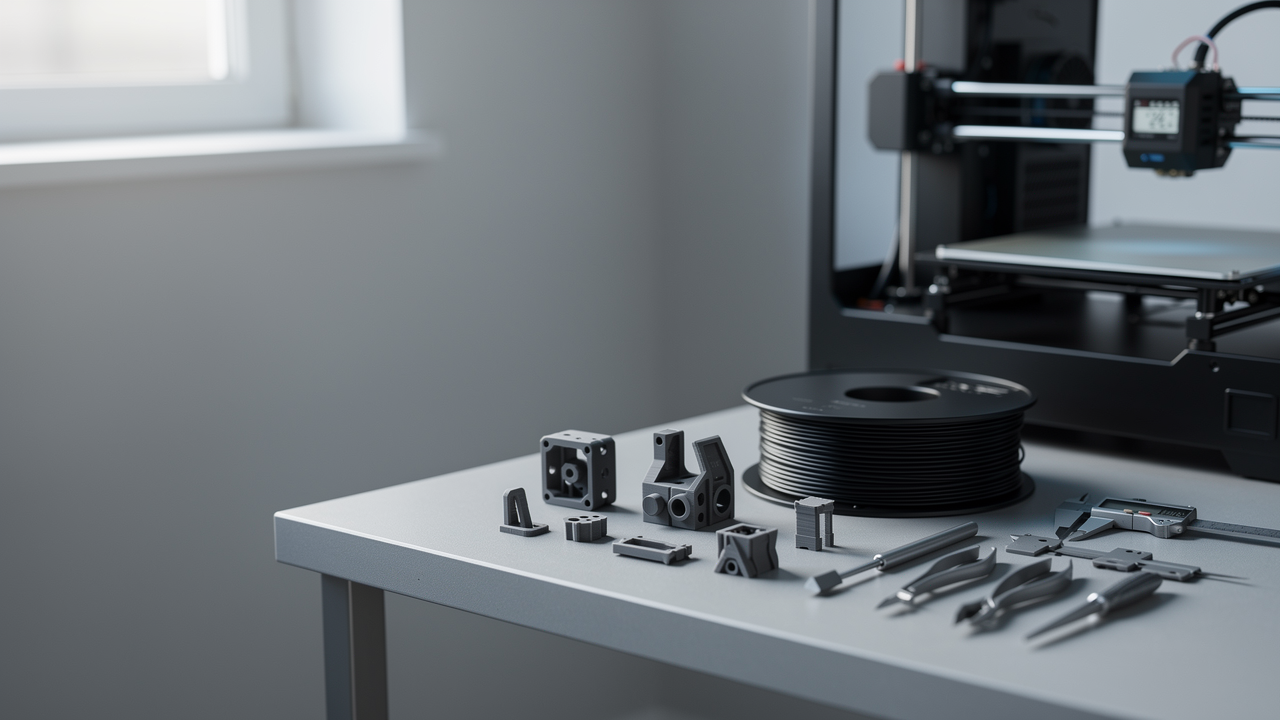

Why Is the AxiLoop MC8 Drawing Attention? The 8-Toolhead FDM Printer Aims to Reduce Waste in Multi-Material Printing
The AxiLoop MC8 is drawing attention because it addresses two core issues that have been discussed for years in multi-material FDM printing at the same time: lost time and material waste caused by purging. According to 3Druck.com’s news report dated August 16, 2026, AxiLoop introduced its first 3D printer, the MC8, with eight toolheads and an automatic spool-changing concept. Based on the framework shared in the report, the system is designed to improve efficiency especially in jobs that require frequent color or material changes.
This kind of news matters for Ucuz3D readers because, on the desktop FDM side, multi-color or multi-material printing is often not just a visual feature but also a decision that directly affects production planning. If the same part requires a rigid body, different-colored markings, or support structures, transitions made through a single nozzle can create significant purge waste. What makes the MC8 stand out is that it tries to solve this bottleneck not with a software promise, but directly through its hardware architecture.
What does the MC8’s key technical framework tell us?
According to the product summary seen in search results, the AxiLoop MC8 has a build volume of 300 x 300 x 300 mm. AxiLoop also shares a print speed of up to 600 mm/s and a 2,500-point bed measurement system; it is also stated that this calibration process is completed in about one minute. The most striking claim is that, thanks to the combined operation of eight toolheads and eight automatically switching spools, the system aims for up to 10 times higher efficiency and 10 times less waste.
The critical point here is this: at this stage, these figures should be read as launch-side claims rather than results from independent field testing. Even so, the approach itself is important. Because in multi-material FDM printing, the real bottleneck is often not the printer’s theoretical speed, but the time spent during transitions and the filament that ends up in the trash.
Why does this matter not only for hobby use, but also for small-scale production?
Systems like the MC8 appeal to a broader area than just multi-color figure printing. Think about it: in a fixture, a rigid main body, different-colored guidance markings, and a separate support strategy may all be required in the same job. If waste per transition drops in such work, the total part cost also becomes more manageable. Especially in low-volume custom manufacturing, this difference directly affects the quotation line item.
That is why, on the 3d printing service side, it is necessary to look not only at the printer brand but also at the color, material, and part geometry required by the job. When making a per-part decision, it is also not enough to consider only the logic of price per gram; in multi-material transitions, waste and operator time can change the overall picture. Likewise, uploading a file and seeing an instant price is a practical starting point, but in multi-material FDM scenarios, the production method may need to be evaluated separately.
What lesson should Ucuz3D readers take from this news?
1) Multi-toolhead architecture is gaining strength again
Although multi-color printing has become more accessible recently, filament transitions through a single flow path still produce waste. The MC8’s claim is to bring back the separate toolhead approach with more aggressive automation.
2) Efficiency is no longer just a speed figure
600 mm/s looks impressive; but in production, the real question is how quickly the print is completed, how much scrap it produces, and how little operator intervention it requires. From this perspective, automatic spool changing may be just as important as speed on paper.
3) It is meaningful for small-batch and functional part production
For color-coded assembly aids, multi-zone prototypes, and parts that require different filament behavior, machines in this class are becoming more meaningful. To compare the material options to be used, the our printing materials page is also a good reference.
Conclusion
What makes the AxiLoop MC8 important is not only the number of eight toolheads; it is that it targets waste, one of the least visible yet most frustrating problems in multi-material FDM printing. Whether the launch claims will be confirmed to the same extent in real field use will become clear over time. However, the direction indicated by 3Druck.com’s August 16, 2026 report is clear: competition in the FDM world is no longer just about faster printing, but about smarter production with less scrap.


 Türkçe
 العربية
 Русский
 فارسی
فارسی Deutsch