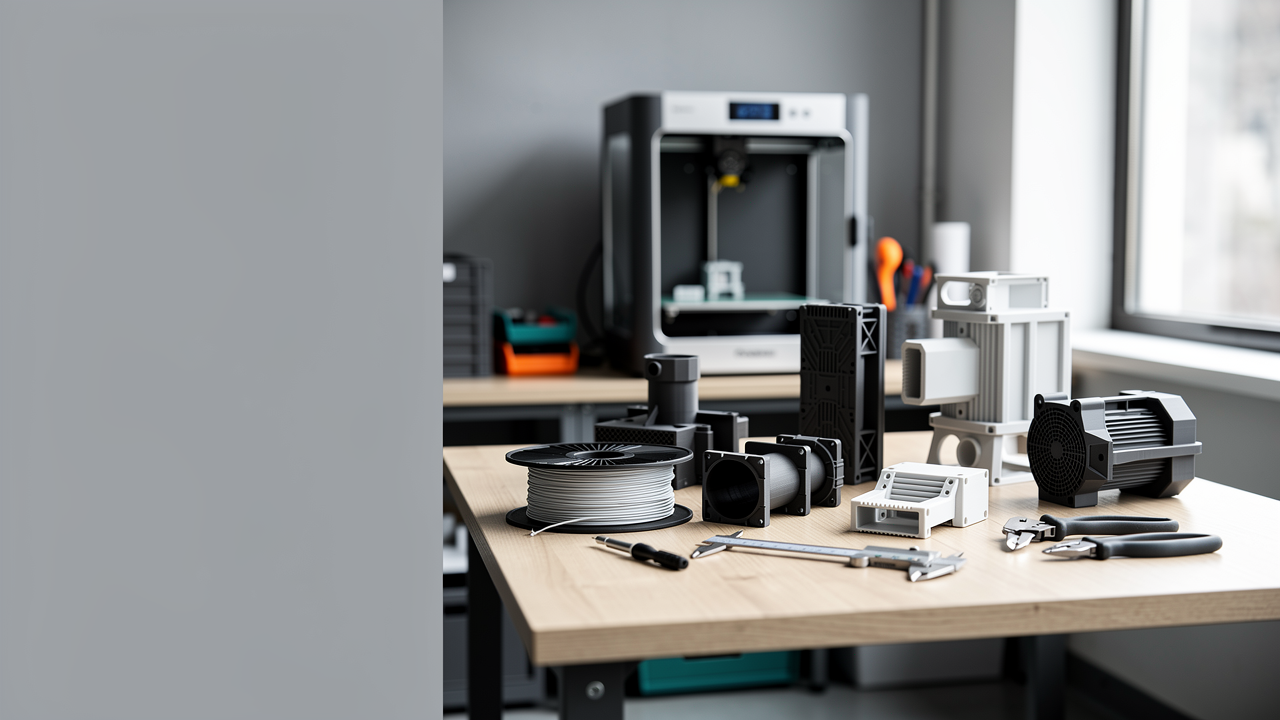

Why Lincsolution’s 3D-Printed Heat Pump Parts Move Matters: Mass Production and Miniaturization Are Now on the Same Agenda
The launch of South Korea-based Lincsolution’s new research into 3D-printed heat pump parts may at first seem like just another industry R&D story. But the real significance of the news is that 3D printing is now being considered not only at the prototype bench, but also for components in energy equipment that are moving closer to mass production. According to VoxelMatters’ report dated 17 August 2026, the company is focusing on developing manufacturing technologies for next-generation heat pump parts within an international research project supported by the Korea Institute of Energy Technology Evaluation and Planning.
The key point here is the direct emphasis on mass production capability and miniaturization. Heat pumps require precise part design in areas such as fluid routing, housings, connections, airflow, and ease of assembly. In systems like these, 3D printing stands out especially for its geometric freedom, low-volume trial production, and fast revision capability. For Ucuz3D readers, this development is not just news about major industrial players; it shows that a product development approach built around more compact designs, faster validation, and application-specific adaptation when needed is gaining strength.
Why is it important now?
According to the framework presented in the report, South Korea aims to significantly increase heat pump installations in residential heating in order to move away from fossil fuels. As demand grows, manufacturers face two classic problems: cost and part optimization. This is exactly where 3D printing can step in, first at the prototype stage and then in production preparation for specific components. Especially for assembly aids, custom-geometry parts that guide flow, test fixtures, and low-volume transition series, 3D printing service is becoming a faster decision-making tool.
This news also shows that the solve it in CAD first, then move to tooling approach is gaining ground in energy equipment. In products like heat pumps, small geometry changes can directly affect layout, service access, or part count. In such cases, seeing several revisions quickly through an online 3d printing workflow can create a much more practical intermediate step compared with conventional manufacturing methods.
What is the practical meaning for Ucuz3D readers?
For many SMEs, the real question is this: what does this kind of news mean for me? The answer is clear: 3D printing is no longer only about presentation models or one-off demo parts. In energy, HVAC, and mechanical product development, prototype housings, connection brackets, test setups, assembly aids, and low-volume validation parts are becoming more important. If you also work in product development, using a price per gram approach to evaluate total cost in early-stage per-part trials often provides a more realistic starting point.
The critical lesson here is this: the road to mass production often does not begin directly with tooling. First comes functional validation, then assembly trials, followed by revisions suitable for field testing. In this chain, 3D printing allows the product team to see more variations in less time. Especially in applications with expectations for temperature resistance, rigidity, and chemical durability, choosing the right material is also crucial. That is why the issue is not only the printer itself, but also being able to build a test strategy with suitable engineering materials.
Mass production does not mean every part will be 3D printed
At this point, it is important not to overstate the case. The VoxelMatters report does not yet make clear which parts Lincsolution will move into production or through which processes. So for now, it would not be correct to conclude that heat pumps will be produced entirely with 3D printing. A more accurate reading is this: manufacturers are putting additive manufacturing on the table much more seriously for certain complex and high-value components. That alone is important, because the role of 3D printing in product development, testing, and small-batch production for selected parts is becoming increasingly visible.
In short, the Lincsolution news shows that 3D printing is moving into a new area of use in energy equipment: smaller, more optimized, and faster-validated part development. For Ucuz3D, this means growing demand for more informed part development, from functional prototypes to pre-production technical parts. Source: VoxelMatters, 17 August 2026.


 Türkçe
 العربية
 Русский
 فارسی
فارسی Deutsch