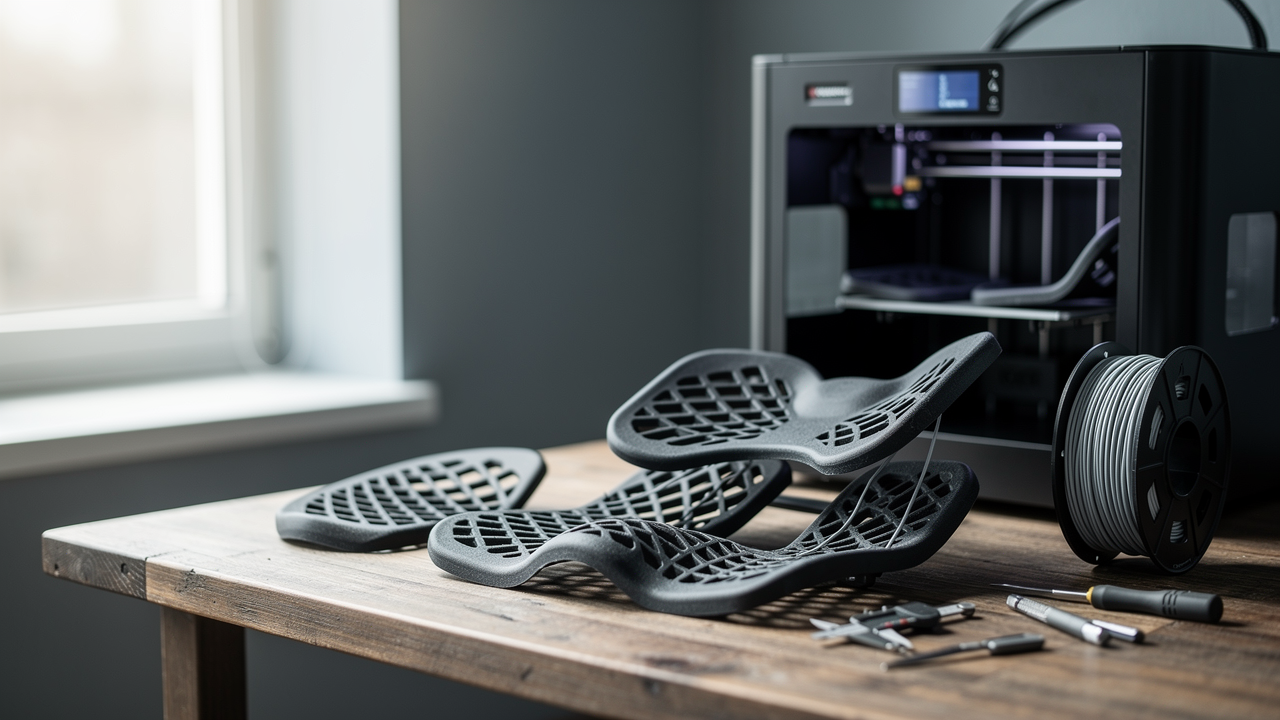

Why Is a Custom 3D-Printed Wheelchair Cushion Important? Kalogon Verro Strengthens the Logic of Body-Specific Support
For wheelchair users, seating support is not only a matter of comfort; it is also a critical issue in terms of posture, pressure management, daily usage time, and long-term fit. According to 3D Printing Industry’s report dated July 24, 2026, Kalogon introduced its custom cushion series called Verro. The report especially emphasizes that, for users with complex postural needs, standard multi-density or contoured cushions cannot always provide a sufficiently precise fit.
For the Ucuz3D reader, the important side of this development is that 3D printing once again delivers a clear advantage in an area that requires “custom geometry.” Because the issue here is not simply producing a part; it is being able to define different firmness levels, different support points, and different relief zones for each user.
What is different about the Verro approach?
According to the information in the report, Verro’s standout version uses a variable-density 3D-printed elastomer lattice structure. In other words, every point on the cushion surface does not have to behave with the same firmness. In areas that require more support, the structure can be made stronger, while in areas where pressure reduction is desired, it can be designed to be more adaptive. Compared with standard cut-foam structures, this logic offers the potential to create a more localized and more controlled support map.
Examples like this explain very well why the 3D printing service approach is increasingly seen as more valuable in made-to-measure solutions. Because while changing shape for each individual in traditional manufacturing often means extra molds, extra labor, or limited customization, creating regional differences through the digital model in 3D printing can turn into a much more natural workflow.
Why is this not just a comfort story, but a function story?
In Kalogon’s case, the issue is not only producing a “soft cushion.” The report states that the structure allows airflow, contributes to moisture and temperature management, and can also be lighter than average cushions. The ability for liquid to pass through the structure instead of collecting on the surface, along with easier cleaning, is also among the important details in medical-use scenarios.
The point to pay attention to here is this: not every 3D-printed structure automatically means medical suitability or universal superiority. The real benefit emerges together with the user profile, clinical evaluation, material behavior, and long-term usage conditions. However, the direction pointed to by the report shows that 3D printing in custom support products has now moved beyond the concept stage and into the logic of concrete products.
What lesson can we draw from this for Ucuz3D?
This report reminds us that the real value in custom manufacturing lies in geometry control. The same idea can also be seen in orthopedic supports, seating accessories, protective parts, components that improve grip ergonomics, and special equipment interfaces. A well-designed digital model can make many problems that are difficult to solve with mass-production logic much more manageable.
Material selection is another separate part of this work. As expectations such as flexibility, surface feel, shock absorption, or rigidity change, the right solution also changes. For this reason, when considering different application types, the general framework on our printing materials page can be useful for understanding which material class may stand out for which part.
What does this tell us about cost and decision-making?
In custom parts, total cost does not consist only of material consumption. Taking measurements, preparing the model, reducing repeat trials, and achieving a more suitable first result for the user also make a big difference. For this reason, in production decisions, it is necessary to look not only at the logic of price per gram, but also at the functional benefit provided by customization.
- Custom geometry is where 3D printing becomes a very powerful tool.
- Regional firmness control can provide more refined solutions than classic single-density parts.
- Low-volume production and jobs that require adaptation to the user highlight the logic of digital manufacturing.
- Correct modeling is often just as decisive as the material itself.
If you are also considering developing a custom part based on the body, hand grip, seating surface, or a specific usage habit, seeing the initial feasibility through the online 3D printing workflow can be a good starting point. Especially in one-off or low-volume projects, producing a part according to the need instead of forcing a standard product to fit often opens a much more sensible path.
In short, the Kalogon Verro report clearly shows why 3D printing remains powerful in medical and ergonomic products: custom shape, regional performance, and low-volume production meet at the same point. This also shows that 3D printing continues to be a serious design tool not only for prototyping, but also for functional products that come into direct contact with the user.


 Türkçe
 العربية
 Русский
 فارسی
فارسی Deutsch