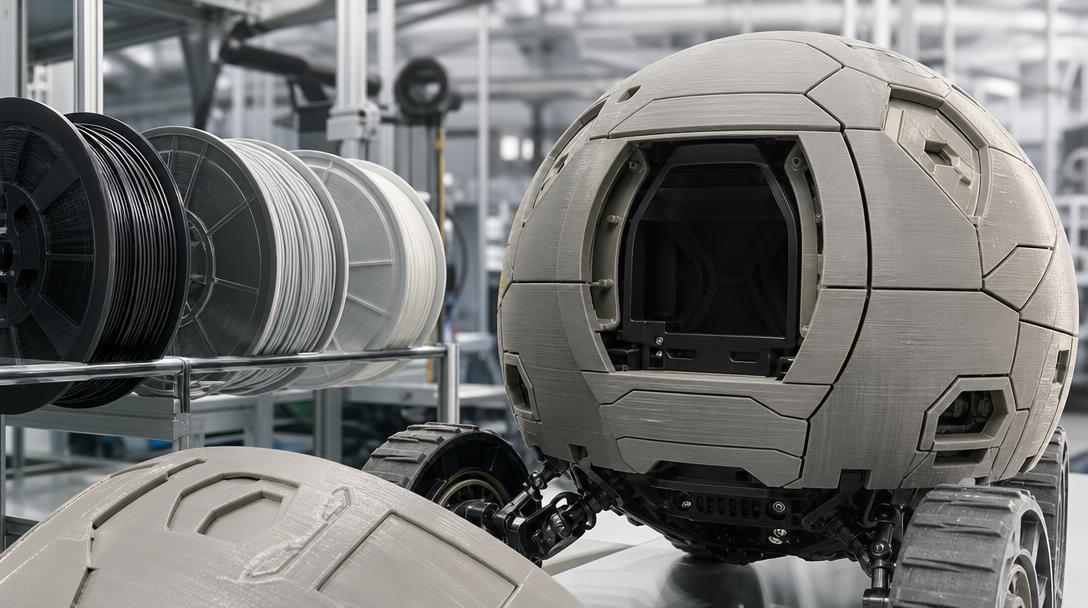

Why Xenia’s 3DF Filaments Are Drawing Attention in the ASTRA Scout Lunar Rover Project
According to VoxelMatters, based in Italy, in its report dated 7 August 2026, Xenia Materials is providing FDM/FFF filament support from its 3DF Materials series to ASTRA Team Polito at Politecnico di Torino. The news directly concerns the world of desktop and industrial extrusion-based manufacturing, because what is being discussed here is not just a concept visual, but a concrete material application aimed at reducing the weight of 3D-printed parts in a real rover structure.
Scout, which the ASTRA team is working on, is a lunar rover with a spherical body architecture. The filaments supplied by Xenia are being used to manufacture the segments that form the outer spherical shell of this structure. According to the first result shared in the report, a meaningful reduction in part weight was achieved without compromising performance. This point is especially important, because for parts produced with FDM, it is not enough that they are simply “printable”; mass, strength, and function must be balanced together.
Why does it matter?
For Ucuz3D readers, the value of this development lies in showing that 3D printing is no longer just a prototype showcase, but can create a serious difference in mission-focused parts through material selection. A lunar rover may sound very niche, but the logic being tested here applies to many engineering parts on Earth as well: a lighter yet sufficiently rigid body, more accurate performance with less material, and the right filament combination for the application.
For this reason, instead of simply saying “let’s print this” for a part, it is necessary to think from the beginning about what each material contributes. If you are preparing a similar functional prototype or a low-volume technical part, it makes sense to start by reviewing production options through 3d printing service and examining the options on the engineering materials page on the material side.
What is the main technical lesson highlighted in the report?
According to the information reported by VoxelMatters, the team is making use of recyclable thermoplastics, especially options such as ASA and nylon. These two materials do not stand out in the FDM world by chance. Since ASA can offer a favorable balance for outdoor use and UV resistance, it is often considered for shell-type applications, while nylon can stand out in jobs involving wear and mechanical stress. Of course, the final choice depends on geometry, wall thickness, print orientation, and real usage conditions; however, the report clearly reminds us of this: in functional parts, filament selection is an extension of the design decision.
Another critical point here is logistics. In the long term, the ASTRA team is exploring the idea of transporting raw material and producing spare parts at the point of need with 3D printing. Although this approach is being discussed for space today, it has a much more familiar equivalent on Earth: solving spare parts and low-volume manufacturing not from stock, but from a digital file. Especially in jobs where conventional mold investment makes little sense, getting a quick quote through the online 3d printing flow can significantly accelerate the transition from idea stage to prototype.
What should Ucuz3D customers take away from this news?
The first lesson is this: if weight reduction is the goal, material and geometry must be considered together. The second lesson: the real usage scenario should be defined early; will the part work outdoors, be exposed to impact, experience friction, or serve only for visual validation? The third lesson is that cost calculation should be based not only on kilograms, but also on the number of revisions avoided thanks to correct material selection. For this reason, during the quotation stage it is healthier to evaluate not only the total cost, but also the logic of price per gram together with the production scenario per part.
The Scout project is not yet a mass-production story; but that is exactly why it is instructive. Because it clearly shows us where FDM makes sense: when used with the right material, for the right task, and with measured expectations, it can provide very fast iteration and a tangible weight advantage. The space application may be in the headline, but the main takeaway is the same for everyday engineering and prototyping work: filament selection is not the final step of printing, but one of the most critical decisions at the beginning of the project.


 Türkçe
 العربية
 Русский
 فارسی
فارسی Deutsch