
How Many Walls Should You Use? What Most Determines Strength in an FDM Part
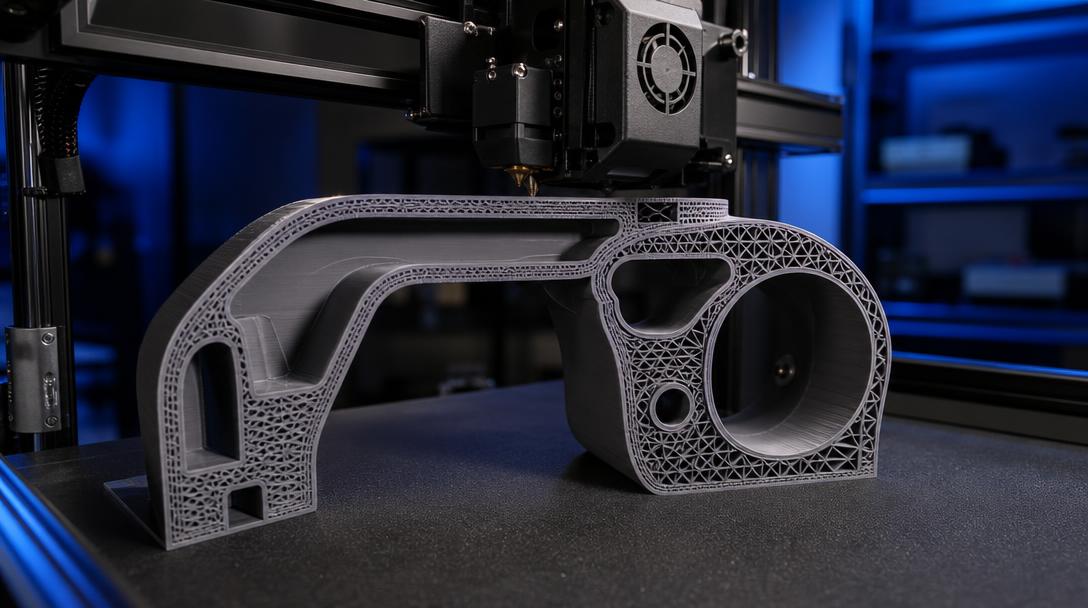
Wall count often affects part strength in FDM printing more than infill density does. That is because most of the load is carried by the outer shell; so if you want resistance against breaking, crushing, or deformation around screw areas, you should first set the wall count correctly.
Why is wall count so important?
In FDM printing, the printer forms the shell by going around the outer boundaries of the part several times. These layers are called “walls” or “perimeters.” Many users first increase the infill percentage to improve strength; however, in small and medium-sized functional parts, the real difference is often made by the wall count. The reason is simple: impact, bending, and clamping forces first reach the outer surface. The inside provides support, but the shell is the first structure that carries the load.
For example, if you are printing a cable clip, electronic enclosure, fixture foot, or small mounting part, using 4 walls instead of 2 may be more meaningful than simply increasing the infill density. Especially if you want to compare different scenarios before ordering, you can get an instant quote and quickly see how wall count affects print time and cost.
How many walls should be used for which part?
There is no single magic number; the right value depends on the function of the part. Still, there is a simple framework that works well in practice:
- 2 walls: visual prototypes, light decorative parts, low-load test prints.
- 3 walls: general-purpose enclosures, covers, light-duty fixtures.
- 4 walls: screw areas, clipped parts, functional products that are handled under pressure.
- 5-6 walls: durable parts exposed to impact, tightening, carrying, or continuous load.
The important point here is to think about wall count together with nozzle diameter. On a printer using a 0,4 mm nozzle, 4 walls mean roughly 1,6 mm of shell thickness. This is a good starting point for many functional FDM parts. If your goal is to get a real 3d printing service output for production use, you should define shell thickness according to the technical requirement instead of looking only at the infill percentage.
Should you increase infill density or wall count first?
If the part does not take a constant axial load or does not need to feel completely solid, increasing the wall count first usually gives more efficient results in most cases. For example, a part with 20% infill and 4 walls may perform more consistently than a part with 50% infill but only 2 walls. That is because a thin shell is more vulnerable to crack initiation no matter how high the internal infill is.
So you can think about the design decision like this:
- First, determine how strong the outer shell of the part needs to be.
- Then adjust the infill density according to total weight, print time, and material consumption.
- If necessary, locally reinforce critical areas such as screw holes, corners, and clips.
To better understand this logic, the guide in the Knowledge Center titled What Is Infill Density? Which Percentage Should You Choose? is also a good companion resource. Wall count and infill work together; but in most functional parts, priority belongs to the shell.
The most common mistake: using the same setting for every part
The most common mistake is leaving one single wall count in the slicer profile and printing every model with the same logic. However, a thin box lid and a load-bearing connector foot do not behave the same way. If areas around screws are breaking, clips are fatiguing quickly, or edges are crushing easily, the problem is often an “insufficient outer shell.” In that case, increasing infill alone may lead to unnecessary print time and filament use.
In short, wall count is one of the quiet but decisive settings behind strength in FDM printing. If you want to build the right balance between lightness, durability, and cost in your project, choosing the wall count consciously according to the part type is the best place to start.



 Türkçe
 العربية
 Русский
 فارسی
فارسی Deutsch