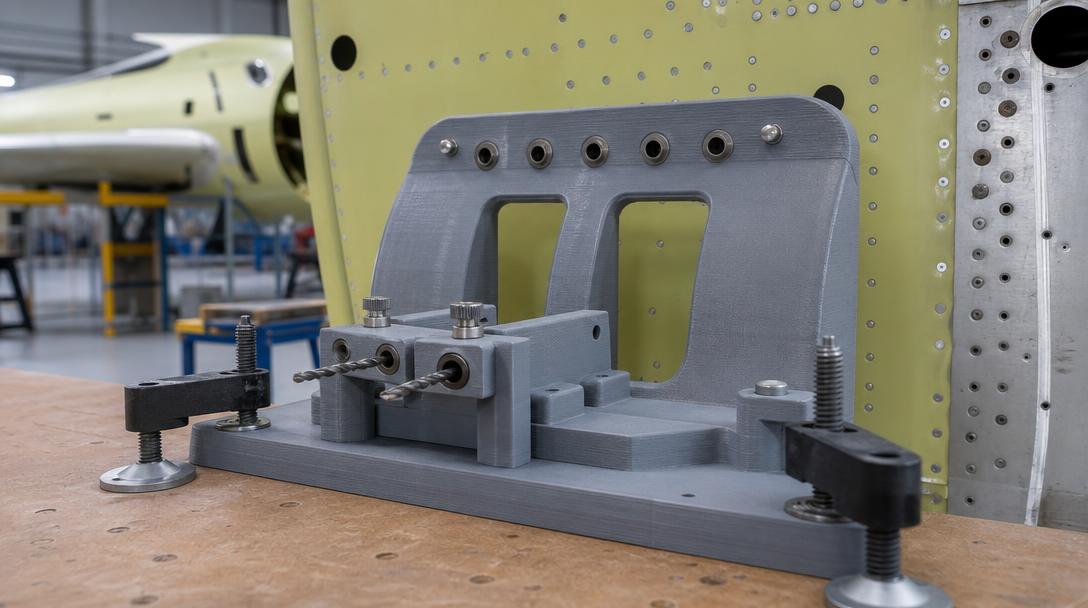

Why Boom Supersonic’s FDM Drill Guide Move Matters: Fixture Production Time and Cost in Aerospace Are Being Reconsidered
When people talk about 3D printing in aerospace, the conversation usually goes straight to end-use parts that actually fly. In reality, one of the areas that truly speeds up the production line is not the part itself, but the tools, guides, and fixtures that help produce that part. That is exactly why the news reporting that Boom Supersonic achieved a 92% cost reduction in drill guide production with Stratasys FDM technology matters. Source: TCT Magazine, August 7, 2026.
The key point in the report is that FDM can create a serious economic advantage not only for prototypes, but also for support equipment used in assembly and manufacturing processes. Parts such as drill guides may look small at first glance; however, they play a critical role in correct hole positioning, repeatability, and assembly accuracy. Especially in aerospace, where error tolerance is low, being able to produce this kind of support equipment quickly adds value not only in terms of cost, but also in terms of scheduling.
Why is this not just a cost story?
A 92% cost reduction is striking on its own; but the truly important aspect is its impact on production flow. Fixtures machined with conventional methods often require steps such as subtractive manufacturing, external sourcing, waiting for revisions, and remanufacturing. When the design changes, the tool usually has to be remade as well. FDM offers a more agile path here: the geometry is updated, a new guide is printed, it is tested on the shop floor, and if needed, it can be revised quickly. This approach creates a major advantage, especially in aerospace programs where time pressure is high.
At Ucuz3D, a similar logic often applies: not only final products, but also production aids, assembly templates, and low-volume tools are frequently handled through a 3D printing service approach. As part complexity increases or tooling costs for conventional methods grow, the decision is often based not on the unit part alone, but on the total process cost.
Why does FDM make sense here?
The value of this report for Ucuz3D readers is that it clearly shows where FDM shines in a real workflow. In drill guides and similar fixtures, what is usually required is not a mirror-like surface finish, but sufficient rigidity, dimensional repeatability, reasonable heat resistance, and short lead times. Depending on the need, PETG, ASA, ABS derivatives, or more technical engineering polymers can be selected. Especially when higher heat resistance, higher mechanical load capacity, or more controlled dimensional behavior is required, the engineering materials side should be considered.
This leads customers to a practical question: would a tool like this make more sense with CNC or with FDM? The answer depends on the application; however, for low-to-medium quantities, frequently revised fixtures, or tooling that needs to be deployed quickly, FDM is often a strong candidate. Especially at the quotation stage, the general logic on the affordable 3D printing prices page—namely the gram-based approach that varies according to material and production scenario—makes these decisions more transparent.
What is the lesson that comes down from aerospace to the workshop?
The Boom Supersonic example should not be read only as the success story of a major aerospace brand. The main lesson here is this: the value of 3D printing sometimes appears not inside the final product, but around the production system. Support elements such as drilling guides, assembly tools, inspection templates, cable-routing fixtures, or protective transport parts are among the areas where companies get the fastest return from 3D printing.
For this reason, many teams today transform support equipment first instead of jumping directly into serial production parts. That is because the risk is more manageable, the return is faster, and the learning curve is shorter. If you also want to see whether a similar part can be produced with FDM, you can upload your file and evaluate the initial suitability and production approach more quickly through the online 3D printing workflow.
Conclusion
The Boom Supersonic news shows that FDM stands out in aerospace not only with eye-catching end-use parts, but also with more invisible yet critical tasks that accelerate the production line. A 92% cost reduction will not be repeated exactly in every project; however, the main signal from the story is strong: when used for the right part, FDM can offer a serious alternative to conventional methods in fixture and guide production, both in terms of cost and agility. From Ucuz3D’s perspective, this is also an important example confirming that FDM use cases—from prototypes to production aids—are becoming increasingly more commercial and more tangible.


 Türkçe
 العربية
 Русский
 فارسی
فارسی Deutsch