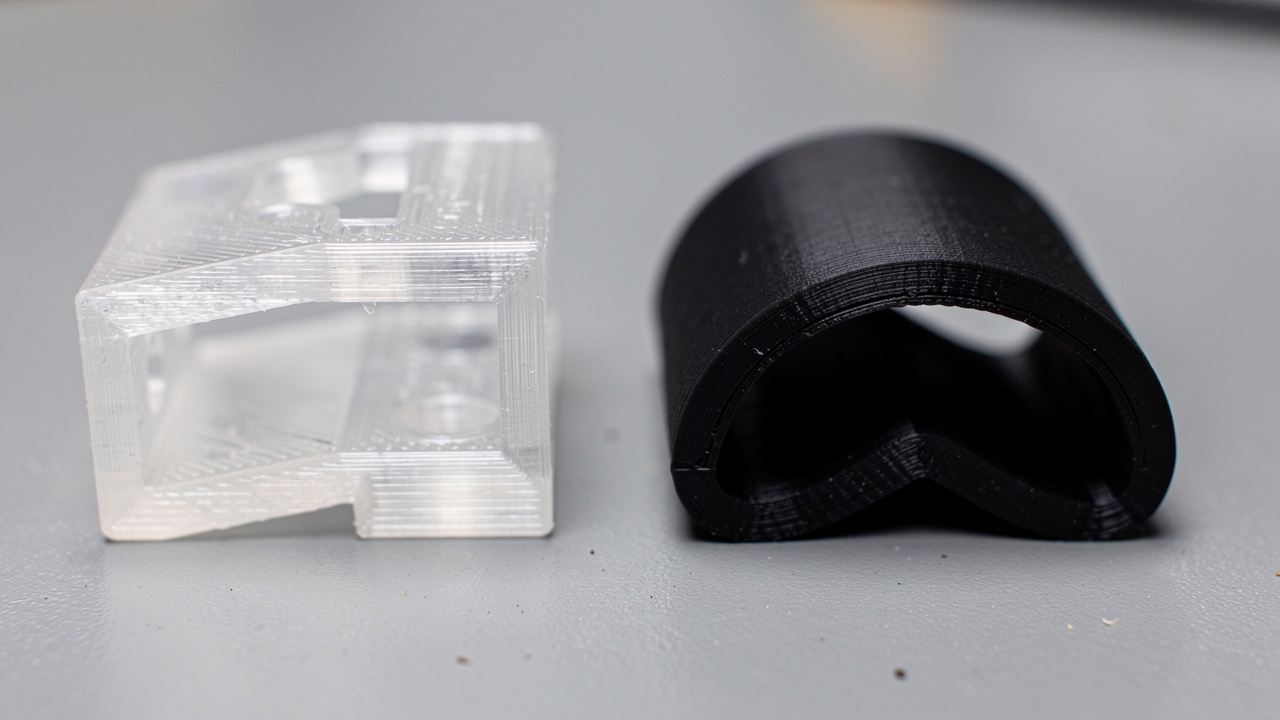

PETG or TPC? Which Is the Better Choice for Flexible but Wear-Prone Parts?
When there is a need for a flexible or semi-flexible part, many users think of TPU first; however, TPC can also be a serious alternative for certain jobs. So when PETG and TPC are on the table at the decision point, which one makes more sense? The short answer is this: if the part needs to keep its form, PETG is the better choice; if it will flex repeatedly and work under friction, TPC is the more suitable candidate. If you are considering getting a 3d printing service for a near-production prototype or a functional part, material selection affects the print result more than you might expect.
PETG is an FDM material widely used for everyday functional parts because it is tougher than PLA and slightly more resistant to heat. TPC, on the other hand, belongs to the flexible class; although it is not as common as TPU, it can stand out in some applications when more durable recovery and wear behavior are expected. Seeing different FDM options together on Ucuz3D’s our printing materials page makes this distinction much clearer.
What is it good for, and what is it not good for?
PETG is a strong choice for boxes, covers, fixtures, cable holders, enclosures exposed to light impact, and everyday parts that need to maintain their dimensions. If you want a part to feel somewhat tough but do not want it to behave like rubber, PETG makes sense. On the other hand, it is not ideal for constantly bending hinge-like structures, vibration-damping feet, or soft contact surfaces that operate through friction.
TPC stands out in parts that need flexibility, are expected to absorb impact, or require softer contact with a surface. It can offer advantages in cable sleeves, protective bumpers, flexible connectors, or certain technical parts exposed to repeated movement. However, using TPC instead of PETG for rigid corners, hard mounting tabs, or box-type parts that need to preserve their form with millimetric accuracy is usually not the right choice.
Outdoor use, heat, and impact performance
For outdoor use, PETG is generally a more practical choice for short- and medium-term needs. It is not overly sensitive to moisture and remains calmer under heat than PLA. Still, if there is prolonged sun exposure and high heat load, it is not correct to see PETG as a material for every condition. On the TPC side, flexibility is an advantage; however, because outdoor performance can depend heavily on the product formulation, it is difficult to declare a universal superiority.
In impact behavior, the two materials work differently. PETG behaves in a tough way under impact; in other words, it works well when a rigid part needs to take some load without breaking. TPC, by contrast, can absorb impact and provide damping through deformation. For this reason, a rigid enclosure and a soft bumper are not the same thing; material selection here should be made by looking directly at the use scenario.
Rigidity, flexibility, and ease of printing
If you want rigidity, PETG is by far the safer side. It holds its form better in parts such as screw areas, clip slots, desktop fixtures, or electronic enclosures. The area where TPC is strong is controlled flexing and repeated bending. If the part should bend slightly in your hand, conform to a surface, or reduce vibration, TPC becomes the more meaningful option.
In terms of ease of printing, PETG is generally more accessible as well. Because TPC belongs to the flexible material class, it can be more sensitive to printer setup, filament path, and print speed. That is why it is necessary to think not only about the cost per kilogram of material, but also about the number of trials and the production risk. Before placing an order, it is useful to understand the logic of price per gram; because with flexible materials, reaching the right part sometimes shows that material is not the only variable.
Which one for which part?
If your target is an electronics box, protective cover, fixture, hanger, support bracket, or an everyday functional enclosure, think of PETG first. If your target is a protective bumper, flexible sleeve, soft contact part designed to work through friction, or an element that will bend again and again, look at TPC. If your design file is ready, comparing the production approach for the two materials in the online 3d printing workflow also makes the decision easier.
In short, PETG is positioned on the side of the “semi-technical and everyday functional rigid part,” while TPC belongs more to the side of the “flexible part expected to show slightly more technical behavior.” If your part does not truly need to flex, moving up to TPC is often unnecessary. But if a prototype printed in PETG feels too rigid in the hand, does not conform to the surface, or cannot absorb impact, then TPC may be the better answer.




 Türkçe
 العربية
 Русский
 فارسی
فارسی Deutsch