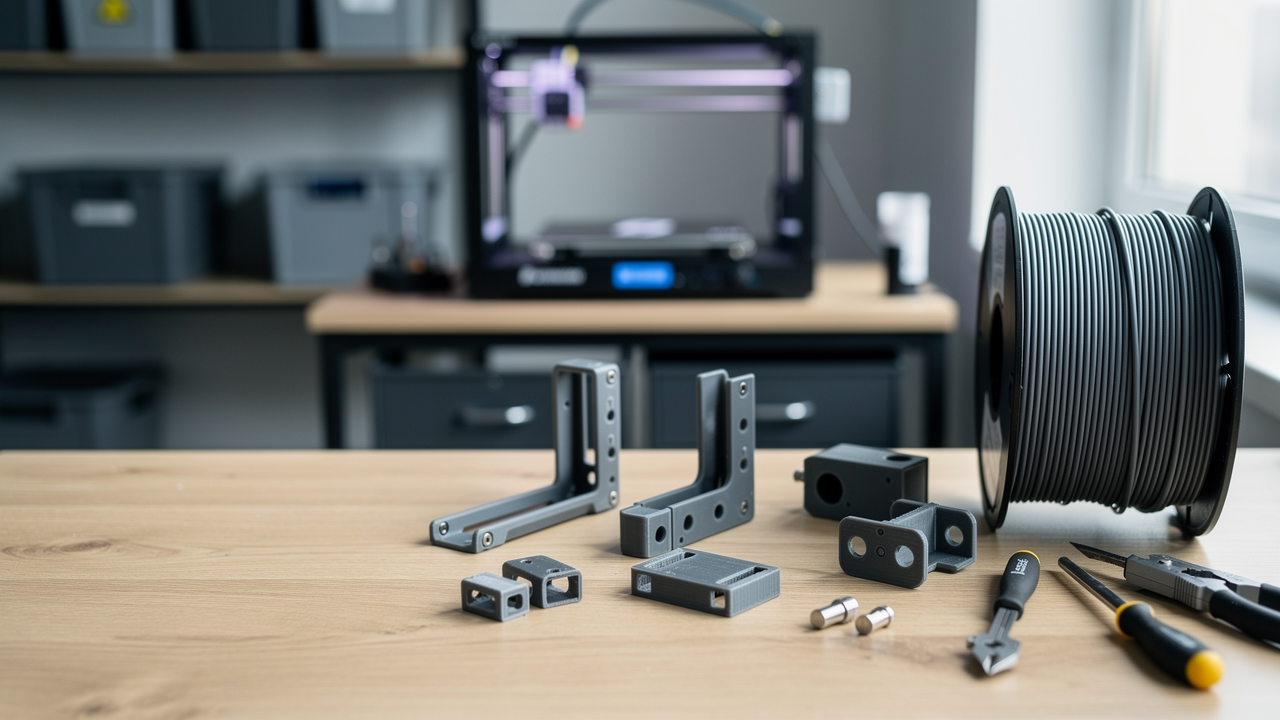

Why TOM’s Open-Source 3D Printing Model Matters: Accessibility Is Growing in Assistive Devices with Desktop FDM
The biggest problem in assistive devices and personalized support products is often not a lack of technology, but a lack of access. The interview focused on Tikkun Olam Makers (TOM), published by 3D ADEPT Media on August 18, 2026, clearly shows why desktop FDM printers can fill this gap. According to the article, TOM has developed more than 1,200 open-source solutions in 36 countries, doing so through an accessible manufacturing mindset instead of expensive, closed production chains.
For the Ucuz3D reader, the key point is this: The model here clearly explains how 3D printing becomes truly meaningful not only for prototypes, but also for low-volume functional parts with real practical value. If a part varies from person to person, needs rapid revisions, and waiting for conventional supply makes no sense, the 3D printing service approach offers a serious advantage here.
Why is the emphasis on desktop FDM important?
According to the model described by TOM founder Gidi Grinstein, the focus is not on expensive industrial systems, but on accessible desktop FDM printers. The organization wants solutions to be manufacturable, as much as possible, within small and widely available print volumes. The reason is simple: The more printers a solution can be reproduced on, the faster it can spread.
This approach is also familiar from the Ucuz3D perspective. In many parts, the real value is not theoretically having the most advanced technology; it is being able to iterate the part quickly, get user feedback, and, if needed, produce the next revision immediately. Especially for hand-grip aids, adapters, simple stabilizers, holders, and maintenance tools, the online 3D printing workflow can significantly shorten the decision process.
Why does material selection stand out in the article?
The interview shows that TOM especially relies on materials such as PLA, TPU, and high-quality PETG for use cases suitable for food contact. This matters because accessibility is not only about the price of the printer; the material also needs to be available, repeatable, and manageable. In short, the issue is not the “most exotic material,” but choosing the right material for the need.
For example, PLA or PETG may make sense for a rigid assistive part that needs to be produced quickly, while TPU may be more suitable for parts that touch the skin, absorb impact, or need slight flexibility. These decisions depend directly on the function of the part; here, the general framework on the our printing materials page makes selection easier. On the cost side, instead of memorizing exact figures, it is more accurate to know that the job changes according to weight, geometry, and print time; that is why seeing the price per gram logic is often healthier.
What does this news say about use cases in Turkey?
This development is another reminder that 3D printing is not only about “printing a part.” The real value lies in making small needs visible and filling the gap that standard manufacturing cannot solve. Assistive devices, personalized handles, add-on parts that make access easier, or simple support products used around rehabilitation all fall into the category of low-volume but high-benefit production.
There is also a second contribution from the open-source approach here: the design does not remain tied to a single factory. A part can be tested and revised in the field, then produced again in another city using the same logic. This strengthens the distributed manufacturing side of 3D printing. Especially for teams working in maintenance, education, medical support, and accessibility, this could mean more demand for local manufacturing in the future.
What is the takeaway from the Ucuz3D perspective?
The TOM example makes one thing clear: In assistive technology, the winning approach is not the most expensive system, but the combination of the right material, repeatable design, and fast production. This is exactly where the real power of desktop FDM appears. If an idea can turn into a prototype on the same day and then into a ready-to-use part in a short time, 3D printing is no longer only a testing tool, but a manufacturable production method that can be chosen with confidence.
For this reason, in accessibility-focused projects, manufacturability is just as important as technical perfection. TOM’s model is genuinely noteworthy because it shows how practical an impact open-source design and FDM production can create when they work together.


 Türkçe
 العربية
 Русский
 فارسی
فارسی Deutsch