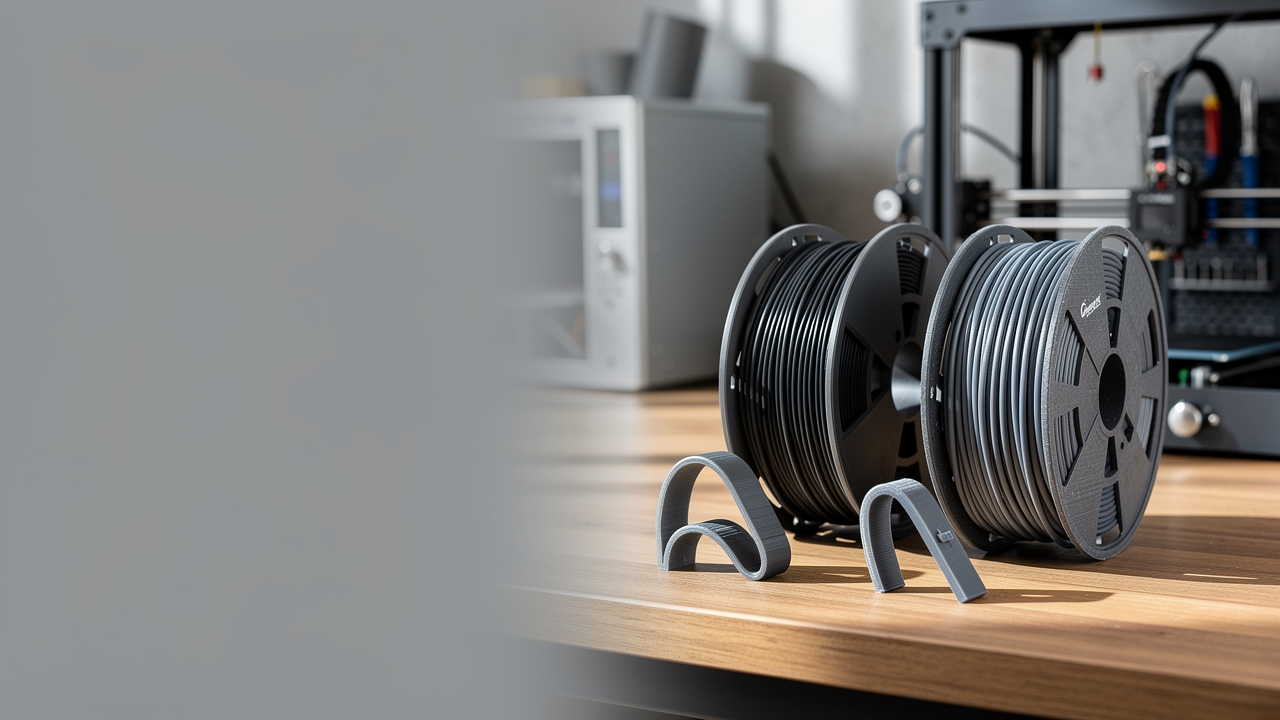

ASA or TPU? Are You Printing a Rigid Outdoor Fixture or a Flexible Protective Part?
ASA and TPU are two FDM materials that may come up in the same project, but in reality they solve very different problems. One stands out for rigid parts that keep their shape outdoors, while the other is better for parts that need to absorb impact and flex. So when making your decision, you should look beyond strength alone and consider whether the part will stay under the sun, take impact, and need to be rigid or flexible. If you are planning production for a prototype or an end-use part, material selection on the 3D printing service side directly affects the final result.
The first distinction is very clear: ASA makes sense for rigid outdoor parts that must hold their shape, while TPU becomes meaningful for protective, cushioning, and gripping parts that require flexibility. In other words, ASA is the better choice for a sun-exposed box foot, an outdoor sensor enclosure, or a fixed mounting bracket. By contrast, TPU usually gives better results for a flexible intermediate part such as a cable grommet, an impact-absorbing bumper, a protective sleeve that touches a foot, or a vibration-damping pad. This is exactly why the same model can behave completely differently with ASA and TPU in an online 3D printing workflow.
When does ASA stand out?
ASA is one of the materials often mentioned when outdoor durability is discussed. Against UV light and weather conditions, it behaves more reliably than standard materials mainly intended for indoor use. It is also much more sensible than TPU for parts that see some heat but still need to keep their shape, because TPU deforms under load due to its soft structure. ASA stands out in scenarios such as brackets, covers, enclosures, fixed mounting tabs, and parts inside a vehicle that may be exposed to sunlight but must not flex.
But ASA is not the right choice for every job. It is not as suitable as TPU for parts that need to absorb impact, make soft contact with a surface, or show elastic behavior such as a tight snap fit. It is also not considered as easy to print as PLA or PETG; enclosed build volume, temperature control, and warping management are often more important. For that reason, if multiple trial runs are expected or the part behavior is still unclear on the customer side, the job should be evaluated not only with a price per gram mindset, but also by considering the risk of reprinting.
When is TPU the better choice?
TPU is strong where flexibility and impact absorption are needed. It offers major advantages in items such as phone-like cases, feet, bumper parts, cable protectors, vibration-reducing blocks, and some functional parts that need a light interference fit. Where a rigid material might crack or create a knocking sound, TPU can provide safer and more comfortable performance. This difference is especially clear in parts that come into contact with the user or hit the ground.
On the other hand, TPU is not always automatically the best choice for outdoor use. It can be used in sun-exposed environments, but the main decision criterion here is not UV resistance; it is whether flexibility is truly necessary. That is because printing a non-flexible mounting part in TPU can compromise the part’s function. Also, if you expect high rigidity, sharp dimensional stability, and shape retention when a screw is tightened, ASA is the more logical choice. TPU printing also requires care in its own way; depending on the material’s flow behavior and the geometry, the printing process may become slower.
Which one is more suitable for which part?
- ASA: outdoor enclosure, fixed fixture, sun-exposed mounting part, rigid cover, technical part that must keep its shape
- TPU: bumper, foot, gasket-like flexible detail, vibration-absorbing part, grip surface, protective element exposed to impact
From a cost perspective, looking only at raw material is also incomplete. TPU can sometimes deliver the right part on the first try with a lower risk of breakage, while ASA can reduce the total cost of repeats by providing a longer service life outdoors. So the real decision should be based not on memorized per-part pricing, but on the actual use scenario. If you want to see different functional and engineering-focused options together, our printing materials page is a good place to start.
In short: if the part needs to stay rigid, be exposed to sunlight, and keep its dimensions, ASA makes more sense; if the part needs to flex, absorb impact, and feel softer in user contact, TPU is the better choice. In uncertain cases, evaluating the same model in both materials makes it easier to make the right decision both in 3D printing service planning and at the instant quote stage.


 Türkçe
 العربية
 Русский
 فارسی
فارسی Deutsch