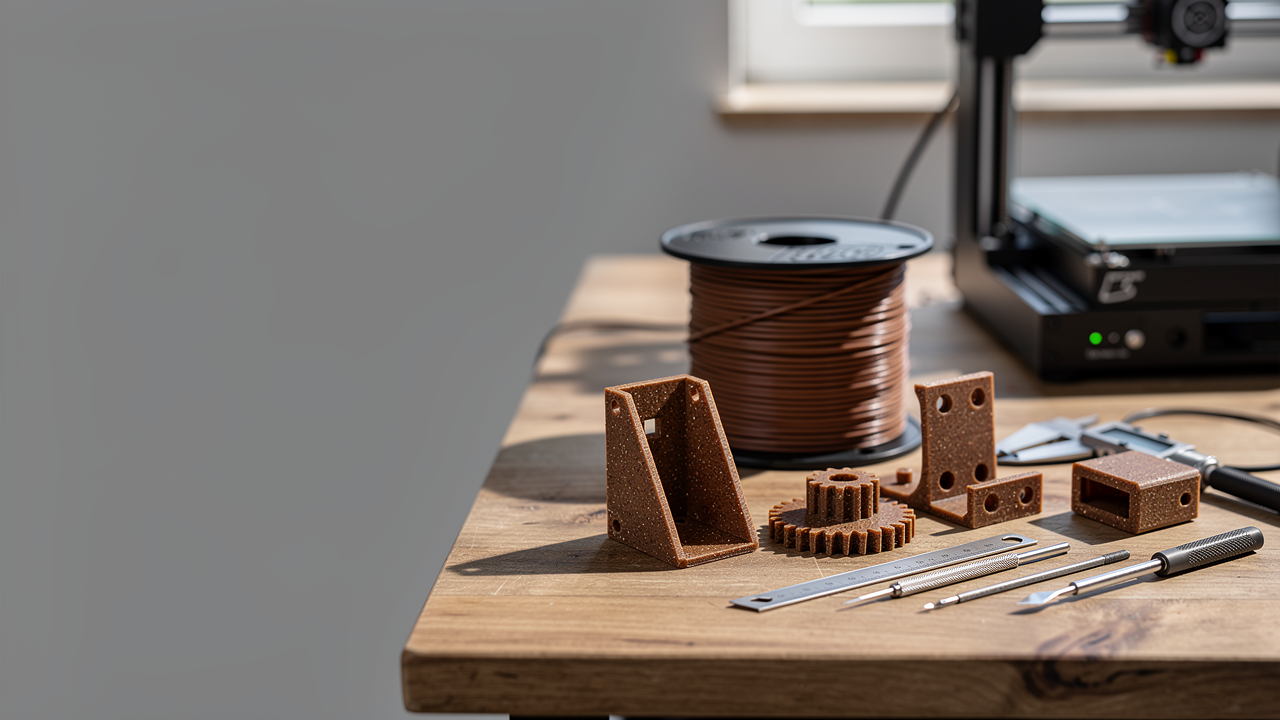

Why Is eSUN PLA-Coffee Getting Attention? How New PLA with Coffee Waste Additive Could Affect Surface Feel in FDM Printing
Sustainability claims have been common on the FDM filament side for a long time; however, not every new material offers the user a tangible difference. In that respect, eSUN’s PLA-Coffee announcement dated July 30, 2026 deserves a closer look. The company says its new PLA filament with recycled coffee grounds additive can stay close to a standard FDM workflow while also offering a more matte, more natural surface character. If you want your prototype or presentation part not to “look like plastic,” material developments like this become directly important. When evaluating the balance between function and appearance, material selection on the 3D printing service side is therefore not only a matter of strength.
The core claim of PLA-Coffee is that by adding upcycled coffee particles into PLA, it produces a surface with more natural tones, softer reflections, and a visual effect that can hide layer lines a little better. A summary published by Electronics For You on August 6, 2026 also states that this material is intended to be compatible with most FDM printers, while promising a matte surface and good layer adhesion. On paper, this opens an interesting space especially for showcase prototypes, decorative objects, concept models, and desktop product presentations.
Why does it matter?
For the Ucuz3D reader, the real value lies not so much in the material’s “eco” label, but in what it adds to the print result. One of the most common aesthetic issues in FDM is that layers can look overly plastic under light. According to the information shared by eSUN, the coffee particles alter light diffusion, creating a more diffuse reflection and giving the surface a micro-matte appearance. If this claim proves consistent in practice, it could become an option that reduces the need for paint and surface finishing, especially in early prototypes meant to present a product idea.
An important boundary should be drawn here: PLA-Coffee is still a PLA-based FDM material. In other words, it should not be thought of as real wood, composite board, or a high-heat engineering plastic. Its value shows up more in visual character, presentation feel, and the waste-added material approach.
What kinds of jobs could it make sense for?
This kind of filament seems most suitable for concept mockups, decorative desktop products, boxes and stands where natural tones are desired, cafe-retail themed presentation objects, and prototypes where you want to avoid an “overly shiny plastic” look. It can be especially advantageous in designs seeking earth tones, a matte surface, and a warmer perception. For those who want to review general material options, the our printing materials page is also a good starting point.
On the other hand, this material should be evaluated more cautiously for functional parts that will stay outdoors for long periods, be exposed to in-car temperatures, or operate under high impact. That is because a sustainability additive and an aesthetic surface do not, by themselves, mean higher heat resistance. At this point, it is healthier to separate the part requirement into “it should look good” and “it should carry load.”
What does it suggest on the production side?
According to the recommendations cited in the news, the material is offered in 1,75 mm format and is intended for use close to standard PLA. This is important, because many special-look filaments may be a good idea but can make the printing process unnecessarily difficult. If PLA-Coffee truly offers broad printer compatibility, it could fall into the category of “special material, but low surprise” for decorative and short-cycle prototyping. That shortens decision time in small-batch trials and presentation parts. When comparing printing cost, instead of memorizing fixed numbers, it is again more accurate to evaluate it with a price per gram logic.
The practical meaning from Ucuz3D’s perspective
This announcement shows that the FDM material market is continuing along two directions: on one side, more technical and higher-performance filaments; on the other, special PLA variations that improve appearance and user feel. PLA-Coffee belongs to the second group and may stand out especially in projects where presentation quality matters but resin or extensive post-processing is not desired. If you are looking for a natural tone, a matte surface, and a different material story for a model, it is important to mention this at the ordering stage. For this kind of work, writing the intended use in the online 3D printing flow or noting your visual expectation while getting an instant quote directly makes it easier to move toward the right material.


 Türkçe
 العربية
 Русский
 فارسی
فارسی Deutsch