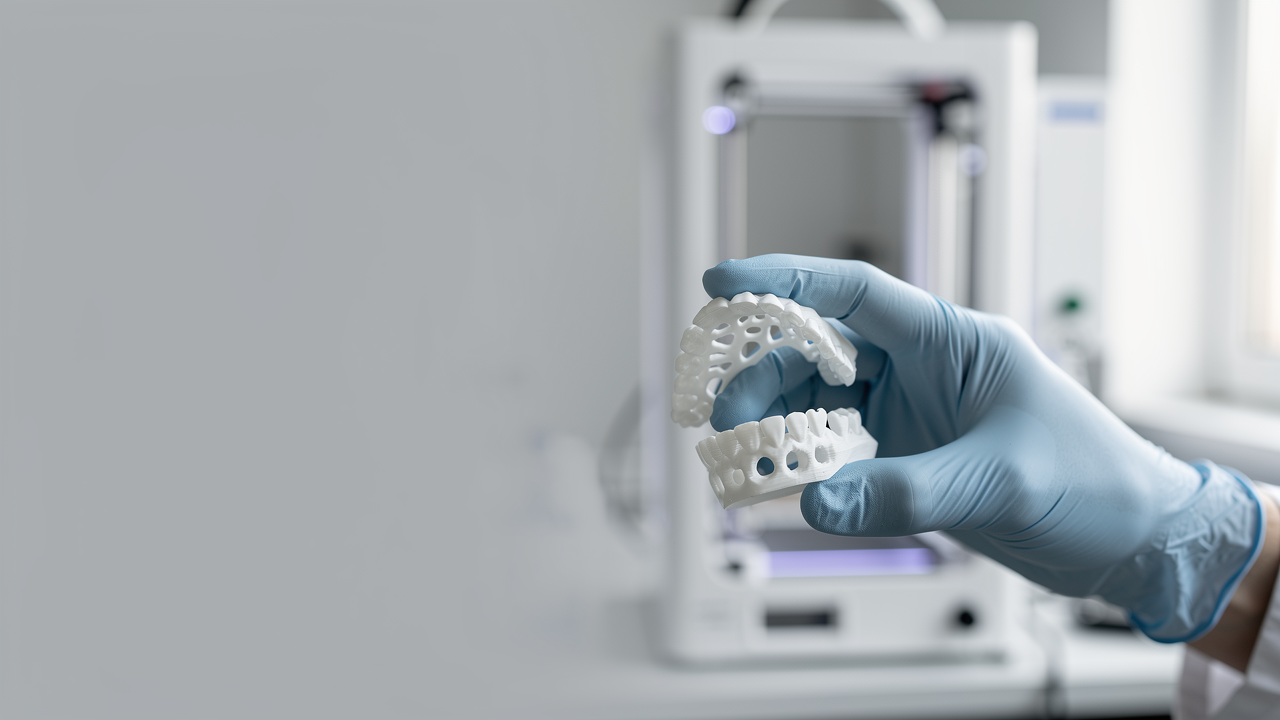

Why Is Adelaide University’s 3D-Printed Dental Training Model Project Important? Patient-Specific Surgical Rehearsal Is Entering a New Phase
The new project shared on August 18, 2026 by Adelaide University, Fusetec, and the Additive Manufacturing Cooperative Research Centre clearly shows why medical 3D printing is growing on the training side. Reported by VoxelMatters, this work aims not only to produce a model that replicates dental anatomy, but also to simulate more realistically how teeth, jawbone, and soft tissue behave during a procedure. This means that, especially in complex extraction and surgical preparation processes, the gap between a “purely visual model” and a “rehearsal close to real intervention” is getting smaller.
For the Ucuz3D reader, the key point is this: 3D printing is no longer just a tool for producing mock-ups, prototypes, or simple training objects. It is also becoming a much more serious tool for functional preparation models that improve decision-making and execution confidence. This approach is particularly noteworthy for teams that want to understand patient-specific geometry, see the access angle before an operation, or test how a specific part may behave when fractured.
Why is it important?
The standout difference in the project is the goal of using multi-material production not just for “color difference,” but to make tissue behavior more realistic. In current training models, it is possible to see the anatomy, but tissue behavior during cutting, fracture, or resistance often remains limited. The Adelaide team aims to develop more biomimetic models by combining clinical imaging, digital modeling, and multi-material production in the same workflow. This kind of approach could make repeated practice in training far more valuable.
This news also shows that 3D printing is moving beyond the job of “making a single part” and shifting more toward process validation and application preparation. The same logic can also be seen in surgical planning, assembly rehearsal, custom fixture development, and low-volume functional model production. If you also want to verify the form, accessibility, or use scenario of a part in your own project, a professional 3d printing service can significantly shorten the time from file to finished part.
What does this news mean from Ucuz3D’s perspective?
Not every medical application is produced with exactly the same manufacturing method, but the main message of this news is very clear: when the right geometry, the right material behavior, and rapid iteration come together, 3D printing creates real value in training and preparation processes. This logic applies not only in healthcare, but also in product development, spare part validation, fixture preparation, and user-specific devices.
For example, in some projects, a low-risk geometry validation is needed first, and only then is there a move to a more rigid or more technical material. That is why material selection is at the center of the job. To see the general options, it may make sense to look at the our printing materials page, and to compare options focused more on strength and temperature resistance, the engineering materials section may also be useful.
The real lesson: rehearsal costs are falling, decision quality is improving
The real value of the Adelaide University project is that it reduces the “cost of learning” before a part that will reach the end user is made. Being able to move a process that may be difficult, expensive, or risky in real life onto a model first can help teams practice more, spot errors earlier, and increase confidence in execution. One of the strongest aspects of 3D printing is already here: not promising perfect production in a single attempt, but accelerating the test-and-improve cycle.
For this reason, whether the file is ready or not, producing a validation model of a part first is often the right step before final production. To understand the combined effect of variables such as part size, infill, material, and quantity, it is useful to examine the logic of price per gram; and on the fast quoting side, using the instant pricing flow makes the process more practical.
Conclusion
This step by Adelaide University, Fusetec, and AMCRC tells us more than just another eye-catching medical 3D printing technology story. The real message is that as patient-specific training and surgical rehearsal models become more realistic, the value of 3D printing as a decision-support tool is increasing. From the Ucuz3D side, we can read it like this: a good 3D printing job does not only produce a part; it also improves design, preparation, rehearsal, and execution quality.


 Türkçe
 العربية
 Русский
 فارسی
فارسی Deutsch