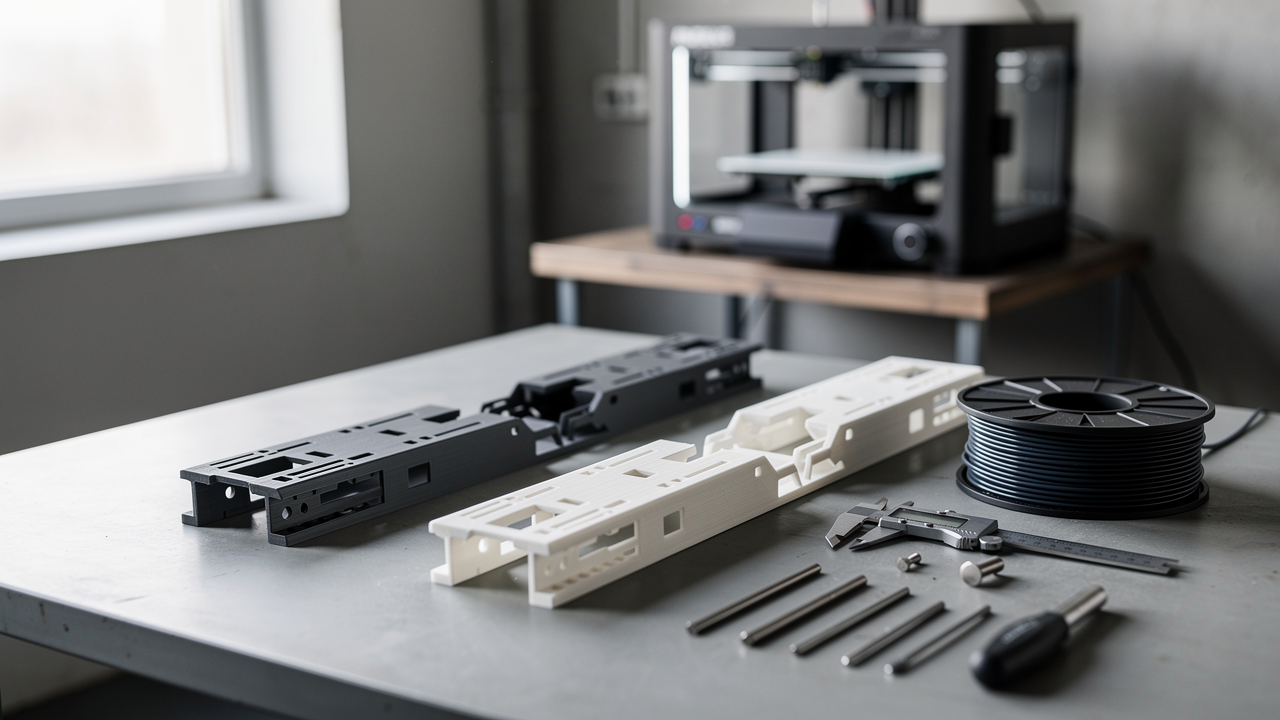

Why HÖRMANN’s 3D-Printed Rail Exterior Panels Matter: Granule Extrusion Challenges Mold Costs in Small Series
HÖRMANN Vehicle Engineering GmbH (HVE) announced that it has developed a new production chain centered on 3D printing for large exterior body parts of rail vehicles. According to TCT Magazine’s August 19, 2026 report, the workflow developed within the 3D-FiberTrain project combines granule-based extrusion, load-path-oriented reinforcement placement, and automated machining steps. Siemens Mobility’s Velaro MultiSystem high-speed train family was used as the reference platform, and the technology was validated with the nose and front skirt components.
For Ucuz3D readers, this news does not simply mean that “a large train part has been printed.” The real point is that an area of traditional composite manufacturing that normally requires high mold costs, long preparation times, and intensive manual labor is being rethought through extrusion-based 3D printing. Especially in low- and medium-volume production, mold costs can inflate the total budget very quickly, so mold-free or low-preparation-cost manufacturing methods can make a serious difference.
Why is this strong news?
Rail exterior panels are not ordinary showcase parts. They are large, geometrically complex, exposed to high environmental loads, and subject to serious validation expectations. That is why the approach shared by HVE matters: it positions 3D printing not only for prototyping, but within a functional, large-format composite part workflow. The report specifically highlights the search for an alternative to traditional methods such as thermoset-based hand lay-up and vacuum infusion.
The critical advantage here is that granule-based extrusion can handle large geometries with a more flexible production logic. Then, adding targeted reinforcement in high-stress areas and achieving final dimensions through automated subtractive machining shows that this is not “printing alone,” but the creation of a real manufacturing chain. That turns the story from a simple showcase into an application example much closer to real industrial use.
What does it mean from Ucuz3D’s perspective?
In Ucuz3D’s day-to-day workflow, most parts may not be as large as a train nose, but the underlying decision logic is the same: as part quantities decrease and geometry becomes more customized, mold and fixture costs become relatively more critical. That is why 3D printing becomes especially meaningful for custom covers, exterior-surface fixtures, housings, jigs, and low-volume functional panels. For users who want to outsource production, this is also where the value of the 3d printing service approach becomes clear; decisions can be made on a per-part basis without investing in molds.
The report emphasizes cost advantages and a lower carbon footprint for small and medium series. These two points should be considered together. 3D printing may not always be the cheapest method; however, once tooling cost, revision needs, and lead time are taken into account, the picture can change. For that reason, from the user side, pricing should be evaluated not only through raw material cost but through the logic of the total process. This is why the affordable 3d printing prices approach is meaningful for understanding part-based budgeting.
Takeaway for FDM and large-format production
This development is another reminder that extrusion-based 3D printing should not be seen only as a desktop prototyping tool. Granule-fed systems can open a different lane in terms of material economy and production speed for large parts. Of course, producing a rail panel with desktop FDM is not the same thing, but the core principle does not change: manufacture complex geometry without molds, accelerate iteration, and update the design for each specific part when needed.
Especially in engineering-focused projects, material behavior, outdoor conditions, rigidity, and dimensional stability should be evaluated together. That is why, for functional parts, the engineering materials page is a good reference for understanding which class of material may be the right choice.
Conclusion
HÖRMANN’s 3D-FiberTrain work shows that 3D printing in rail systems is moving beyond the “mock-up and prototype” level toward large-format exterior parts. If workflows that reduce mold requirements in low- and medium-volume production become more widespread, the same logic could expand into more areas, from automotive to industrial covers. If you want to see whether a similar production approach is suitable for your own part, getting an instant quote is the most practical step for clarifying geometry and material decisions at an earlier stage.


 Türkçe
 العربية
 Русский
 فارسی
فارسی Deutsch