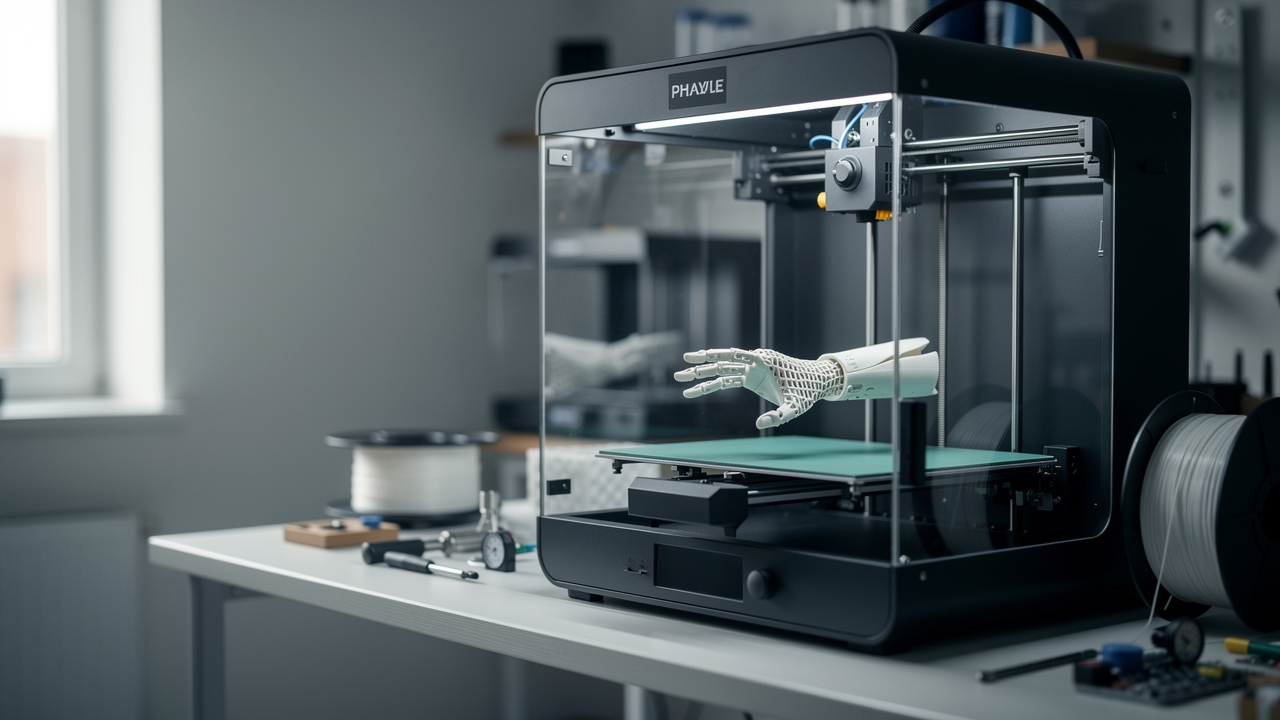

Why the Stratasys and Limbitless Collaboration Matters: FDM Prosthetic Access and Sustainability at the Same Table
One of the strongest aspects of 3D printing is that it can sometimes answer a very tangible human need rather than just the most complex manufacturing problem. The latest expansion of the partnership between Stratasys and Limbitless Solutions stands out precisely for this reason. According to TCT Magazine’s news report dated 19 August 2026, the two organizations are expanding access to 3D-printed prosthetics for children while also making the sustainability and education dimensions more visible.
For Ucuz3D readers, the value of this news lies in showing once again that 3D printing is not limited to producing prototypes or workshop fixtures. When the right workflow is established, FDM-based manufacturing can bring personalization, rapid iteration, and low-volume end-use part production together in the same equation. The approach we see today in a child’s prosthetic can appear tomorrow with the same logic in the production of custom holders, training devices, ergonomic support equipment, or protective parts.
What is the main point highlighted in the news?
According to the report, Stratasys is expanding its collaboration of more than 12 years with Limbitless Solutions at the University of Central Florida. This structure goes beyond simply donating equipment; material support, engineering contributions, and a laboratory model where students can learn a real production workflow all move forward together. The key element in this new phase is Stratasys adding a certified refurbished F370 printer to this setup.
This detail matters because the issue is not simply installing a new printer. Bringing a refurbished but production-ready FDM system back into active use shows that extending equipment life can also create distinct value within the 3D printing ecosystem. In other words, sustainability here means not only saving material, but also using the machine fleet more efficiently.
Why is this meaningful for Ucuz3D readers?
In prosthetics and assistive devices for children, one of the most critical factors is speed. In conventional manufacturing methods, low quantities, custom measurements, and frequent revisions can slow the process down. With FDM, however, making quick geometry updates, printing trial parts, and producing new versions based on measurements is much more practical. That is why, on the 3d printing service side, parts that require personalization are still among the strongest use cases.
This news also reminds us of the cost logic. In custom parts, the real value is often mold-free production; in other words, a full tooling investment is not required for a single size. For this reason, for the ordering party, it is more realistic to evaluate the production scenario together with the per-gram pricing logic. This approach creates a serious advantage especially for low-volume parts, parts that need frequent revisions, or parts adapted to the user.
Is this development only a social impact story?
No. Although it has a strong social dimension, this is also a story about a production model. In the Limbitless example, 3D printing brings end-use components, thermoforming molds, and prototype part production together under the same roof. This shows us how a single printer fleet can be positioned for different needs. In the field, a workflow can be built with trial fitting first, then adaptation, then functional parts.
The same logic also applies to custom-fit holders, specialized ergonomic arms, lightweight protectors, and educational demonstration parts. Once the design file is ready, the transition from file to production becomes faster through the online 3d printing workflow; in scenarios that require revisions, reordering also becomes more manageable.
What should we take from this in terms of materials and process?
The report does not share the full technical recipe details, so it would not be right to generalize based on a single filament or a single settings set. However, in the FDM prosthetic and assistive device space, the basic expectations are usually the same: dimensional consistency, sufficient strength, repeatability, and user comfort. That is why material selection varies depending on the part type; one approach may be needed for a rigid load-bearing body, while another may be necessary for an intermediate part close to the skin. In this context, to see different options, the general material family on the our printing materials page is a good reference point.
In short, the Stratasys–Limbitless story once again shows that FDM manufacturing should not be viewed only through the label of “rapid prototyping.” Personalization, education, sustainable equipment use, and real products that directly affect end users can all come together in the same workflow. And the strongest stories of 3D printing in the field often begin exactly here.


 Türkçe
 العربية
 Русский
 فارسی
فارسی Deutsch