
Why NIT Rourkela’s Recycled Filament Move Matters: What a Low-Cost Extruder Means for FDM
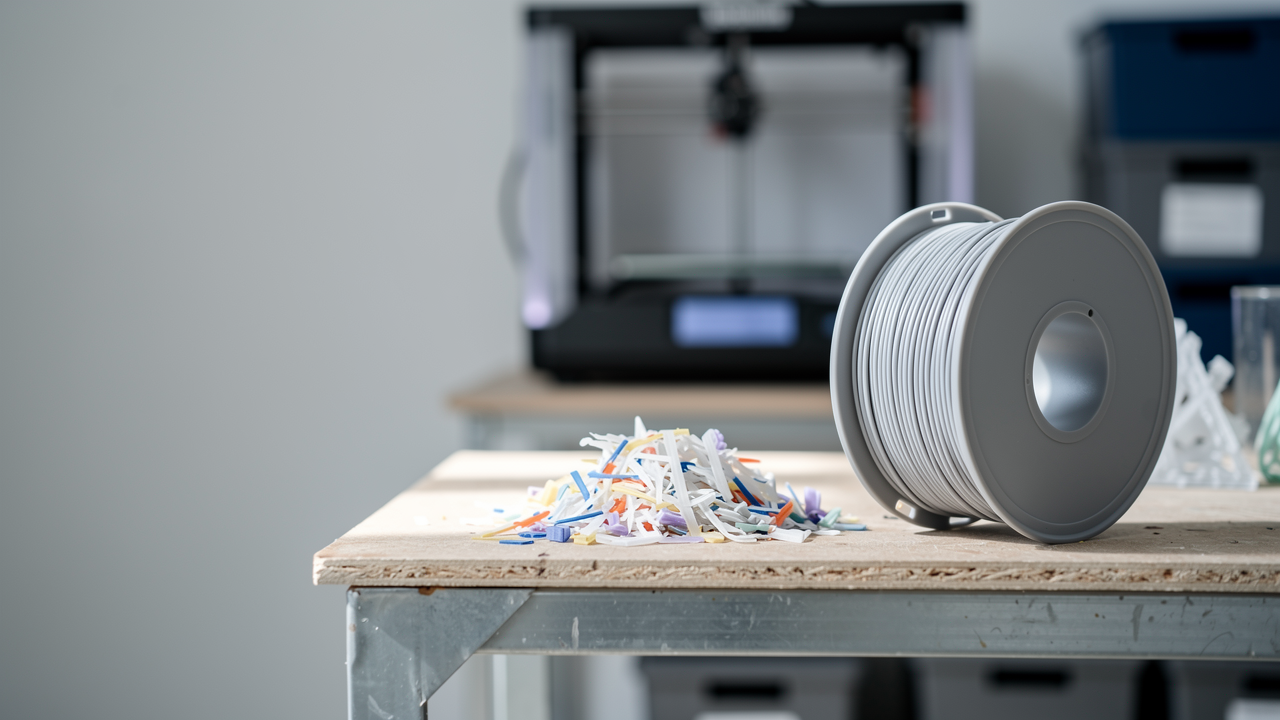
Producing filament from recycled plastic has been discussed for a long time; however, portable, low-cost solutions that actually work in the field are still limited. That is why the patent news about the team at India’s National Institute of Technology Rourkela, published by VoxelMatters on 13 August 2026, is drawing attention. The team announced that it has developed a low-cost and portable extrusion system that converts waste plastic into composite filament that can be used in 3D printing.
For Ucuz3D readers, the real value of this news goes beyond the headline of “recycling” and touches the core logic of FDM production. That is because filament cost, material consistency, and part performance directly affect outcomes in every job, from prototyping to small-batch manufacturing. Whether you are ordering a 3D printing service for your own product or reviewing the logic of per-gram pricing, how the material is produced and how consistent it is remain important issues in the long run.
Why is the system developed by NIT Rourkela important?
According to the report, the system operates with an extruder, a controlled cooling structure, and PID-based temperature control. The researchers say they were able to obtain composite filament by blending recycled plastic particles with different reinforcement materials. The critical point here is not simply melting waste; it is making diameter, flow, and core material behavior more controlled.
On the FDM side, one of the biggest problems is that cheap but unstable filament can quickly reduce print quality. Surface defects, fluctuations in layer adhesion, dimensional inaccuracies, and loss of mechanical performance are often directly linked to filament quality. For that reason, a system like this could be an interesting signal, especially for workshops investing in local recycling or closed-loop production.
What is the practical meaning for Ucuz3D customers?
Today, for most users, the safest approach is still to work with commercially validated filaments. In other words, this news does not mean “tomorrow everyone should produce their own filament.” However, it does open another door for low-volume manufacturing, educational labs, university workshops, and materials R&D teams: reprocessing certain plastic waste streams to produce application-specific filament.
Local filament production may become more visible in the future, especially when cost pressure increases in prototyping or when a specific material behavior is needed. If you are not sure which filament makes more sense for your project, it is useful to first review the options on our our printing materials page. After that, using the online 3D printing flow to evaluate your model offers a healthier path.
Technically promising, but there are points that require caution
According to the information in the report, the system was developed at a cost of around 45,000 rupees. Although this figure looks accessible compared with industrial filament lines, it is not a sufficient success metric on its own. For truly usable results in FDM, filament diameter tolerance, moisture management, melt-flow stability, and batch-to-batch repeatability remain critical.
Another important issue is that not every recycled plastic produces the same result. In waste plastics with uncertain origins, additives, contamination, and prior thermal history can make a serious difference. For that reason, this news should be read not as the announcement of a ready-to-use commercial product for end users, but as a meaningful research step toward more sustainable and more local filament supply in the future.
What trend in the 3D printing sector does this strengthen?
Recently, two trends have been growing at the same time on the filament side: on one hand, more performance-oriented engineering materials; on the other, more accessible and sustainable feedstock solutions. NIT Rourkela’s work stands out in the second category. If systems like this become more consistent, some workshops may eventually be able to reproduce filament from their own waste streams and use it for prototypes or auxiliary production parts.
This could add extra flexibility to the standard supply chain, especially in applications with high cost sensitivity. Even so, for real parts being ordered today, choosing the material according to the application is still the better approach. For jobs with demanding technical requirements, getting professional 3D printing service support first, then evaluating the logic of affordable 3D printing prices together with part geometry and material choice, remains the safest method.


 Türkçe
 العربية
 Русский
 فارسی
فارسی Deutsch