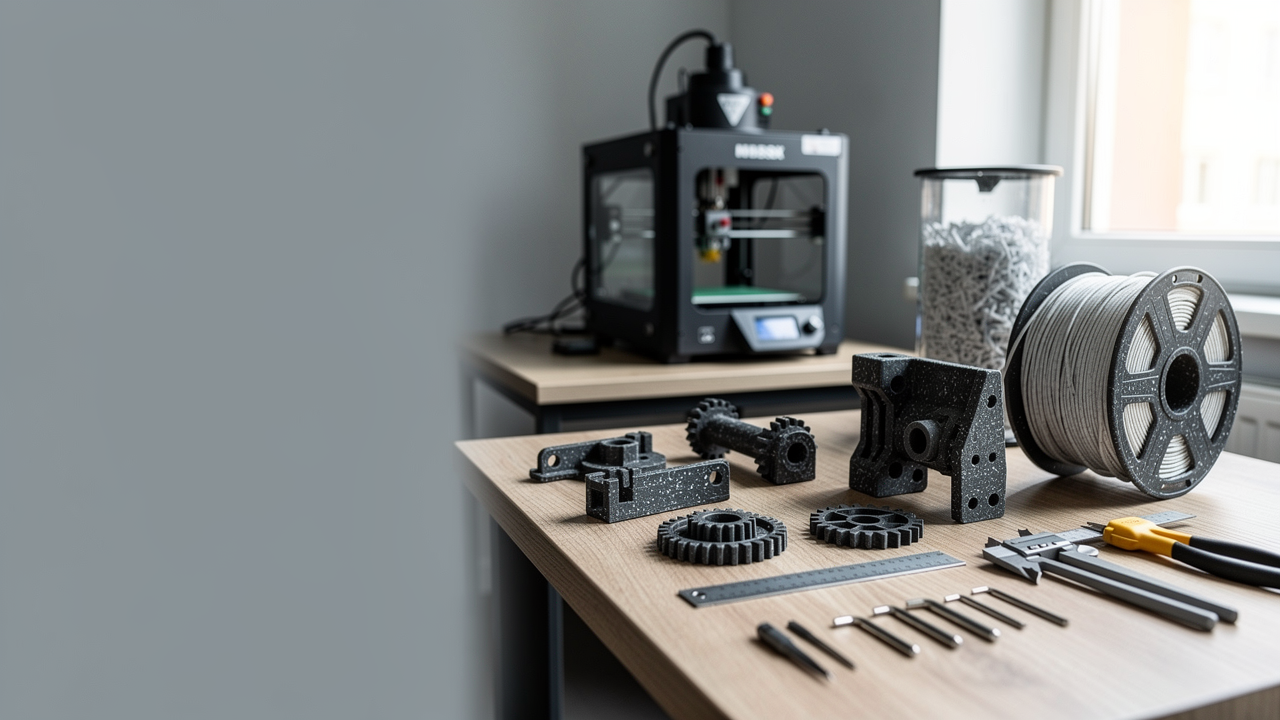

Why NIT Rourkela’s Recycled Filament Extruder Matters: Turning Plastic Waste into FDM Material at a Smaller Scale
The idea of recycled filament is not new; the real challenge is turning it into a reliable, repeatable, small-scale workflow. According to 3D Printing Industry’s report dated August 18, 2026, the team at NIT Rourkela in India has received a patent for a portable extruder that converts plastic waste into composite filament suitable for use in FDM printing. This news is more valuable than a simple note saying ‘a new machine has been introduced,’ because it targets two long-standing problems in desktop manufacturing at the same time: pressure from material costs and the challenge of turning waste plastic into filament that is genuinely usable.
Today, recycled material sounds appealing to many users, but when it comes to real-world application, questions arise around diameter stability, layer consistency, and part strength. That is why people who want more predictable results, from prototypes to end-use parts, still tend to choose standard commercial spools. If you also want to validate your part geometry and production scenario externally, it may be useful to see how the 3d printing service approach works for different kinds of parts and needs.
What exactly does the patented system promise?
The key point highlighted in the report is that the system is not just a simple recycling setup that melts and pushes material through. The NIT Rourkela team aims to manage filament formation more tightly through a controlled cooling stage and PID temperature control. This is critical, because with recycled material, the real issue is not simply reshaping plastic, but producing a filament that will behave consistently during printing.
It is also noteworthy that the system can process multiple types of plastic and produce composite filament by combining recycled particles with reinforcement materials. The team says this approach could deliver more durable results than ordinary recycled filament. Of course, the real field performance of such claims still needs to be seen through long print runs and different printer profiles. Even so, this is exactly where the report is strongest: the subject is not just sustainability messaging, but a process-control approach that directly affects print quality and mechanical performance.
Why could this matter for small producers?
Large manufacturers can solve material supply through scale; for small workshops, schools, laboratories, and startup teams, the picture is different. For them, turning waste plastic into a usable spool sounds attractive in theory, but in practice it is often difficult. NIT Rourkela’s approach suggests a middle layer between an industrial-scale recycling line and a hobbyist test setup. For the Ucuz3D reader, this is an important signal, especially for educational models, trial prototypes, fixtures, and fast-iteration parts.
The economic message is also clear: in FDM, total cost is not just the price tag on the spool. Scrap, supports, wall count, the need for reprints, and grams consumed per part are at least as important as the material itself. That is why it is healthier to look at the logic of price per gram rather than memorized pricing. For teams that want to see early on whether a file is suitable for production, the online 3d printing workflow also offers a practical first checkpoint for feasibility.
What conclusion should we draw from this right away?
It would not be correct to read this news as “now everyone will be able to produce their own filament without problems.” Receiving a patent does not mean every desktop user can instantly produce perfect filament. Drying, the quality of shredded raw material, additive ratio, diameter tolerance, and printer profile still determine the result. However, the value of the news lies in the fact that a small-scale and more accessible bridge between recycling and filament production is starting to be taken seriously from a technical standpoint.
Especially for institutional prototyping, educational laboratories, and teams that iterate frequently, systems like this may become more important in the future. Not every part requires the most expensive engineering material; in some applications, controlled recycled filament may be a sensible intermediate solution. To compare which scenarios call for standard material and which require more technical options, it also helps to look at the general framework on the engineering materials side in order to set the right expectations.
In short, the NIT Rourkela news brings the sustainability discussion in 3D printing closer to a real production workflow instead of leaving it as an abstract environmental narrative. If portable and process-controlled systems like this are validated in the field, turning plastic waste directly into new prototypes and auxiliary parts could become a much more practical option in the FDM world.


 Türkçe
 العربية
 Русский
 فارسی
فارسی Deutsch