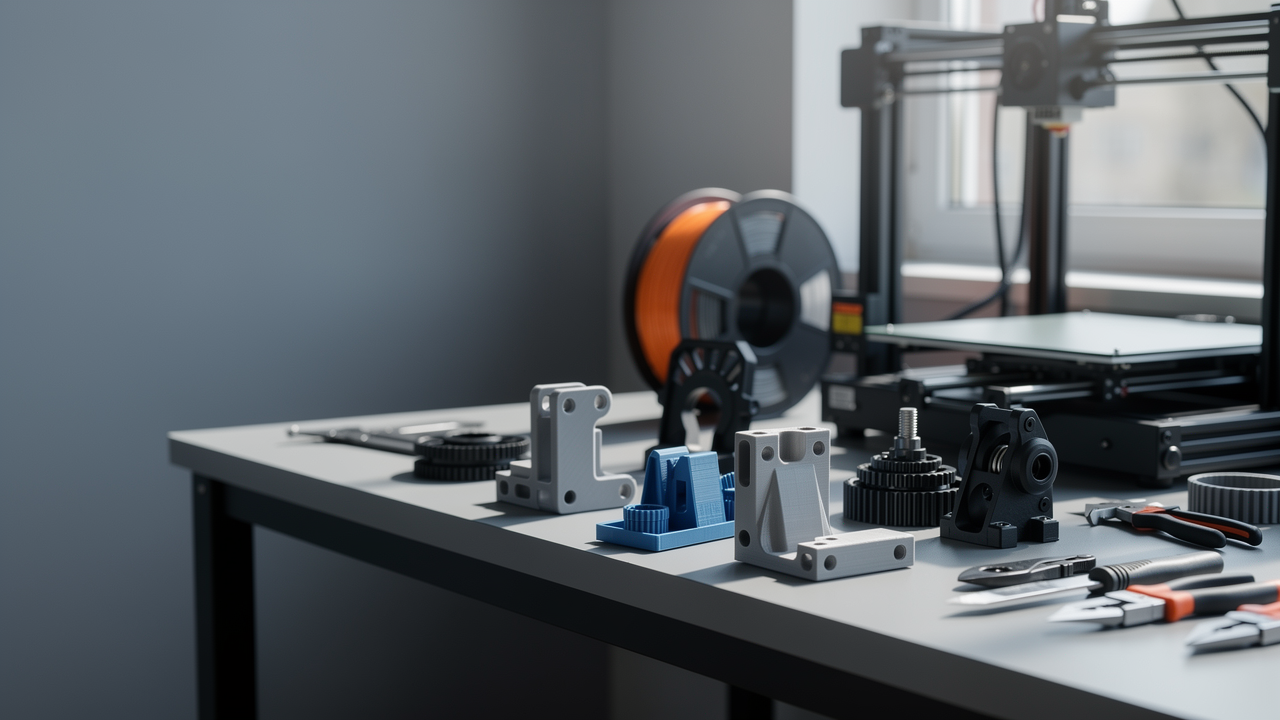

Why Is Co Print Quadro Drawing Attention? It Aims to Reduce Waste in Four-Independent-Toolhead FFF Printing
One of the biggest complaints in multi-color and multi-material FDM/FFF printing is the time spent on nozzle cleaning and the filament wasted in the process. A 3Druck article dated August 20, 2026 brought Co Print’s new open-source approach called Quadro back into the spotlight. According to the report, the system aims to deliver multi-color or multi-material FFF printing on the same job with four independent toolheads, using a workflow that needs less reliance on traditional purge towers.
The main difference here is that although the four print heads are positioned on the same X axis, they can operate individually. Each toolhead carries its own filament, while temperature, flow, and similar settings can be managed separately for each material. According to the manufacturer, any unused head is moved to a fixed parking position outside the build area. This makes it possible to switch directly to the appropriate head instead of running long cleaning sequences at every transition. In theory, this approach could create a serious efficiency advantage, especially for visual prototypes with frequent color changes and functional parts that require rigid-flexible combinations.
Why is it not just “another printer”?
Multi-color printing in the desktop segment is no longer new; however, most systems still introduce a workflow cost because of purge waste and longer print times. What makes Quadro stand out is that it tries to solve this problem through mechanical design rather than a software trick. The manufacturer says it aims to significantly reduce filament waste compared to conventional cleaning logic. While independent testing will determine how this claim holds up in real-world conditions, the approach itself is important: making multi-material FDM more productive.
This is especially meaningful for product development teams. Combining a rigid body with a more flexible contact surface in the same print can speed up prototype decisions. When developing a fixture, protective cover, or a product part that comes into contact with the user, being able to evaluate different materials in a single workflow instead of through separate prints can save a great deal of time. In such scenarios, getting a professional 3d printing service can also be a sensible way to clarify the right material and geometry choices before investing in the limits of desktop systems.
What does this mean in practical terms for Ucuz3D readers?
A printer having multiple heads is not enough by itself; the real issue is which part actually benefits from it. Presentation models, multi-zone prototypes, fixtures that need soft contact surfaces, and parts where cleaner surfaces are targeted through support material could be the natural playground for systems like Quadro. On the other hand, for single-material, simple, high-throughput parts, this kind of architecture is not always necessary. On the ordering side, users should focus not only on the printer but also on the material logic. That is why, together with a price per gram approach, it is more realistic to consider factors such as labor per part, material transitions, and the need for trial prints.
If your goal is to test rigidity, flexibility, color separation, or different surface behaviors within a single part, these developments on the desktop side matter. But for now, the right decision is still made according to the part itself. Before finalizing the right production method and material combination, seeing your model in the online 3d printing calculation workflow offers a more concrete framework in terms of print time and production approach. If you want to compare material alternatives in general terms, the our printing materials page is also a good starting point.
A point where caution is needed
There is an important note here: at this stage, Quadro stands out less as an industrial platform with maturity proven at scale in the field and more as an ambitious FFF architecture. Its open-source approach and independent toolhead structure are exciting; however, alignment stability in long prints, the profile ecosystem, ease of maintenance, and reliability at real production pace will only become clear as usage becomes more widespread. Even so, that is exactly where the value of the news lies: the desktop FDM market is no longer focused only on “faster,” but also on the question of “smarter multi-material printing with less waste.”
In short, Co Print Quadro promises more than a flashy showcase innovation in multi-color FFF printing. If the manufacturer’s parking-station and independent-toolhead approach works in practice as expected, it could establish a meaningful threshold in the cost-efficiency equation of multi-material desktop printing.


 Türkçe
 العربية
 Русский
 فارسی
فارسی Deutsch