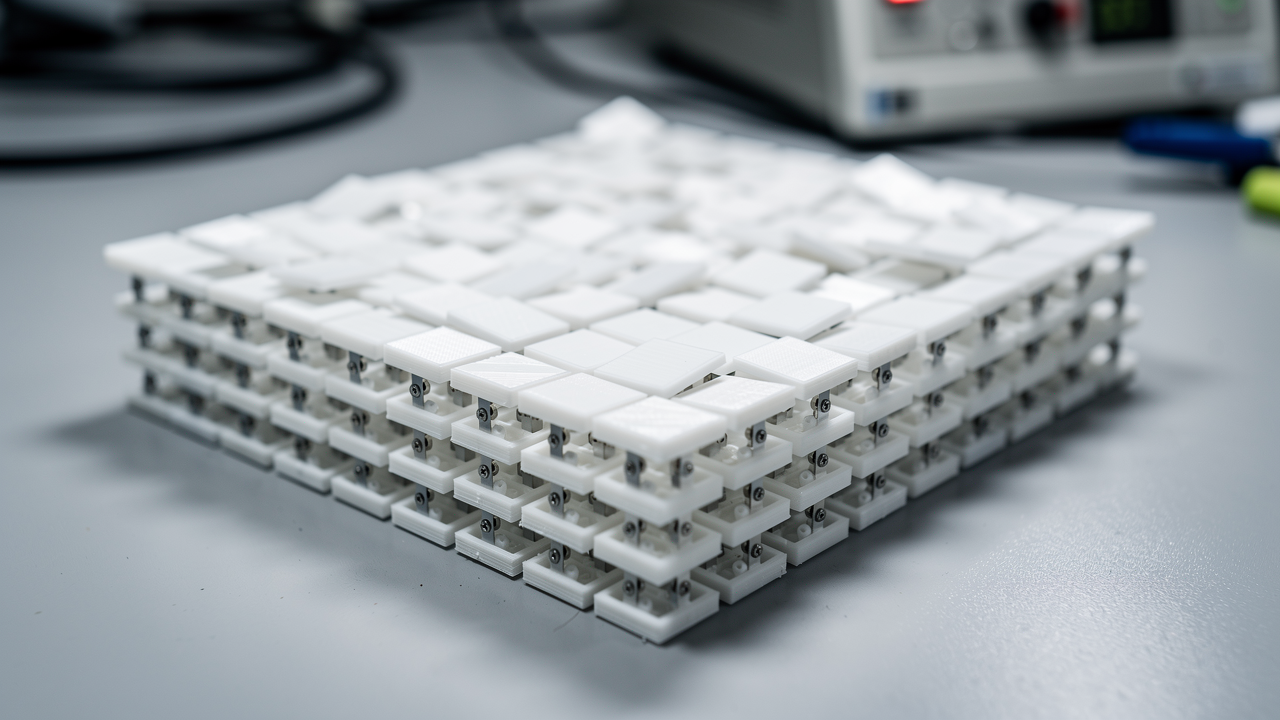

Why MIT’s ShiftLens System Matters: 3D-Printed Mechanical Indicators Open a New Path in Prototype Design
In 3D printing, most interactive parts still require electronics, sensors, or separate assembly steps. The ShiftLens approach announced by MIT researchers challenges that assumption to some extent: the system combines optical and mechanical layers within the same 3D-printed structure, allowing a part’s surface appearance to change depending on pressing, sliding, or turning motions. According to MIT News, the study was shared on August 5, 2026; 3D Printing Industry then brought it to a broader AM audience in its August 11, 2026 article.
From Ucuz3D’s perspective, the value of this news lies less in being direct production news and more in making it possible to test user interaction earlier with prototype 3D printing. In other words, questions such as whether a product lid has been turned in the correct direction, whether a slider clearly shows the difference between open and closed positions, or whether a warning window becomes visible based on user movement could be tested more quickly without adding separate LEDs, screens, or electronics. Using a 3d baskı hizmeti for this kind of validation can save time, especially in the first iterations.
What exactly does ShiftLens do?
According to the shared information, the system uses two optical layers working on top of each other on the surface. When the user presses, slides, or turns the part, the relative position of these layers changes, and the visible mark, color, or pattern changes as well. In short, the goal here is not just an aesthetic effect; it is to turn mechanical motion into visual feedback. The MIT team has demonstrated this on an example resembling a chemical bottle and on a game-like interface that shows different symbols as it is turned.
This approach has the potential to provide a clearer answer, directly through a physical prototype, to the question of whether the user has used a part correctly, especially in product development. In traditional methods, this might require a separate window, label, colored insert, or electronic status indicator. ShiftLens, however, aims in some scenarios to embed that communication directly into the part’s geometry.
Why is it noteworthy for FDM users?
The setup used in the research is based on multimaterial 3D printing infrastructure, so it would not be realistic to expect exactly the same result today from every desktop FDM printer. Even so, the idea itself matters: in FDM parts, mechanical status indicators, orientation windows, lock-open symbols, or visual feedback that reduces human error during assembly should now be considered a much more serious design topic.
For example, when developing a maintenance cover, adjustment knob, sliding latch, laboratory fixture, or small consumer product, you may first want to test the geometry. At this stage, production based on a gram başı fiyat model remains one of the most practical options for low-volume trials. For teams that want to upload the file quickly and see the first physical sample, an online 3d baskı workflow can also shorten the decision process.
Where can it create real value?
- Assembly guidance: When the user turns a part, they can visually understand the correct position.
- Maintenance and service parts: States such as open-closed or locked-free can be communicated without labels.
- Laboratory and medical auxiliary fixtures: Passive markers that reduce the risk of incorrect use can be added.
- Consumer product prototypes: The logic of the physical interface can be tested before adding electronics.
The critical point here is this: ShiftLens is not a short-term ready-made solution that will put a “smart indicator” into every part. However, it does invite product developers to think about 3D printing not only for shape and strength, but also for feedback at the moment of use. For teams that want to explore different options in terms of material and durability, the baskı malzemelerimiz page can also be the right starting point.
Conclusion for Ucuz3D readers
The strongest aspect of this news is that it pushes 3D printing beyond being only a production tool that gives shape, toward physical interfaces that can “communicate” with the user. In the near term, it may take time for all these features to become part of the standard FDM workflow; however, the message for teams developing prototypes is clear: in the future, a good part may not only be a part that is printed strongly, but one that can explain its correct use on its own.


 Türkçe
 العربية
 Русский
 فارسی
فارسی Deutsch