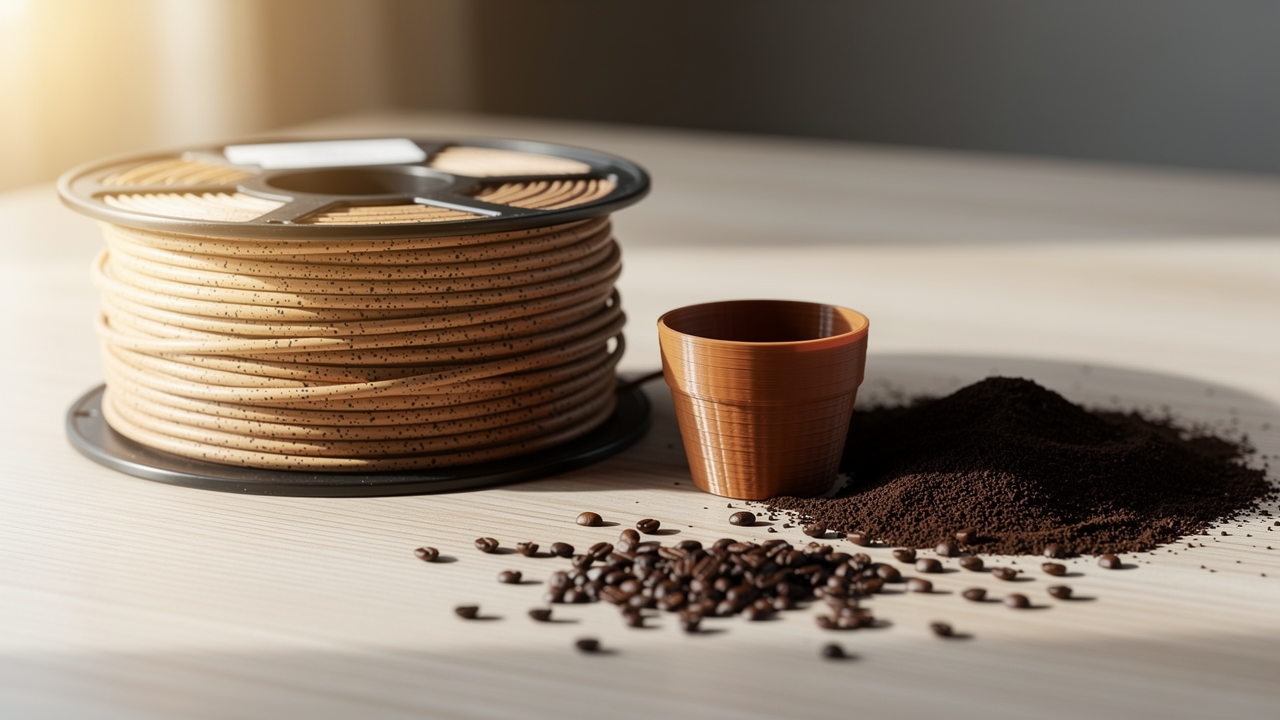

Why Is eSUN PLA-Coffee Getting Attention? What Does PLA with Recycled Coffee Grounds Promise in FDM Printing?
On the FDM side, news about new materials often means nothing more than a new color or a small variation. However, PLA-Coffee, announced by eSUN on July 29, 2026, is a slightly more noteworthy example in this respect. According to the information shared by the company and Comunicaffe’s report dated July 29, 2026, the material combines recycled coffee grounds with biobased PLA. This approach does not mean a revolution on its own, but it is still important because it shows that sustainable material experiments in FDM are now turning into more commercial and accessible products.
From the Ucuz3D perspective, materials like this may be especially appealing for presentation pieces, decorative prototypes, and short-run jobs where surface feel matters. If not only the mechanical strength of a part but also its texture and perceived material character are important, alternatives beyond standard PLA become more meaningful. At this point, it also provides a strong answer to the question of why the material variety you see on the our printing materials page matters.
What exactly does PLA-Coffee bring?
Current information says the material is produced by drying and grinding everyday coffee waste and then blending it with PLA. The real value here is not simply that coffee grounds are added for marketing purposes; rather, they are positioned as an additive that changes the surface appearance and the perception of the material. eSUN emphasizes that these particles alter light refraction to create a more matte, softer-looking surface effect.
This touches on two common situations in FDM: layer lines becoming more visible and some PLA prints looking overly plastic. The micro-particle matte appearance promised by PLA-Coffee could somewhat reduce the need for post-processing, especially in display models or desktop objects. In other words, the issue here is not just a “coffee-scented filament,” but the claim of offering an FDM material with a more natural visual character.
Why could this matter for Ucuz3D readers?
This type of material will not be the right choice for every job. For parts that require high heat resistance, outdoor use, or severe mechanical stress, the decision should still be made according to the application. However, for prints intended for indoor use, with visible texture, to be shown to customers, or presented like shelf products, PLA-Coffee could be an interesting option. It seems especially meaningful for wood-toned decor, planters, desktop accessories, helper parts around coffee equipment, and concept presentation models.
On the other hand, when deciding in terms of cost and production, it is not enough to look only at the story behind the material. If you are planning your project as a service, you can see the overall workflow on the 3d printing service page, and you can evaluate the overall production approach through the logic of affordable 3d printing prices. If your file is ready, seeing an instant quote on the online 3d printing side can also speed up the decision process.
Which points on the technical side should be read cautiously?
In Electronics For You’s summary dated August 6, 2026, it is reported that the material is compatible with most standard FDM printers, is offered in 1.75 mm spool format, and aims for a printing logic close to standard PLA. This is a positive signal, but with filled PLA types, it would not be surprising to see small variables such as color differences from batch to batch, surface consistency, or nozzle behavior. So while the material is interesting, it should not automatically be read as an engineering-grade solution.
Another important point is expectation management. Even if the coffee-ground additive makes the material look “natural,” that does not automatically make the part suitable for outdoor use or high temperatures. The core matrix here is still PLA. Therefore, it is more realistic to look for the main advantage not so much on the mechanical side, but in surface aesthetics, matte appearance, and the sustainability story.
What is the real signal?
The important aspect of this news is that in the FDM materials market, it is no longer only faster or tougher filaments that stand out, but also more characterful materials that make creative use of waste streams. PLA-Coffee will not change the world of manufacturing on its own; however, by turning coffee waste into a functional filament additive, it shows new directions in commercial material development. For Ucuz3D readers, the takeaway may be this: in some projects, success is not only about strength, but also about surface language and the story the material tells. PLA-Coffee is positioned exactly at that intersection.


 Türkçe
 العربية
 Русский
 فارسی
فارسی Deutsch