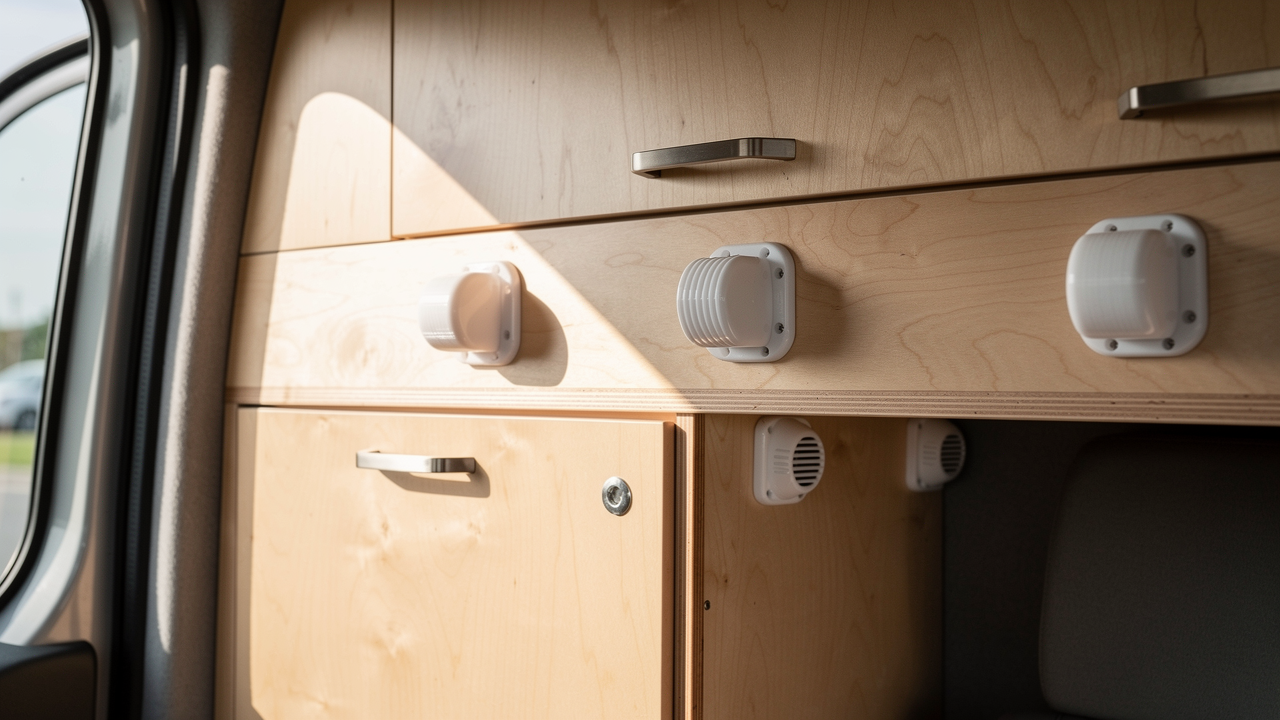

Why Is This 3D-Printed Camper Interior Getting Attention? Buckley Conversions Combined Lightness and Customization in the Same Workflow
One of the biggest issues in camper and van conversion projects is still the same: the balance between weight, assembly time, and personalization. According to a VoxelMatters report dated August 10, 2026, Buckley Conversions tried to push this balance in a different direction by producing a very large part of the interior with 3D printing in a Mercedes-Benz eSprinter-based prototype. According to the information shared in the report, instead of a conventional setup dominated by wood and aluminum, the company used 3D scanning and large-format thermoplastic printing to achieve a structure that is about 680 kg lighter than its previous standard conversion.
This development should not be seen only as “an interesting showcase project.” Because when it comes to low-volume, made-to-measure, and repeatable parts, thermoplastic-based manufacturing can offer advantages such as reducing the need for molds, simplifying assembly steps, and producing parts that fit vehicle interior geometry more closely. For Ucuz3D readers, this is where the value of the news begins: the logic of digital design, lightweighting, and part consolidation that we learned in the FDM world has now been carried into a real vehicle interior application on a larger scale.
Why does it matter?
According to the setup described in the report, the team scans the van’s interior volume in 3D and digitally designs the parts around this real geometry. Then, with a KUKA industrial robot and extrusion system, large parts are produced directly to fit that volume. The practical result of this approach is a reduction in the common carpentry cycle of “measure on site, test, cut again.” Especially if variations will be produced on the same platform according to different customer needs, a digital file-based workflow can provide a serious advantage.
Another important point is that the number of part joints can be reduced. In traditional manufacturing, a cabinet, panel, or seating module is created by cutting and joining many sub-parts. 3D printing, however, can allow some geometries to be produced as a single part or with fewer joint lines. This has the potential to reduce both assembly time and small mismatches caused by tolerances. The same logic is also noteworthy for companies looking for a 3d printing service for low-volume custom fixtures and in-vehicle support equipment.
What does it tell us in terms of material and production?
According to VoxelMatters, the seat body, cabinets, and wall panels were produced with polypropylene-based parts, while wood was retained only in some surface details. This choice shows that in 3D printing, the approach of simply “make it durable” is not enough. In vehicle interiors, weight, impact behavior, surface cleanliness, ease of assembly, and repeatability per part are all considered together. The same material may not be the right choice for every project; however, the report clearly shows that functional thermoplastics are being evaluated more seriously for decorative or semi-structural interior components.
The lesson from this for the desktop FDM world is this: even in a large project, the real value is often not “printing a single part,” but producing the right part with the right material and the right geometry. If you are also developing a prototype, in-vehicle fixture, enclosure, or custom connector part, you can compare material options on the our printing materials page and clarify at an early stage which material makes the most sense for the design.
What is the takeaway for Ucuz3D?
This news directly reminds us of one thing: the commercial value of 3D printing increases not so much in one-off visual parts, but in low-volume jobs that require customization and are not worth making a mold for. Camper interior support parts, cable routing solutions, mounting brackets, small enclosures, fixtures, and prototypes are among the most visible examples of this logic. For such parts, seeing file-based feasibility first through an online 3d printing workflow, and then evaluating the price per gram logic, usually helps people make decisions faster.
Of course, this news does not mean that “every camper interior part should now be made with 3D printing.” Different production methods may make more sense for large flat panels, surfaces with very high cosmetic expectations, or very large-scale mass production. However, the Buckley Conversions example shows that thermoplastic-based 3D printing is beginning to take on a more ambitious role in low-volume custom manufacturing not only for prototypes but also for end-use parts. Especially when lightness, customization, and digital repeatability are all required at the same time, this approach may appear more often in the near future.


 Türkçe
 العربية
 Русский
 فارسی
فارسی Deutsch