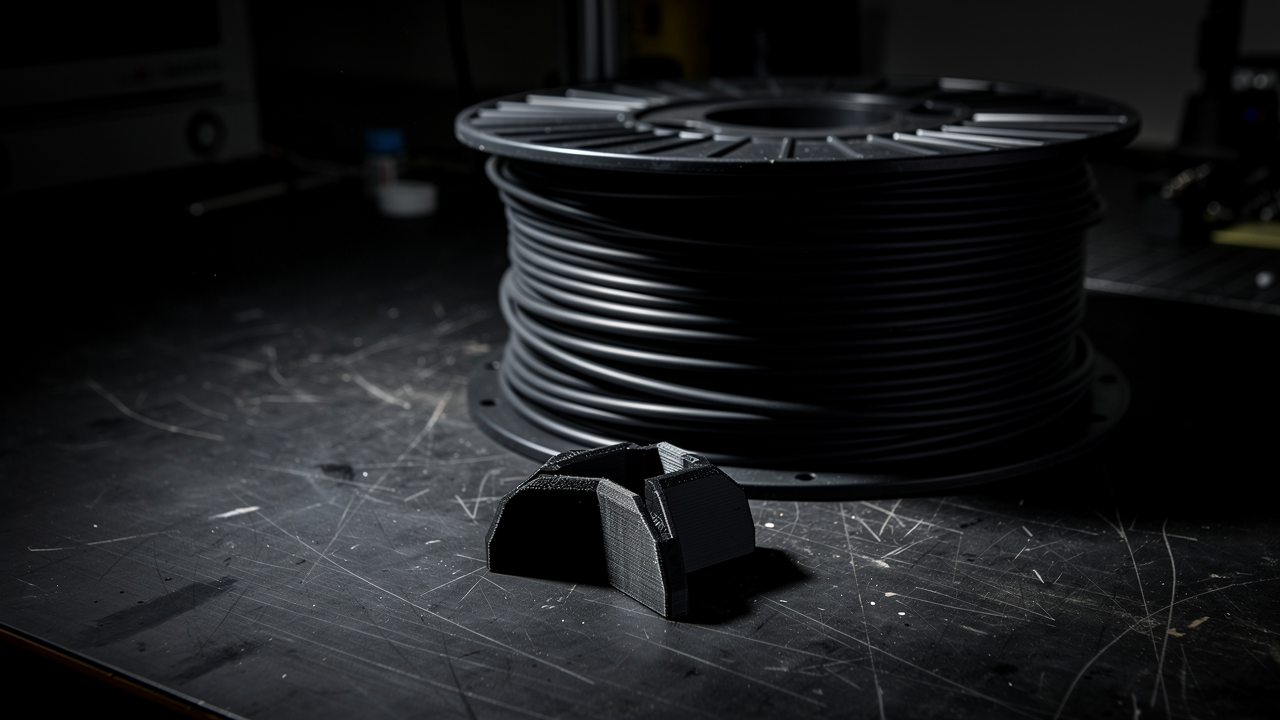

Why Lyten’s PA1205 Graphene-Reinforced Filament Matters: A New Threshold for Modovolo’s Portable 3D Printing Platform
The idea of portable, near-field production has been discussed for a long time; however, for this model to truly work, not only the printer but also the material needs to inspire confidence. According to the report published by 3D Printing Industry on July 28, 2026, Lyten’s graphene-reinforced nylon filament called PA1205 is being positioned as the default material on Modovolo’s portable industrial 3D printing platform called BFP. For Ucuz3D readers, the real value of this news is that the “production in the field” narrative is no longer limited to a printer launch, but is turning into a tangible manufacturing model through the material-printer pairing.
Modovolo’s BFP platform is being developed with the claim of producing large and complex parts closer to the point of need, without depending on a central factory. The critical point here is this: while printing a complex part close to the field looks attractive in theory, that advantage quickly disappears if the material is not stable enough. That is why filament selection, especially for engineering-grade parts and portable production scenarios, is no longer just a cost item but is becoming part of the system architecture.
Why is PA1205 attracting attention?
According to the report, PA1205 is a PA12-based filament reinforced with Lyten’s “3D Graphene” additive. The company says this material can offer greater strength, lower weight, and better surface quality compared to competing options. It also claims advantages in temperature performance, print speed, and warping control. All of this should be read as single-source company data rather than independent field testing; still, the important point in the report is that the material is directly becoming the standard choice for a real platform.
Developments like this also point to a familiar question for teams developing products in Turkey: what loads does the part actually experience, and does the chosen filament fit that scenario? For teams that want to use a 3d baskı hizmeti when moving from prototype to functional part, material selection no longer stays at the level of simply “PLA or PETG?”; in some applications, it may be necessary to move toward nylon-based or more technical options. For that reason, it may make sense to look at the mühendislik malzemeleri page to see engineering-grade options together.
What is the practical meaning of this news?
This development matters in three ways. First, thinking about the material and the machine together is no longer an exception; it is becoming a mainstream approach. Second, in portable production scenarios, it is once again clear that the time gained from logistics only creates value when it is supported by reliable material behavior. Third, in areas such as defense, aerospace, motorsports, and industrial maintenance, the idea of “producing where needed” is becoming more visible.
Of course, this does not mean that every business should immediately switch to graphene-reinforced nylon. For many everyday fixtures, enclosures, prototypes, or low-risk parts, more accessible materials may still be the right choice. The decision logic here is usually based on part load, environmental conditions, quantity, and tolerance requirements. That is why, when making project-based decisions, it is also necessary to consider the logic of price per gram; because moving to a technical material changes not only mechanical performance but also the overall production approach.
How should Ucuz3D readers interpret this?
It is more accurate to read this news not as “a new exotic filament has arrived,” but as the match between material and application is getting stronger. In the Modovolo example, the main point is that a portable production infrastructure is being standardized together with a specific material family. This is an important signal especially for teams that need spare parts, field fixtures, drone components, lightweight structural parts, or rapid iteration.
If you also want to clarify whether your part should be produced with a standard filament or a more technical option, the best first step is to define the use scenario. Then, making a preliminary assessment in the online 3d baskı workflow based on the file and dimensions can speed up the decision process. Especially for load-bearing or heat-exposed parts, the material decision should not be made only according to printability; it should be based on strength, surface expectations, and field conditions.
In short, this news shows that competition in 3D printing is now taking place not only on the printer side, but across the trio of material + platform + supply chain. While the Lyten and Modovolo example does not offer a formula that will be adopted directly by every workshop, it clearly shows why proper material standardization is so critical for functional FDM parts.



 Türkçe
 العربية
 Русский
 فارسی
فارسی Deutsch