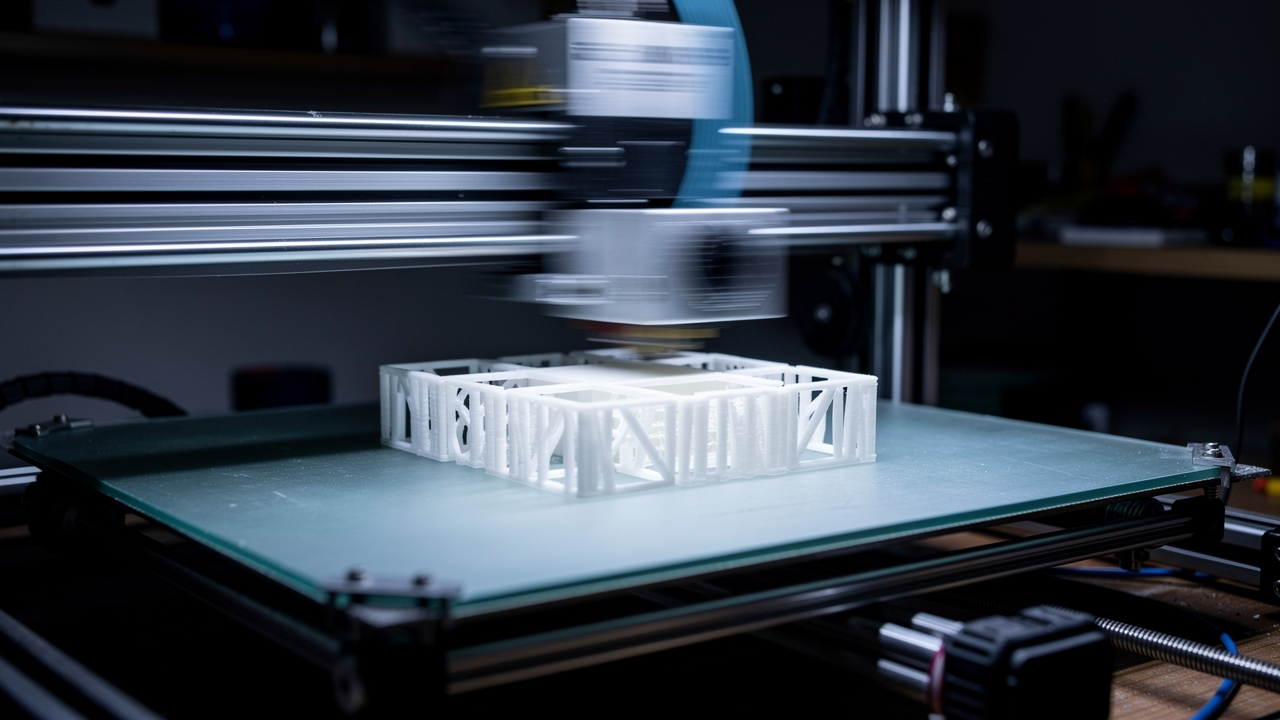

Why Is eSUN PLA-HF Drawing Attention? What Does a 1000 mm/s-Class Speed Claim Mean for FDM Prototyping?
In its 6 August 2026 announcement, eSUN introduced its new PLA-HF filament. The company’s message is clear: the speed limit in desktop FDM printing is being pushed higher again. According to the official statement, PLA-HF aims to maintain print quality at around 600 mm/s in everyday use and, on suitable systems, reach the 1000 mm/s class. In announcements like this, manufacturer data and real-world field results may not always match exactly; still, the news matters because it shows that a new speed-focused segment on the material side is gaining strength.
For Ucuz3D readers, the real value is that materials like this do not simply mean “faster printing.” They can create practical benefits such as faster iteration, getting more test parts within the same day, reducing time on large prototypes that normally take a long time, and improving cycle efficiency in print farms. This is especially important for jobs such as functional prototypes, enclosures, fixtures, and validation parts, where shorter print times allow design decisions to be made faster as well. That is why, on the 3D printing service side, material selection is becoming more critical not only for strength but also for delivery rhythm.
Why is PLA-HF positioned differently?
According to the technical framework provided by eSUN, the main promise of PLA-HF is to achieve high flowability and controlled viscosity at the same time. In other words, the filament needs to melt and flow quickly enough at high speed, but without becoming so runny that it causes stringing, sagging, or loss of detail. It is also important that the manufacturer says it is targeting a balance that heats more easily and takes shape more quickly. Because in high-speed FDM, the challenge is often not just getting material out of the nozzle, but ensuring that the extruded material becomes stable in time around corners and in small details.
Another point highlighted in the announcement is the emphasis on bed adhesion and interlayer bonding. As speed increases, the problems that can ruin a print halfway through also become bigger: corner lift, top-surface defects, heat buildup in small parts, and weakness in the Z direction are among the main ones. If PLA-HF can manage these risks at a reasonable level in practice, fast printing becomes more meaningful not only for visual mockups but also for serial prototyping workflows. For customers ordering prints, the important question here is not only “which filament is faster?” but also “which material reduces the total job cost more sensibly?” For that reason, when making a decision, you should look not only at the logic of price per gram but also at the total time spent per part.
Why is this news important from Ucuz3D’s perspective?
If high-speed PLA variants like PLA-HF can preserve the easy-to-print nature of classic PLA while accelerating the workflow, they can make a serious difference especially in early-stage product development. Examples include electronics enclosures, assembly-check parts, ergonomic trials, presentation models, and large-volume visual prototypes. Of course, this will not be the right choice for every job; different materials may still stand out for parts that need outdoor use, high temperature resistance, or heavy impact resistance. However, in office prototyping and rapid validation workflows, new-generation fast PLA materials are opening up more space.
At this point, it would not be right to choose a material based on the speed label alone. The part’s use case, geometric structure, expected surface quality, and any post-print assembly operations should all be evaluated together. Those who want to compare general material options can see the broader framework on our printing materials page. If your file is ready, moving forward through the online 3D printing workflow can provide a clearer path on a part-specific basis.
What practical conclusion should be drawn from this?
The eSUN PLA-HF news shows that in the FDM market, the “high speed” narrative is no longer only the main competitive field for printer manufacturers, but also for filament manufacturers. For Ucuz3D readers, this means the following: soon, delivery time, material choice, and printing strategy will become less separate from one another. In other words, in some projects, a filament that looks more expensive but prints faster and more stably may become the more sensible choice in the overall project cycle.
In short, this announcement alone does not create a result that will change every PLA preference; however, it should be read as an important sign that the balance between speed and quality in FDM prototyping is being re-established at the material level. If the manufacturer’s claims are consistently confirmed across different machines, materials like PLA-HF could become a more visible standard, especially for workshops that need fast iteration.


 Türkçe
 العربية
 Русский
 فارسی
فارسی Deutsch