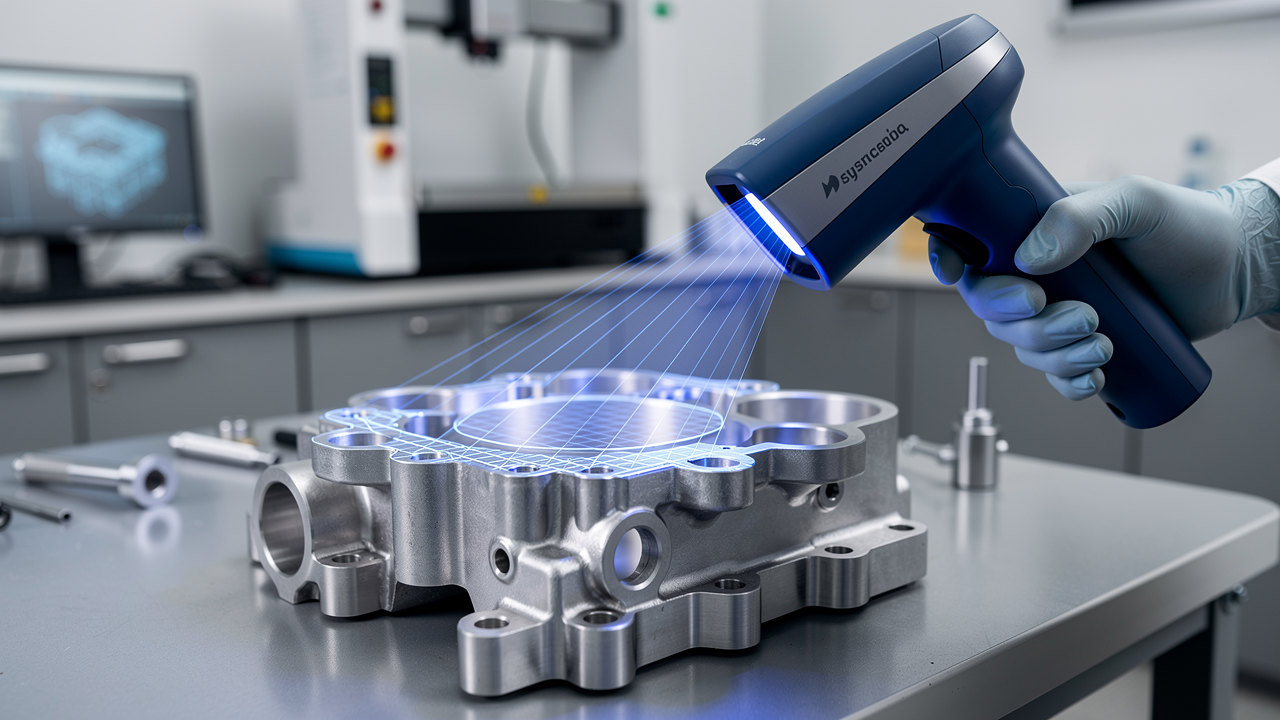

Why Is Artec Point II Attracting Attention? It Aims to Accelerate Metrology-Grade 3D Scanning, Spare Parts, and Quality Control
Artec Point II may not be a product as visibly prominent in the 3D printing world as the printer itself; however, it could have a major impact on spare-part reverse engineering, quality control, and rapid prototyping workflows. According to 3D ADEPT’s report dated August 6, 2026, Artec 3D announced Point II, the new version of its target-based handheld laser scanner Point series. The company says the new model can capture up to 5.8 million points per second, records denser data than the previous generation, and still delivers this with a certified accuracy level of 0.02 mm.
What makes this kind of announcement important for Ucuz3D readers is this: in 3D printing, lost time often happens not during printing, but before printing begins. If you have a physical part in hand, it first needs to be digitized reliably. This is exactly where progress on the 3D scanning and reverse engineering side directly affects the production decision.
Why is this important news?
The technical framework presented by Artec is not limited to simply claiming faster scanning. Point II highlights three different operating modes: ultra-fast mode for large surfaces, hyperfine parallel mode for finer details, and single-laser mode for deep holes and hard-to-reach areas. This approach shows an aim to handle both large assemblies and small but critical geometries with a single device.
It has the potential to create practical value especially in the following areas:
- Discontinued spare parts: Capturing dimension-critical areas more reliably can shorten the remodeling process.
- Quality control: For parts requiring tight tolerances, comparing scan data with the nominal model can become more systematic.
- Fixture and jig production: Designing auxiliary parts that fit existing equipment exactly can become faster.
- Maintenance and repair operations: If the step of transferring a disassembled field part into the CAD environment becomes shorter, the next production decision can also be accelerated.
What impact could it have on the 3D printing side?
Many users see 3D printing as a process that starts only when an STL file arrives. In real life, however, most jobs come in when there is a part in hand, not a file. In such cases, there is first scanning, then model cleanup, then revision for manufacturability, and finally the printing stage. The stronger the beginning of this chain is built, the more predictable the 3d printing service at the end becomes.
The critical point here is this: faster scanning does not automatically mean a better part. Worn edges, damaged surfaces, assembly gaps, and deformations caused during use still require engineering judgment. In other words, systems like Point II can make the job easier; but the path to a working spare part still requires dimensional verification, CAD correction, and proper material selection.
Why should Ucuz3D follow this?
On the Ucuz3D side, one of the most common high-value scenarios is reproducing parts that are unavailable on the market or have long lead times. In such jobs, risk decreases as the quality of digitization improves. Especially for parts such as brackets, covers, housings, connection fixtures, or test jigs, scanning accuracy and the production decision are closely linked.
There is also a cost dimension to this. If scanning and model preparation result in fewer revisions, the number of part repeats may also decrease. For those who want to understand the general cost logic before printing, the price per gram approach is still a useful reference. Once the file is ready, the instant quote flow makes it easier to carry out a faster preliminary assessment before moving into production.
What is the main takeaway?
The real value of this news is that it shows that, within the 3D printing ecosystem, not only the printer and filament but also the transition from measurement to model is speeding up. Artec Point II is not a magic solution on its own; however, features such as denser data, one-handed use, separate modes for deep areas, and certified accuracy point to a serious promise of efficiency, especially on the reverse-engineering and inspection side.
If you have a part without a technical drawing, the message of the news is clear: in the future, competition will not be only about faster printing, but also about faster and more reliable digitization. In many cases, the real commercial value of 3D printing starts exactly here.


 Türkçe
 العربية
 Русский
 فارسی
فارسی Deutsch