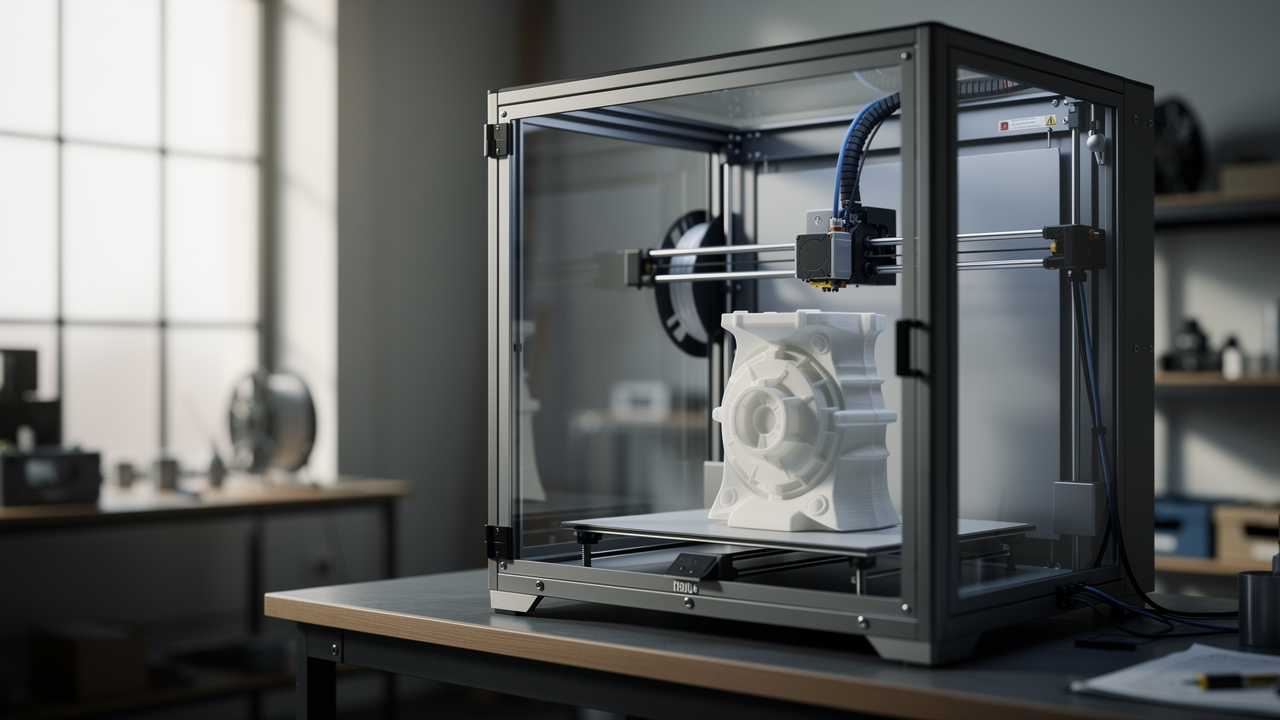

Why Is the Kentstrapper Mille Drawing Attention? How a 1 Cubic Meter FDM Printer Could Change Large One-Piece Production
Italian manufacturer Kentstrapper highlighted its large-format FDM system called Mille in an announcement reported by 3D Printing Industry on August 5, 2026. The important part of this news is not only the size of the build volume; it is the fact that one-piece production, controlled chamber temperature, and solutions aimed at reducing operator intervention during long prints are brought together on the same platform. For the Ucuz3D reader, the key point is this: for large parts, the question is no longer only “will the print fit?” but also “how safely and how cleanly can it be produced in a single run?”
Why is Mille being discussed differently?
The report states that the system has a 1,000 × 1,000 × 1,000 mm build volume. The real advantage of an FDM printer at this scale is not just that it can print large parts, but that it increases the chance of producing parts with fewer joints that would normally need to be split into several sections. Especially when molds, fixtures, large enclosures, prototype bodies, or production-assistance tools are involved, reducing the number of joints can also reduce assembly time, tolerance buildup, and the need for later corrections.
The actively heated enclosed chamber structure emphasized by Kentstrapper is also critical here. In large FDM prints, the problem is often not only the print duration; it is also necessary to manage temperature distribution throughout a long print, balance the behavior of different areas on the build plate, and preserve part stability, especially with materials approaching engineering-grade performance. That is why this news says more than simply announcing a “giant printer.”
Which technical details matter?
According to 3D Printing Industry, Mille features a build plate divided into multiple independent heating zones, pre-print surface mapping and automatic compensation, interchangeable nozzle options, and a high-flow extrusion approach. This combination aims to address two basic needs in large parts at the same time: gaining speed when needed through thicker layers and higher material flow, while also allowing for more controlled surface detail when required.
Another notable point is that continuity mode has been considered for long or unattended prints. If there is a problem with filament flow or a spool runs out, preventing the job from stopping completely could provide a practical safety layer, especially for large-volume prints that take many hours. Of course, features like these should always be judged by real-world results; however, the direction is clear: large-format FDM is no longer selling only raw volume, but operational reliability as well.
What does this news mean for the Ucuz3D reader?
Not everyone needs a 1 cubic meter printer. But launches like this point to an important threshold in part design and production planning. Being able to produce in a single print a part that previously had to be split can make a serious difference in strength, appearance, and assembly. On the other hand, this is not automatically the right path for every large part. Geometry, the material to be used, the target tolerance, and the end-use environment all need to be considered together. In such cases, when choosing a 3D printing service, it is important to look not only at printer size but also at the production strategy.
A similar situation exists on the cost side. One-piece production can sometimes reduce the total workload by cutting down on assembly; in other cases, it creates a different balance because of print time, support requirements, or material consumption. For that reason, when making a decision, it is healthier to evaluate both the logic of price per gram and the overall production approach together.
For which materials and which jobs does it make sense?
The report mentions common FDM materials such as PLA, PETG, ASA, ABS, and TPU, as well as some reinforced options that move closer to the technical class. This shows that large-format printing is still being considered not only for visual mockups, but also for jobs such as outdoor equipment, production-assistance components, protective housings, and functional prototypes. If you want to see the general framework on the material side, the engineering materials page is a good place to start.
For the end user, the takeaway is clear: the large-format FDM market is no longer competing only on volume; it is also trying to offer more mature solutions in areas such as temperature control, nozzle changes, long-job safety, and remote monitoring. If you have a large part or want to see what you gain by producing it without splitting it, it may make sense to get an instant quote and map out a production scenario at an early stage. Source: 3D Printing Industry, August 5, 2026.


 Türkçe
 العربية
 Русский
 فارسی
فارسی Deutsch