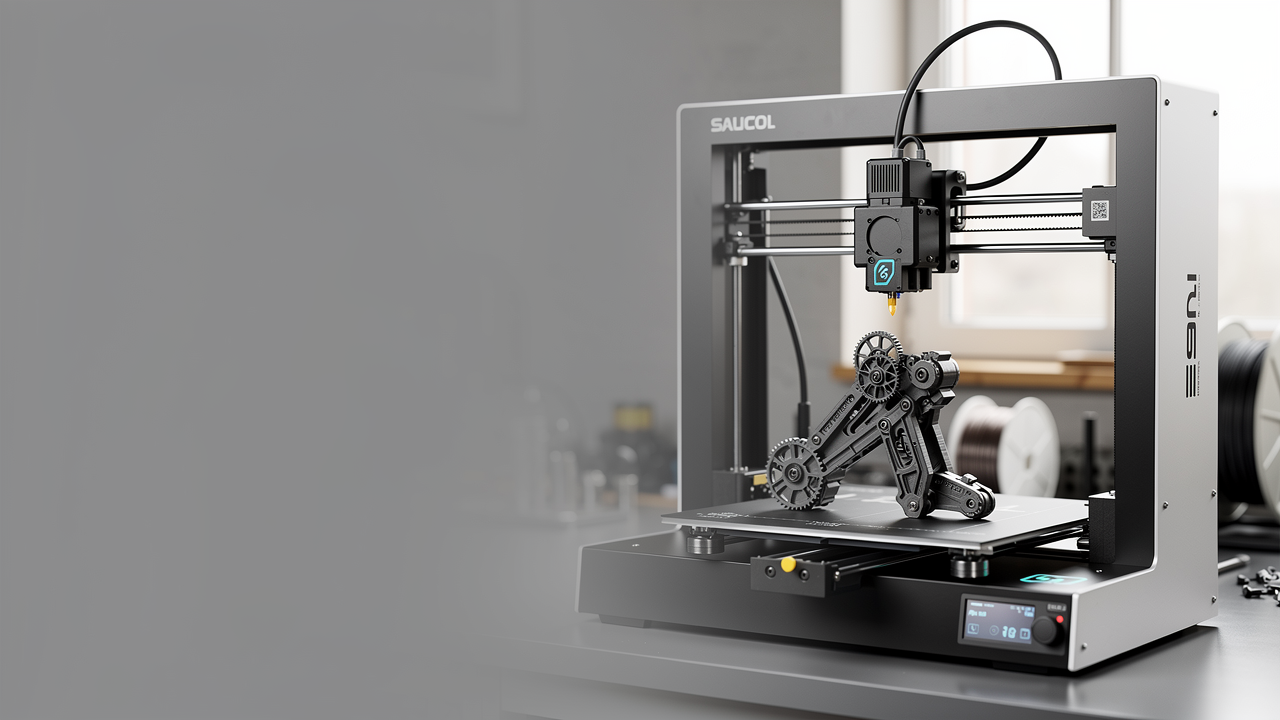

Why Is Prusament PA11 Natural Important? What Does the New FDM Material Promise for Moving Parts?
In its official blog post dated July 23, 2026, Prusa Research announced the Prusament PA11 Natural material. At first glance, the news may seem like nothing more than the addition of a new engineering filament. However, the real importance of the announcement lies in how pure PA11 is once again being highlighted as a strong option for moving parts, gears, and functional components exposed to wear. In particular, the emphasis on low friction, good layer adhesion, and outdoor durability brings this launch beyond a hobby-focused novelty and closer to real-world use cases.
For Ucuz3D readers, the critical point is this: not every strong material is the right choice for every part. PA11 Natural can be highly valuable in the right application, but in terms of print preparation, moisture management, and printer conditions, it is not as forgiving a material as PLA or PETG. That is why this news matters not just at the level of “a new filament has been released,” but because it shows how FDM material decisions are becoming more specialized.
Why does PA11 Natural stand out?
The main difference highlighted by Prusa is that carbon fiber reinforced PA11 and pure PA11 serve different needs. Carbon fiber reinforced options can often behave more rigidly and offer better dimensional stability. In contrast, pure PA11 stands out with better interlayer bonding and better sliding properties. This distinction matters, because in parts such as gears, friction guides, hinge-like working components, or flexible functional elements that need to tolerate impact, high rigidity alone is not what is being sought.
The announcement highlights PA11’s wear resistance, impact resistance even at low temperatures, UV resistance, and chemical resistance. None of these individually guarantees every application, but together they explain why it may attract interest for outdoor fixtures, moving joints, or certain auxiliary parts around automotive environments. Especially in parts exposed to long-term friction, the material’s sliding behavior may be more critical than tensile strength alone.
What does this news mean in practice?
In the FDM world, many users still test a part with PLA first, and then move to PETG or ABS/ASA if necessary. Materials like PA11 Natural, however, require a more targeted decision. In other words, the issue is not simply that it is a “more expensive and more technical filament,” but what problem it is being chosen to solve. If the part is exposed to impact, needs slight flexibility, operates under friction, or is expected to last longer outdoors, PA11-class materials can become seriously meaningful.
On the other hand, this material is not an automatic choice for everyone seeking easy printing. Prusa also clearly states that the material is hygroscopic, meaning moisture management is important. The need for drying, an enclosed environment, a suitable print surface, and a more controlled process requires setting the right expectations at the ordering stage. That is why, when getting a 3d printing service, it is more accurate to focus not only on the question “which is the strongest filament,” but on how the part will actually function in real use.
Likewise, when evaluating cost, it is better not to think only in terms of the spool price label, but also to consider geometry, the risk of failed prints, and output per part. This perspective makes it more important to understand the logic of price per gram. For those who want to upload a file and quickly make a production pre-assessment according to the application, the online 3d printing flow also makes this decision process more practical.
For which parts could it make more sense?
From a cautious perspective, PA11 Natural appears to make sense for gears, bushing-like friction parts, impact-prone clips, certain outdoor fixture bodies, and functional components that are expected to flex a little instead of breaking. In contrast, if only a quick, low-risk visual prototype is needed, easier-to-process materials may still be more efficient. For this reason, PA11 should be evaluated not as a general-purpose material, but as an engineering material that solves specific problems.
For those who want to view material selection in a broader context, the engineering materials 3d printing page can also be a useful reference. Because the decision often comes not from the strong side of a single material, but from your actual need compared with the alternatives.
Conclusion: What is the news really saying?
The announcement of Prusament PA11 Natural shows that the material portfolio on the FDM side is becoming more mature and more application-focused. The news does not offer everyone a single “super filament”; instead, it defines a more refined option for moving, wearing, and more technically demanding parts. In short, this launch reminds us that in FDM manufacturing, choosing the right material is no longer based only on whether it can be printed, but on the part’s real behavior in use.



 Türkçe
 العربية
 Русский
 فارسی
فارسی Deutsch