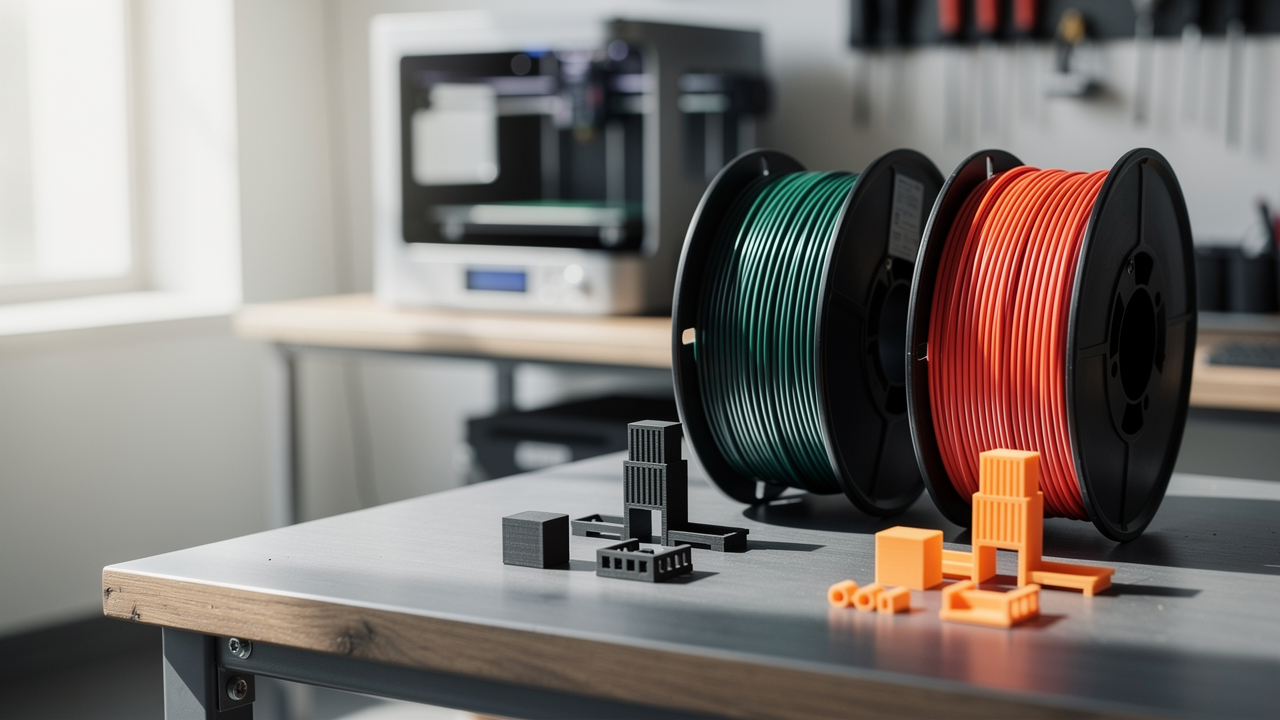

PLA+ or ABS? Which Makes More Sense for Everyday Functional Parts?
At first glance, PLA+ and ABS may seem to answer a similar question: which one should you choose for parts that will do slightly more serious work in daily use than standard PLA? But in practice, these two materials behave very differently. In short, if your priorities are easy printing, a clean surface, and rapid prototyping, PLA+ is the safer starting point for most users. If you are aiming for a functional part that can handle a bit more heat, a bit more impact, and works in an enclosed environment, ABS is still a strong option. If you want to clarify the material decision before having a part made, a project-based 3d printing service approach is exactly where this distinction becomes useful.
What is it good for, and what is it not good for?
PLA+ is positioned by most brands as a material that is slightly tougher, slightly more forgiving, and more comfortable for daily use than standard PLA. It makes sense for desktop accessories, boxes, prototypes, presentation pieces, and light functional products. However, since “PLA+” is not a standard on its own, there can be major differences from one brand to another; for that reason, not every PLA+ should automatically be treated like an engineering material.
ABS, on the other hand, has a more technical character. It is better suited for parts similar to automotive interior trim, enclosures that may see light impact, fixtures exposed to somewhat warm environments, and prints that will later be sanded or machined. On the other hand, it may not be the first choice for outdoor parts expected to have very high UV resistance; in those scenarios, ASA is generally the more sensible option.
Where is the difference in heat and outdoor use?
One of the clearest factors separating these two is heat. Although PLA+ works well in many applications, it can be risky for a part left in a hot car, fixtures exposed to long periods of sunlight, or applications near an engine area. ABS generally handles this type of heat load more comfortably. So a PLA+ part that performs very well on a desk can quickly lose its shape in a hot environment.
Outdoors, however, the situation is more nuanced. Although ABS is a more sensible candidate than PLA+ against weather conditions, it is not a perfect solution under long-term UV exposure. In other words, the choice is not as simple as “I’ll put it outside, so it must be ABS.” ABS can have an advantage in short-term or semi-sheltered use, but for long-term open-air exposure, it may be necessary to consider different materials.
Impact, stiffness, and feel in use
PLA+ generally feels stiffer and more controlled during printing. This is an advantage especially for boxes, lids, desktop brackets, and visual prototypes where dimensional feel matters. The part looks rigid and clean. However, in some geometry and load scenarios, that stiffness can turn into brittle behavior.
ABS, in many applications, can offer a slightly tougher profile that distributes impact better. This can be especially important for snap-fit lids, slots that need slight flex, and parts exposed to user contact. However, this advantage disappears if proper printing conditions are not achieved; a poor ABS print with warping, cracking, and layer separation can cancel out the material advantage on paper in real-world use.
Printability and cost logic
When it comes to ease of printing, PLA+ is clearly the easier option. It is generally printed with lower risk, requires an enclosed chamber less often, and offers more predictable surface quality. That reduces both trial time and the risk of failed prints. ABS, by contrast, demands more process discipline. Environmental conditions, bed adhesion, and part geometry become more important.
On the cost side, looking only at spool price can be misleading. If the part comes out clean on the first try, PLA+ can often be more economical overall. But if that same part will deform because of temperature, the choice that seemed easier at first can become costly later. That is why you need to look not only at the material label, but also at the usage scenario. Before ordering, it is healthier to review the logic of the price per gram and then evaluate the file via instant pricing.
Which one for which part?
- PLA+: desktop accessory, prototype, light-duty box, display piece, everyday product suitable for indoor use.
- ABS: enclosure exposed to light impact, fixture exposed to a somewhat warm environment, technical part to be processed afterward, functional use in an enclosed environment.
If both the usage load and the environmental demands of the part increase, it is also important not to limit yourself to only these two materials when making a decision. To see the general options, the our printing materials page is a good starting point.
Short verdict
If the part will be used indoors and fast, trouble-free production matters, PLA+ is the more sensible starting point. If the part will face a bit more heat, a bit more impact, and a slightly more technical job, ABS stands out. So the real question is not “which one is better?” but “where will the part live after printing?”


 Türkçe
 العربية
 Русский
 فارسی
فارسی Deutsch